

Related

PRISM Wealth-Building Process
Knowing your preferences for carrying out your portfolio strategy allows you to focus only on what you will consider and ignore the investments that aren't a good fit for you.
by Charles Rotblut | May 2021

Charles Rotblut leads a class in AAII's new Essential Investing Video Course. Go to https://www.aaii.com/ves for more information and to subscribe.
How involved should you be in the management of your portfolio?
This may seem like a simple question, but its answer has big implications. Answering the question should prompt you to consider what you can and cannot do. It determines how your portfolio should be managed. It even narrows the scope of suitable investments.
Think of an individual investor’s preference for an investing management approach as existing on a spectrum. At the one end is the do-it-yourself investor who researches and selects each investment. At the other end of the spectrum is the adviser investor. An adviser recommends an asset allocation, selects investments and manages the portfolio. The investor meets with the adviser on a periodic basis to discuss the portfolio and any changes in their life.
In between these two opposites are preferences of varying degrees of involvement. An individual investor may utilize exchange-traded funds (ETFs) to fill in specific parts of their allocation. Another may hold mutual funds only because their workplace plan requires them to. Some individual investors have a strong preference for index funds. Others may hire an adviser or a financial planner solely for specific tasks such as to get periodic feedback.
There isn’t a single best approach. Identifying one’s investing management approach depends on their interest, ability and time. In this article, we walk you through the key factors to consider when deciding how involved you want to be.
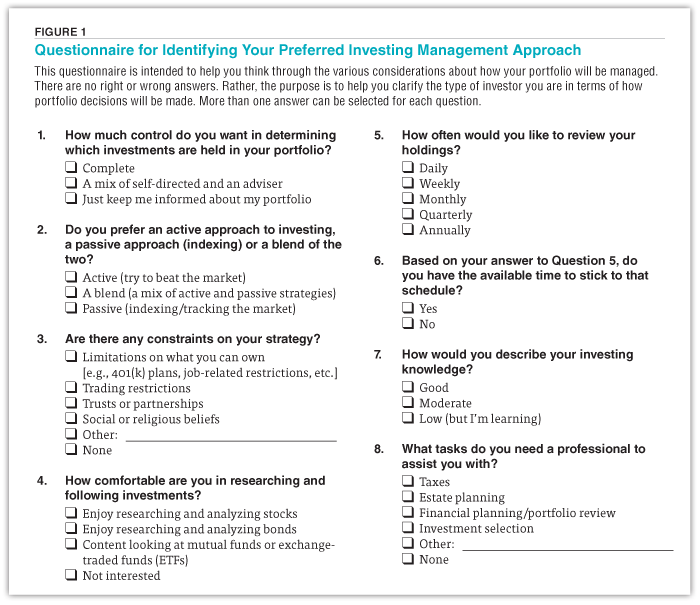
In creating a worksheet (Figure 1) to help you identify your investing management approach, we settled on eight specific factors to ask about. Each one addresses a different part of the investment process. All have implications for how you go about implementing the right allocation to achieve your goal.
Who decides which specific investments will be held in your portfolio?
A diehard, do-it-yourself investor exerts full control over their portfolio. They choose each individual security, whether it’s a stock, bond or other type of security (e.g., a real estate investment trust). This type of investor makes all buy and sell decisions.
Other investors strike a balance by using mutual funds and ETFs. They like deciding which funds are held in their portfolios but are comfortable letting the fund manager choose the actual securities held. In this approach, the investor makes higher level buy and sell decisions—whether to keep or part with a particular fund—while the fund manager makes the decisions of when to buy and sell the individual securities.
An adviser investor effectively outsources the buy and sell decisions. For instance, the investor selects which robo-adviser they use but then relies on the service to determine which ETFs are purchased and sold. In such an approach, a professional—in this specific case, a service and its algorithm—is hired to make the key decisions.
Active investment approaches attempt to beat the market through the individual selection of securities. A do-it-yourself investor who rolls up their sleeves and makes their own stock picks may come to mind as an example, but they are not the only type of investor incorporating an active approach to investing. A fund investor may seek out mutual fund or ETF managers they believe are capable of outperforming. Another investor may believe their adviser has the ability to outperform.
Passive strategies are commonly known as indexing. Investors who favor passive strategies seek to earn the return of a major index. The S&P 500 index is the most commonly followed index, though passive investors may seek to track other indexes with their fund choices as well.
A key trait of passive investing is low cost. Index investors believe the minimal expenses charged by index funds as well as the tax efficiency of such funds provides a performance advantage over active strategies.
Many investors opt for a blend of the two approaches. Doing so takes advantage of the low-cost nature of index funds while still providing the opportunity to outperform.
Constraints may limit an investor’s ability to implement their preferences. This commonly occurs when a workplace retirement plan is involved. The offerings available through a 401(k) plan may force a do-it-yourself investor to adopt a partially hands-on approach by incorporating mutual funds into their portfolio. Another investor who prefers index funds may find that actively managed funds are the only option in their 401(k) plan.
Trading restrictions may exist. An investor may be restricted from investing directly in clients. Another investor may only be allowed to hold mutual funds or ETFs. Limits on how frequently trades can be made may make holding funds a more viable option than stocks.
Those with strong social or religious beliefs may seek to exclude certain types of investments. A person who is concerned about climate change might purposely exclude companies they perceive as harmful to the environment. A religious person might exclude any company perceived as being in conflict with their moral beliefs. Such constraints may make using mutual funds, ETFs or advisers who use strategies in sync with such beliefs an easier way to carry out one’s strategy.
We think you’d like this related webinar! Using Your Personal Preferences to Find the Right Investment
Personal preferences come into play when it comes to researching investments.
Some investors truly enjoy researching individual stocks and bonds. They like figuring out what makes a company’s business model special. They analyze the financial statements for signs of strength or weakness. They look at charts to analyze the trends. On the bond side, they read the prospectuses and look for changes in credit ratings.
Index, fund and partially hands-on investors research mutual fund and ETF candidates as well as track the funds they own. They will monitor performance, look at the fees and may even pay attention to the tax-cost ratio. Some will read the prospectus and/or investigate the fund’s holdings.
Of course, other investors may find no joy in such activities. They may find such efforts boring or otherwise have little desire to do such research.
Investments change over time and thus require periodic monitoring. While investors should not look at their portfolio holdings too often, the frequency at which they are willing to do a review has implications for their investment choices.
Publicly traded corporations report earnings quarterly. This cycle calls for reviewing holdings at least once every three months, which is the cycle followed by the AAII Model Shadow Stock Portfolio. More active investors may wish to review their stocks with greater frequency. Weekly overviews and more detailed monthly reviews can be used. The AAII Dividend Investing and Stock Superstars Report portfolios mostly limit announcing transactions to a monthly cycle if a change is necessary. Investors following a more short-term trading approach may, of course, look at their holdings with even greater frequency.
Mutual funds, ETFs and bonds can be reviewed on a much longer cycle. Quarterly or semiannual reviews may be sufficient. For long-term positions—such as index funds—annual reviews can work.
Even if the desire to analyze investments exists, the available time to do so may not. Work, family, volunteering with charitable organizations, involvement within one’s congregation, travel or other activities can limit one’s ability to set aside the time to look at their investments.
This is a consideration where being honest about your constraints is important.
Time constraints do not mean that individual securities need to be fully avoided. How one approaches such investments may need to be altered, however. Investment newsletters and model portfolios can reduce the research time needed. (Investors are still encouraged to do their own due diligence.) A long-term approach may also be warranted.
Alternatively, a blended approach could be used. This would involve holding a limited number of individual securities and supplementing those holdings with mutual funds and/or ETFs.
Of course, if the time available to research and track investments is limited, relying on index funds or actively managed funds (mutual funds or ETFs) can make sense. Using an adviser—either partially or fully—may also be a consideration.
FIGURE 2. Types of Investors by Investing Management Preferences
Though no description matches every investor, we believe the following provides a good framework for classifying the type of investor you are from the standpoint of your preferences. The description for each type includes references to specific questions shown in Figure 1. Use the answers to those questions to determine the type of investor that best describes you.
 |
Fully hands-on investors seek a high level of control (Question 1), tend to hold individual stocks and individual bonds (Question 4), have the interest and time to research individual securities (Questions 4 and 5) and have a moderate-to-high level of investing knowledge (Question 7). |
 |
Partially hands-on investors own both individual securities (most commonly individual stocks) and funds (Questions 2 and 4), have at least a moderate level of knowledge of investing (Question 7), are comfortable using mutual funds or ETFs (Question 4) and may lack the time or interest to research every security of their portfolio (Questions 5 and 6). |
 |
Index investors prefer index mutual funds and ETFs for their low cost and ability to consistently realize returns similar to that of broad indexes (Question 2), may not want to devote the time or effort to research individual securities (Questions 4 and 5) and/or may have trading restrictions or a lack of knowledge to research individual securities (Questions 3 and 7). |
 |
Fund investors are willing to own mutual funds and ETFs (Questions 1 and 4), consider owning both index and actively managed funds (Question 2), hope to outperform by using active strategies (Question 2), may not want to devote the time or effort to research individual securities (Questions 4 and 5), may have trading restrictions or a lack of knowledge to research individual securities (Questions 3 and 7) and/or take comfort in having a professional portfolio manager choose investments. |
 |
Combo hands-on/works with a planner investors combine using a fee-only planner with personal control of investments (Question 1). They may self-manage part of the portfolio and have an adviser or robo-adviser manage another part (Questions 1 and 2), hire a financial professional to provide assistance with the portfolio review process or to simply provide objective feedback and consultation (Question 8). This type of approach works best for those who want some personalized assistance while still making their own investing decisions. |
 |
Bolt-on approach investors are similar to combo investors but work with specialists to address specific tasks (Question 8). Examples of such specialists include a life insurance agent, a tax professional or an estate attorney. These investors may use a fee-only financial planner for providing recommendations to specialists. |
 |
Adviser investors outsource the process of implementing and managing their allocations and investment strategies (Question 1). They may lack the confidence, knowledge and/or the time to make their own investing decisions (Questions 4 and 7). Robo-advisers would be a consideration for those with moderate levels of wealth who don’t require much one-on-one communication. A traditional adviser is most suited to those who have complex financial and/or estate-planning needs (Question 8). |
Being cognizant of the limits of your investing knowledge will reduce the number of mistakes you will make. Among those mistakes is holding investments you do not fully understand. If you cannot identify what might cause an investment to fall in value, you will not know when it is time to sell. The same applies to strategies. If you do not know what the strategy is designed to do, you will not understand what is causing it to underperform or experience a period of negative returns.
In investing, it is very easy to run before you learn to walk. You simply need enough money to open an account and buy an investment. This fact leads to an unfortunate cycle of investors having to learn from their mistakes at younger ages before finally realizing the importance of learning how to invest as they gain experience. This cycle can take place over a lengthy period of time.
A prudent strategy is to start as a fund or index investor and build up knowledge from there. A blended approach can work well, particularly if shares of a few companies that an investor is familiar with are held at first. Such an approach can help to spark interest without going too far beyond one’s knowledge limitations.
Even experienced investors should be conscious of their limitations. An investor can be skilled at analysis, but if they lack access to information about, say, foreign investments or lack the background to understand research about emergent pharmaceutical treatments, a mutual fund or ETF may be the better option.
Are there any tasks warranting the use of a professional?
Estate planning is one such scenario. An estate attorney can assist not only with wills but also with trusts and powers of attorney, among other things. A tax professional may provide suggestions for reducing one’s tax exposure in addition to preparing returns for filing.
You may also require assistance with buying or managing a life insurance policy, a long-term care policy or an annuity. Older investors may eventually need assistance with their finances.
We think you’d like this related webinar! Individual Investor Show: How the Famous Think, Members’ Mistakes and Investing Preferences
Combined, the factors give insight into the type of investor a person should consider themselves to be. Though no description matches every investor, we believe the descriptions in Figure 2 provide a good framework for classifying the type of investor you are from the standpoint of preferences for an investing management approach.
Some of you will quickly find a fit with one of the investor types. Others will find themselves matching more than one that type. In such cases, opt for one of the blended types such as partially hands-on or combo hands-on/works with a planner.
Once this determination is made, you can then begin to set rules for implementing your allocation strategy. Index investors need not spend time researching stocks. Do-it-yourself investors may not need to worry much about mutual funds. The big advantage to knowing your investment management preference is the ability to narrow your focus. By identifying what you will consider, you can ignore the investments that aren’t a good fit for you.

Go to the Learn & Plan section of AAII.com to walk through the entire five-step Individual Investor Wealth-Building Process. To aid in building your plan, there are short videos to watch and fun challenges to work through.
PRISM Wealth-Building Process

Computerized Investing

Financial Planning

BARRY J from TX posted over 5 years ago:
JAMES R from OH posted over 5 years ago:
Hugh P from WA posted over 5 years ago:
You need to log in as a registered AAII user before commenting.
Log InCreate an account