

Related

The Big Question
Women participate on the capital markets less than men do, but this difference is not always attributable to gender.
by AAII Staff | July 2021

Women participate on the capital markets less than men do, but this difference is not always attributable to gender.
A study found that attitudes toward risk play a much bigger role in participation rates. Risk attitudes not only affect decisions regarding stocks, but other assets as well.
Researchers found that in households with financially knowledgeable persons (FKPs), the gap in participation is around 7.9% (25.8% of men participating versus 17.9% of women). When adjustments for risk aversion are made, the percentage drops to 2.6%.
Generally, women tend to make less risky investment decisions, opting for “safer” assets. “While men more often invest in individual listed shares and certificates, their [women] counterparts prefer to diversify by investing higher fractions of their wealth in fund shares and lower fractions in listed shares and certificates.”
Researchers also found that men are more sensitive to risk than women. Men who seek low-risk investments are more likely to shy away from higher-risk investments than their low-risk women counterparts. While women tend to be risk averse, men are more likely to abide by their risk tolerance than women. If the women analyzed in this study had the same risk-aversion tendencies as the men, their market participation would be reduced by an estimated 10.3%.
The gap between market involvement is less about gender, and more about associated risk tolerance. Those who are more risk averse are likely to participate less in capital markets, regardless of gender.
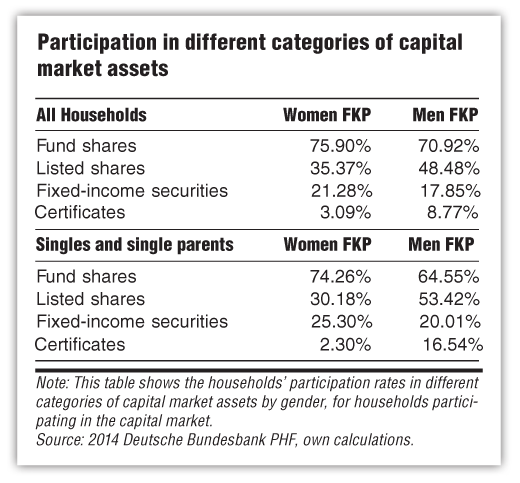
The data was collected by the Panel on Household Finances from the German Central Bank in 2014. The survey collects data on wealth composition, “work life” and other demographic characteristics and comprises 4,461 households with 9,259 persons aged 16 years or older. Direct participation was defined as owning exchange-listed stocks, funds, certificates or bonds. Indirect participation was defined as holding risky assets as part of a private pension plan.
Source: “Risk attitude and capital market participation: Is there a gender gap in Germany?” by Jan-Christian Fey, Oliver Lerbs, Carolin Schmidt and Martin Weber; SSRN, May 2021.
The Big Question

AAII How-To

Portfolio Strategies

No comments have been added yet. Add your thoughts to the discussion!
You need to log in as a registered AAII user before commenting.
Log InCreate an account