


Related

AAII Stock Ideas
Meeting your lifetime goals involves having a good portfolio balance and diversification, making wise decisions about income and putting a solid financial plan in place.
by Jack Brennan | October 2021

Jack Brennan is chairman emeritus and senior adviser of Vanguard. We discussed portfolio strategies and actions that investors can take to achieve their goals.
—Charles Rotblut, CFA
In your book “More Straight Talk on Investing,” (Wiley, 2021) you wrote about the importance of having a portfolio that’s both balanced and diversified. Could you compare and contrast the two concepts?
Balance and diversification are core elements of a successful, long-term program.
Balance between asset classes—and let’s stay with cash, bonds and stocks—is important because it is core to the risk makeup of your portfolio. Over time, having cash and bonds will hopefully provide balance against the more volatile asset class of stocks.
It may be a minimal amount of balance when you’re young—you’ve got 40, 50 or 60 years. Young people should be very heavily invested in equities, so the balance portion isn’t all that important then. But when you get to be my age, late 60s, balance becomes more important because you have less time to make up for risks that came home to roost (Figure 1). So the balance is among the asset classes.
FIGURE 1. Asset Mixes and Past Performance (1926–2019)
Diversification is within asset classes. With diversification, one of the interesting things is that people talk about growth and value, large stocks and small stocks, international stocks and so on. If you look over time, they all coalesce—we’ll stay in the U.S. for now—around very similar-looking returns.
One of the great innovations over the last 40 years has been the advent of a total stock market portfolio, which you can buy in the form of an exchange-traded fund (ETF) or an index mutual fund for a very low price. You get exposure to large-, mid- and small-cap stocks, as well as growth and value stocks.
By definition, when you’re diversified, you’re going to be disappointed that some equity sectors haven’t done as well as some of the other sectors. However, over time, diversification reduces the risks of holding a small number of individual securities.
For me, both concepts are so important. If you go back and look, there are only a few mutual funds that have survived since the Great Depression. One of them is a Vanguard fund: Vanguard Wellington  (VWENX). It has delivered 8.5% a year through a balanced portfolio of high-quality stocks, high-quality bonds and being diversified within each of those asset categories. It’s staggering what kind of returns come from just the discipline of balance and diversification.
Regarding bonds, we continue to be in a low-interest-rate environment. You believe that if we start seeing a period of rising interest rates, it could be good for bond investors. This logic is not intuitive to many.
This is one where people have a hard time accepting it.
Let’s say rates rise 100 basis points (a full percentage point), and investors’ net asset value declines 10%. Many investors can’t understand why this is a good thing. But most investors in bond funds—I’ll use funds because it’s particularly important to explaining the logic—reinvest their dividends. They’re buying 10% more income when the net asset value is down 10% because of rising rates. Their money is working harder for them in a rising rate environment if they’re using it for accumulation.
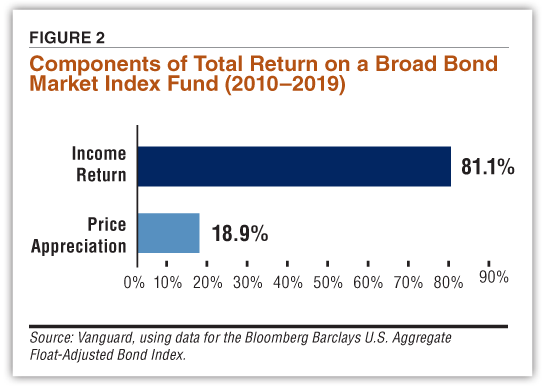
If you look at your mutual fund statement and look at the cost basis in it, it’s interesting. You could have had a 7% or 8% return for a long period of time in a long-term municipal bond fund. But your cost basis keeps rising because you keep buying more shares. Your dividend bought you 3% income last month or last year. Now it’s buying you 3.3% income, and that’s a good thing. Over time, you’ll make all your money in a bond fund on the income side, not on the principal side (Figure 2).
What about retirees? A lot of individual investors feel like they have to reach for income, which is tough in this environment. Any suggestions?
Well, it’s really tough in this environment. It is a challenge. One of the things I worry most about with individual investors is that tendency to take more maturity risk (buying longer-dated bonds) to pick up some yield, to take credit risk (buying lower-rated bonds) to pick up some yield or do something else like some of the stuff that gets sold on the radio with “guaranteed” high yields.
I think people should be very cautious. A longer-term suggestion is to think about taking more equity risk with a diversified portfolio of high-quality equities. An example would be a total stock market fund. It yields 1.2% or 1.3%, and qualified income dividends are taxed at a more favorable rate than ordinary income such as interest. What a 10-year Treasury note pays is not all that different when round numbers are used. So if you’re willing to withstand the volatility of the stock market, you’ll get comparable income with a call on the growth from the equities and, very importantly, the inflation protection that dividends have provided over time. There have been very few periods of time where high-quality stocks have not outperformed inflation from a growth rate standpoint in their payouts.
In the book, I talk about thinking hard about whether your traditional mixes are going to work today, particularly for retirees. If you can avoid overreacting to changes in principal, high-quality equities provide a different avenue to generate income and, I would say, better protection against inflation if you’ve got 10, 15 or 20 years in retirement.
In that scenario, should investors think about a barbell approach: a higher allocation to equities while being more conservative on the bond side?
Exactly.
Whether it’s tax-free or taxable bonds, you’re in the 1% range in terms of yields, but you have to acknowledge and be fine with it. The bond allocation is serving a purpose over there. I would not double down by combining junk bonds or long bonds and equities. The barbell is a different approach to allocation.
One of the good product categories over the last 20 to 25 years has been dividend growth funds—not high-yield dividend funds, but funds that invest in world-class companies that are committed to growing their dividend 3%, 4%, 5%, 6% a year. They are a pretty good way to get income, but you should be careful about doubling your principal risk with riskier bonds because if stocks fall in reaction to rising interest, you’re doubling the hit.
Shifting away from some of these tactical decisions, you’re a strong believer that everybody should have an investing plan.
First and foremost, you want to have a time horizon for various buckets, what I described in my book. I think buckets are really important. There’s the short-term money—the emergency fund or short-term objectives. There’s intermediate-term assets: For a youngish family, that might be college education for the kids or home purchase. And then there’s the long term, which is retirement.
The media tends to focus on retirement, but those first two buckets are important. Understand how you think about your assets that you will accumulate over time through saving. That’s one.
Two, understand your own sense of risk tolerance, and test yourself. Ask, “How did I react in March of 2020? How did I react in 2008 and 2009? How did I react in 2000 and 2001?” It’s an important test to determine whether you have the stomach for significant losses on paper. So your risk tolerance is the second part of this.
The third thing is how are you going to fill those buckets? I get asked all the time for “the best” financial advice I can give. The expectation is for something glamorous, but I say, “Live below your means.” Plain and simple. Whether you’re 16, 26 or 86, living below your means gives you all sorts of flexibility, including in your accumulation years to fill those buckets as appropriate.
Asking who is going to be my trusted partner is the last part that I think goes into that plan. If you’re fortunate to have a great defined-contribution retirement plan with a trusted provider, that job is done. Then the question is how I am going to do it with the short-term bucket? Is it my banker? Is it short-term liquid investments?
You put this down. Look at it once a year max. It doesn’t even have to be once a year, but you want to make sure that you don’t get too far out of balance.
You also want to make sure that your circumstances haven’t changed. Maybe you inherited some money. Maybe somebody’s gifting to your kids for their college education.
I frequently say to people, while you’re watching the Rose Bowl on New Year’s Day, just pull your plan out, sit with your family and your spouse and walk through it. It shouldn’t change much year to year, but when circumstances change revisions may be necessary. One of the great days in people’s lives is when that last tuition check gets written to college. I say, send that money to Vanguard now instead of to Harvard. Just pretend you’re still writing tuition checks.
Think about that. It’s free money—your lifestyle hasn’t changed a bit.
Then the other part that I think is really important is to think about if there have been circumstances when your risk tolerance has been stress tested. Be honest with yourself. Too often people think they’ve got the stamina to withstand downturns. The panic comes, people pull out and then there’s never a good time to get into the market again.
Imagine if you panicked in March 2020. When was the good time to get back into the market? I’ve talked to too many people over the last year who are my age—again, late 60s—and were nervous. They got nervous and they were 35% in the hole, or whatever the drop in year-over-year returns was. They obviously didn’t have the stamina that they thought they did.
What do you say to those people who say, I’ve gotten out, what do I do now? It’s a question I’ve been asked many times as I’m sure you have as well.
My own view is don’t panic, buy. That’s my answer.
I often tell a short story. I went to a restaurant to meet a friend before taking a red-eye flight home from Los
Angeles. This woman comes up and introduces herself. It turns out she’s the fiancée of my friend. She had set the dinner reservation and told him a time later than me because she wanted me to talk to him. On October 20, 1987, he got out of the market, and this dinner was several years later. He was a sophisticated guy, but there was never another good day for him to get back into the market. So I told him that I guarantee that it’s a good time for the next 40 years to get into the market. Is it perfect? No, but over 40 years it will be.
What I encourage people to do is to come back and ask if their time frame is still the same. If it is, then dollar-cost average. I’m a big fan of dollar-cost averaging. I encourage those who panic to reverse the behavior through a dollar-cost averaging program. Pick your time frame—it may be a year, it may be two years, it may be six months, but psychologically you’ll feel better. If the market happens to take off, you’ll say, oh, I could have done better. But you will still have gotten yourself back to where you wanted to be.
You mentioned what to do once college tuition is paid off. We have younger members as well as many parents and grandparents who are trying to help get their kids and grandkids started. Any advice you can give on how to get young people started with investing?
First, if a kid or a grandkid has got a job, max out on their 401(k) or 403(b) contributions. There’s a lot of math on this. In a sense, if you sacrifice 5%, 7%, or 10% of your current income once, you will never have to do it again. Say you get a job at $40,000. You pretend you’re making $36,000, and the remaining $4,000 goes into the retirement savings plan. Start early and start at the highest possible maximum rate because you will adjust your lifestyle (Figure 3). Make sure you take full advantage of these plans—they’re a gift.
FIGURE 3. Investment Goal: $1 Million at Age 65
If you’re a freelancer or something else, do an SEP IRA or a traditional IRA. Better yet, do a Roth IRA because you’re not likely making enough money to qualify for the tax advantage of non-Roth IRA contributions.
That’s the most important advice.
Another idea is to set up match programs. My kids made money caddying, mowing lawns or babysitting, and I said, listen, you give it to me and I will invest it at Vanguard and match it. My oldest child is now doing it with his 9-year-old. It’s sort of a way of gifting, but matches work. It’s an incentive to get the cash out of their hands and put it into something. When you do, share the statement with them. Show them what it looks like. It worked very well for me with my kids and lots of other people I know who’ve done it.
You also talked in your book about getting to Boca Raton, which I thought was a great way of kind of describing the goals—in this specific case, a comfortable retirement in southern Florida. Any suggestions about how to stay focused on goals versus being distracted by the day-to-day events?
I will use the phrase that I’ve used for 40 years: Tune out the noise.
When I was first married, my in-laws were in town. My father-in-law would never miss Wall Street Week on Friday nights. It was a really well-done show with smart guests and smart panelists. So I’d get home from work and we’d watch Wall Street Week, and it was great. Contrast that to the noise that’s out there today.
You have to fight against the temptation to view the opening of the futures in London as something you really care about. The media wants you to think that the latest social media meme stock or something else matters. They’re distractions.
To me, it’s why a plan matters a lot. It’s why having a time frame matters a lot. It’s a matter of discipline. What you want to be is a learner about investments, not someone who reacts to investment-related news.
What happens in the market today, tomorrow, this year or frankly over the next five years is really irrelevant to most of us because we’ve got time frames of 30, 40 or 50 years. I hammer it continually.
Then, know what your Boca Raton is. Is your big goal making a bequest? Is it a big bequest to your family? The establishment of a foundation? People say, “I want to spend my last dollar on my last day on the earth.” That’s a goal too. You need to be clear about your goal because it will affect how much risk you’re willing to take. It will affect your income and spending over the years, particularly in retirement.
It’s fun at my stage of life to have conversations with people about what their objectives are. Is it to make their kids rich, or to pay attention to that old bumper sticker: “Fly first class or your kids will.” There are other people who want to be very philanthropic in their later years. Understanding what your goal is and not letting it be a random event is the key, I think, to both personal and financial success as well as to personal and financial happiness.
Just to shift gears, since you’re the former CEO of Vanguard, I wanted to ask you about indexing. There have been concerns or at least questions raised about what happens if indexing gets too popular.
Nothing happens. I think the future of money management will involve active funds becoming increasingly concentrated. Overpaying for a broadly diversified portfolio when you can get it for very little in an index fund is not going to be a business model that succeeds in the long run.
There will always be plenty of liquidity with a buyer and a seller establishing clearly transparent and liquid prices. The concept of index funds growing so much that there’ll be nobody to set the market price is just never going to happen. My own view is that indexing will just continue to pick up market share, as it should, because it’s very hard for active funds to beat the index.
There’s risk, return and cost in the investment equation. You don’t know what either of the first two are in advance. You do know what cost is. So take the sure cost of an index fund.
Then, there’ll be plenty of other assets out there managed in different ways. I think you’ll see increasing levels of concentration. In order to differentiate, fund managers are going to have to take risks to attract assets to beat an index fund. They’ll clearly set prices that will obviously be reflected in the index funds but will move markets the way markets should move—based on fundamentals in the long run, not on emotions in the short run.
What about corporate governance? What can you say about how index funds are going to play a role in terms of corporate governance and what effect they might have?
I won’t comment on Vanguard or BlackRock, but one of the things index funds bring to corporate governance is that they are permanent shareholders, and that’s a good thing. They’re not a hedge fund in for a trade. Index funds are not a traditional actively managed mutual fund that turns over at 100% a year. Those high-turnover funds are not permanent shareholders. So from a corporate governance standpoint, and frankly from a corporate management standpoint, having more assets in indexed products allows for better strategic discussions about where a company is headed than somebody who owns a stock for a week, a month or a year. In my view, it’s a good thing frankly.
Whether they’re indexed or not, the best money managers have always been engaged on corporate governance matters, particularly the large ones. It’s just getting more publicity today than it did. That’s a good thing—they own the company and, from my standpoint, the rise of index funds as large holders of companies and being involved with companies is a healthy thing. It will allow public companies to be able to think long term.
AAII Stock Ideas

PRISM Wealth-Building Process

Portfolio Strategies

George L from IL posted over 5 years ago:
Tim B from SC posted over 5 years ago:
JAMES F from FL posted over 5 years ago:
JEFF D from OH posted over 4 years ago:
CHARLES R from IL posted over 4 years ago:
JEFF D from OH posted over 4 years ago:
JEFF D from OH posted over 4 years ago:
You need to log in as a registered AAII user before commenting.
Log InCreate an account