

Related

Portfolio Strategies
The index effect has been weakening over time, according to an analysis by S&P Dow Jones Indices.
by Dylan Dease | November 2021

The index effect has been weakening over time, according to an analysis by S&P Dow Jones Indices.
The index effect describes the phenomena where a stock being added to a well-known index experiences positive excess returns, while a stock removed from a well-known index experiences negative excess returns.
An analysis of data from the last 25 years found that stocks added to the S&P 500 index from 1995 through 1999 realized an excess return of 8.32% between the announcement date and the effective date, while during the period of 2000 through 2010 this premium shrunk to 3.64%. The announcement date is when the change to the index is announced. The effective date is the last market close prior to the change being reflected in the S&P 500.
Over the past approximately 10 years, the index effect has essentially vanished: Stocks added to the large-cap index have realized an excess return of –0.04% between 2011 and 2021. For stocks removed from the index, the excess return penalty has shrunk from –9.58% for the years from 2000 and 2010 to 0.06% between 2011 and 2021.
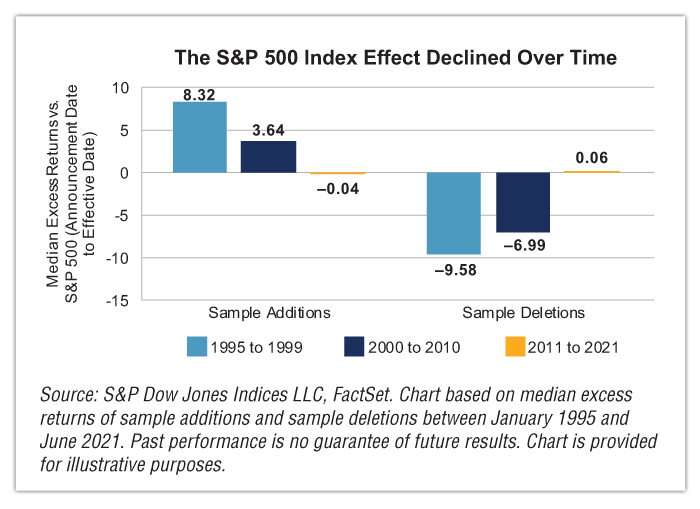
A possible explanation for the visible decline in the index effect over time may be stock liquidity. Index funds have led to more portfolio dollars tracking the major indexes. At the end of 1996, $577 billion tracked the S&P 500. This amount has grown to more than $5.4 trillion at the end of 2020.
Moreover, assets tracking the S&P MidCap 400 and S&P SmallCap 600 indexes have been growing at an even faster rate than those tracking the S&P 500. Researchers believe that “tracking the mid- and small-cap indices, and improved stock liquidity, may have contributed to a reduction in the liquidity premium over time.” The growth in both indexes may have led to less repricing among stocks added to or deleted from the S&P 500.
In order for a stock to be considered for addition to the S&P 500, it must first meet certain criteria regarding earnings, liquidity, market capitalization and public float. Between January 1995 and June 2021, the S&P 500 had 715 additions and 711 deletions, averaging around 27 additions and deletions per year. Slightly more than half of additions (378) came from the S&P MidCap 400, while another 332 came from somewhere other than the S&P 1500, which encompasses the S&P 500, the S&P MidCap 400 and the S&P SmallCap 600. Among deletions, 529 stocks were moved completely out of the S&P 1500, while another 142 were moved to the S&P MidCap 400.
Source: “What Happened to the Index Effect? A Look at Three Decades of S&P 500 Adds and Drops,” Hamish Preston, CFA, and Aye M. Soe, CFA, September 2021.
Portfolio Strategies

First Cut Stocks

Mutual Funds

No comments have been added yet. Add your thoughts to the discussion!
You need to log in as a registered AAII user before commenting.
Log InCreate an account