

Related

Portfolio Strategies
While rebalancing can have advantages in terms of maintaining a desired allocation, rebalancing too frequently can result in undesired costs.

Charles Rotblut leads a class in AAII's new Essential Investing Video Course. Go to https://www.aaii.com/ves for more information and to subscribe.
Rebalancing is the process of bringing a portfolio’s allocations back to their targets. Specifically, rebalancing involves selling a portion of overweighted investments and buying more of the underweighted investments. Rebalancing is typically done at the asset class (stocks, bonds, etc.) or asset class category (large-cap stocks, small-cap stocks, etc.) level.
While rebalancing can have advantages in terms of maintaining a desired allocation, rebalancing too frequently can result in undesired costs. In this article, we discuss why and when you should rebalance a portfolio.
A portfolio’s allocation will shift over time based on the relative performance of each investment held. Historically, stocks have been the highest-performing asset class. This means that any portfolio comprising just stocks and bonds incurs a rising allocation to stocks over time if periodic rebalancing is not done.
A simple portfolio allocation of 50% large-company stocks and 50% long-term government bonds demonstrates this. Such a portfolio has experienced volatility of 11.1% (as measured by standard deviation) in its returns over the period from 1926 to 2020 when rebalanced annually back to its 50/50 allocation target, according to the 2021 SBBI Yearbook.
When the same portfolio was never rebalanced, its allocation shifted from 50% stocks/50% bonds in 1926 to 98.3% large-cap stocks and 1.7% long-term bonds at the end of 2020. This shift resulted in the never-rebalanced portfolio incurring 40% greater volatility than the portfolio that was rebalanced annually.
Our ongoing study of portfolio rebalancing finds that rebalancing preserves diversification and maintains risk reduction over shorter time frames as well. A periodically rebalanced portfolio following AAII’s moderate allocation model of 60% diversified stocks and 40% bonds over the period from 1988 through 2020 maintained the 60/40 allocation. This portfolio ended 2020 with an allocation of 63.6% in stocks and 36.4% in bonds. A non-rebalanced portfolio starting with the same allocation in 1988 ended 2020 with an 86% allocation to stocks and 14% allocation to bonds. The non-rebalanced portfolio’s drift caused it to experience 20% greater volatility than the rebalanced portfolio.
As you can see, periodic rebalancing preserves the diversification and risk reduction benefits of a given allocation. Not rebalancing causes these benefits to be diminished, or even be eliminated, over time.
In addition to preserving an allocation, rebalancing prompts an investor to buy low and sell high. Dollars are shifted out of the best-performing assets and invested into the worst-performing assets.
This can be particularly beneficial during periods when optimism is too high or too low. If, say, stocks are in an extended bull market with high valuations, rebalancing prompts an investor to take profits. If stocks are experiencing a bear market, rebalancing prompts an investor to buy equities at depressed prices. The same applies to other asset classes included in a portfolio, be it bonds, publicly traded real estate, commodities or cryptocurrencies.
The frequency and timing at which a portfolio should be rebalanced depends on the level of simplicity you desire.
Annual rebalancing is the simplest approach. Each year, the portfolio’s asset class and asset class category allocations are adjusted back to their targets. Doing this at the start of each year attaches the task to an easy-to-remember date and makes use of year-end data.
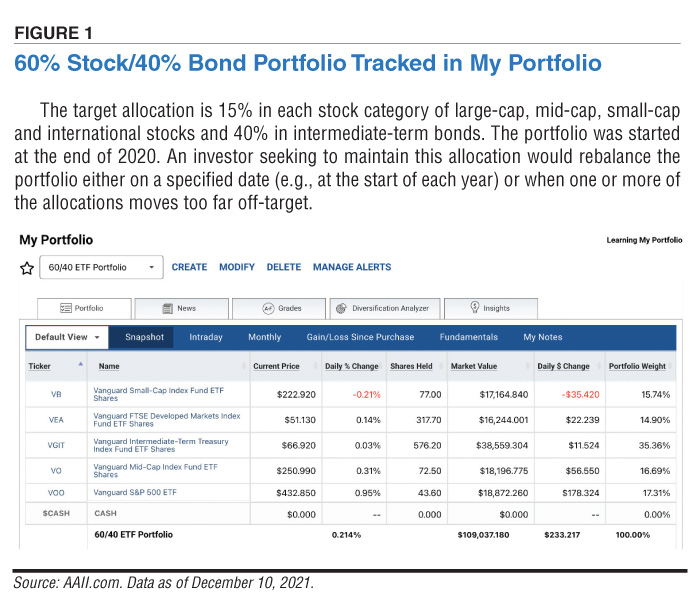
Figure 1 shows a 60% stock/40% bond portfolio comprising five exchange-traded funds (ETFs). The portfolio was created on December 31, 2020, and is being tracked via AAII’s My Portfolio tool.
A quick glance shows that bonds—represented by the Vanguard Intermediate-Term Treasury Index ETF (VGIT)—is underweighted, with a portfolio weighting of 35.36% as of press time. Assuming the allocations did not change significantly at the end of 2021, an investor would have sold shares of the large-cap (S&P 500 index), mid-cap and small-cap ETFs and used the proceeds to purchase shares of the bond ETF on the first trading day of 2022. The dollar amounts would be the equivalent of what is required to bring the Vanguard Intermediate-Term Treasury Index ETF’s portfolio weight back up to 40%.
An alternative is to use a threshold-based approach. Rather than rebalancing on a specific date, rebalancing is only done when the allocation of one or more of the asset classes or asset class categories exceeds a certain threshold.
Bands of five or 10 percentage points are often used in such approaches. Under a 5% band threshold approach, the portfolio shown in Figure 1 would not be rebalanced because the bond weighting is within five percentage points of its 40% allocation target. The bond ETF’s portfolio weighting would have to fall below 35% (five percentage points below 40%) or rise above 45% (five percentage points above 40%) to prompt rebalancing. (Portfolio weightings below 10% or above 20% for any of the stock ETFs would also prompt rebalancing.)
The two approaches to rebalancing can be combined. An investor can check to see if any of their allocations exceed a certain threshold on a regular date, such as the beginning of a new year. If all allocations are within an acceptable range, no rebalancing is done. If any asset class or asset class category is above or below the predetermined thresholds, the portfolio is rebalanced on that date.
AAII members can use the portfolio weight in the right-hand column of the Portfolio tab of My Portfolio to see the current weights of their holdings. A+ Investor and AAII Platinum subscribers can use the Diversification Analyzer tab to see a percentage breakdown of their allocations by domestic stocks, foreign stocks, bonds, cash and other.
If rebalancing is needed, there are a few ways investors can go about it.
The first is to rebalance the portfolio on a single day. This involves selling a portion of the overweight assets and immediately investing the proceeds into the underweighted assets. It has the advantage of simplicity. It also works well when prices of the underweighted asset class or category are unusually low, such as during a bear market for stocks. This strategy can be the least tax-friendly, however.
A second strategy is to adjust future contributions. New dollars added to the portfolio are used to increase exposure to the underweighted asset classes or categories. This avoids capital gains taxes from being realized. For portfolios of significant size, new contributions may not be large enough to fully bring the portfolio’s overall allocation back to its target.
A third strategy is to use the portfolio’s cash proceeds to increase the allocation of the underweighted asset classes and categories. Dividends, distributions, interest income and the proceeds of large positions that are sold for reasons other than rebalancing (e.g., a stock meets the investor’s sell rules) all provide cash proceeds that can be used for rebalancing. As is the case with new contributions, the cash proceeds may not be large enough to rebalance the portfolio.
Retirees and other investors who are taking withdrawals can use a fourth strategy. Investments held in overweighted asset classes and categories are pared down first to free up cash to fund withdrawals. This strategy uses transactions that would have otherwise occurred to rebalance the portfolio. Again, size matters as the withdrawals may not be large enough to fully rebalance the portfolio.
Any of these strategies can be combined when rebalancing. An investor can combine regular savings contributions with cash proceeds from dividends and interest income to rebalance their portfolio over a certain period. A retiree can sell overweighted assets to satisfy the year’s required minimum withdrawal and complete any remaining rebalancing at once. The correct mix depends on the investor’s preferences and tax exposure.
The big benefit of rebalancing is preserving your target allocation strategy. If you have a portfolio allocation that you wish to follow, then you should incorporate plans to periodically rebalance your portfolio to maintain that allocation.
Portfolio Strategies

Portfolio Strategies

Portfolio Strategies

ROBERT A from NC posted over 4 years ago:
RAINER F from MA posted over 4 years ago:
RAINER F from MA posted over 4 years ago:
ROBERT A from NC posted over 4 years ago:
ROBERT A from NC posted over 4 years ago:
ROBERT A from NC posted over 4 years ago:
Steven P from OR posted over 4 years ago:
Wayne S from MA posted over 4 years ago:
MARGARET G from MO posted over 4 years ago:
Lance Y from NV posted over 4 years ago:
ADAM G from MA posted over 4 years ago:
ROBERT A from NC posted over 4 years ago:
Lance Y from NV posted over 4 years ago:
JOHN H from TN posted over 4 years ago:
You need to log in as a registered AAII user before commenting.
Log InCreate an account