

Related

Investor Professor
While bitcoin is often used by those who desire to remain anonymous, one defining characteristic is transaction transparency.

While bitcoin is often used by those who desire to remain anonymous, one defining characteristic is transaction transparency.
For every blockchain transaction, the digital wallet addresses of the involved parties and the payment flows are publicly visible. This feature allowed researchers at the National Bureau of Economic Research to analyze transaction concentration, mining activities and ownership concentration.
The study discovered that very little transaction value on the Bitcoin blockchain is tied to real, economically meaningful activities. Furthermore, most of bitcoin’s real volume is linked to trading and speculation. In 2015, 75% of the minimal real transaction value was for trading and speculative purposes through exchange or exchange-like entities such as online wallets, over-the-counter (OTC) desks and large institutional traders. Non-economically meaningful activities—including users transferring bitcoin between their own wallets and splitting payments among them—accounted for 90% of transaction value.
Miners allow these transactions to take place. They allocate computational power to processing and verifying blockchain transactions in exchange for newly created bitcoins and transaction fees, also called gas fees, as a reward.
The Bitcoin blockchain system critically relies on the understanding that over 50% of its miners are truthful when verifying transactions. Therefore, the concentration of miners is important to understand. Currently, the top 10% of miners control 90% and just 0.1% control close to 50% of mining capacity. This means it would require just over 50 cooperating miners to breach 51% of mining capacity.
The researchers noted that concentrations of mining have had an inverse relationship with bitcoin’s price. During periods of sharp price increases, concentration decreased. During periods of price decline, concentration increased.
Bitcoin holdings are also highly concentrated. At the end of 2020, 2,258 addresses held over 1,000 bitcoins, or over $29 million in bitcoin value at the time. These relatively few addresses accounted for almost half of all bitcoins in circulation. The top 1,000 individual investors controlled about 16% of total bitcoins and the top 10,000 controlled about 27%. Intermediary holdings, such as exchanges and online wallets accounted for about one-third of bitcoins in circulation.
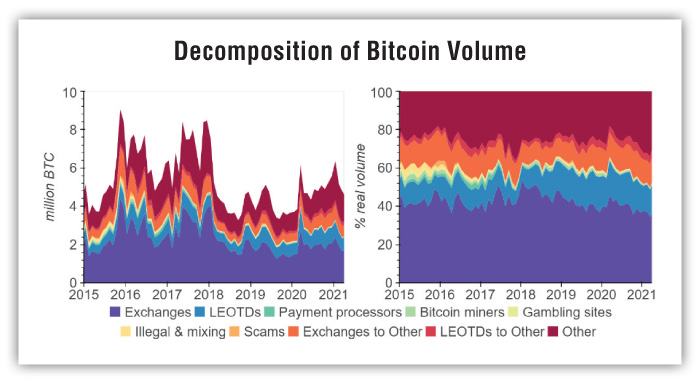
Source: “Blockchain Analysis of the Bitcoin Market,” by Igor Makarov and Antoinette Schoar; National Bureau of Economic Research, October 2021.
Investor Professor

Alternative Investments
Investor Professor

No comments have been added yet. Add your thoughts to the discussion!
You need to log in as a registered AAII user before commenting.
Log InCreate an account