

Related

Financial Planning
Meeting important retirement deadlines doesn’t have to be confusing if you plan early.

Charles Rotblut leads a class in AAII's new Essential Investing Video Course. Go to https://www.aaii.com/ves for more information and to subscribe.
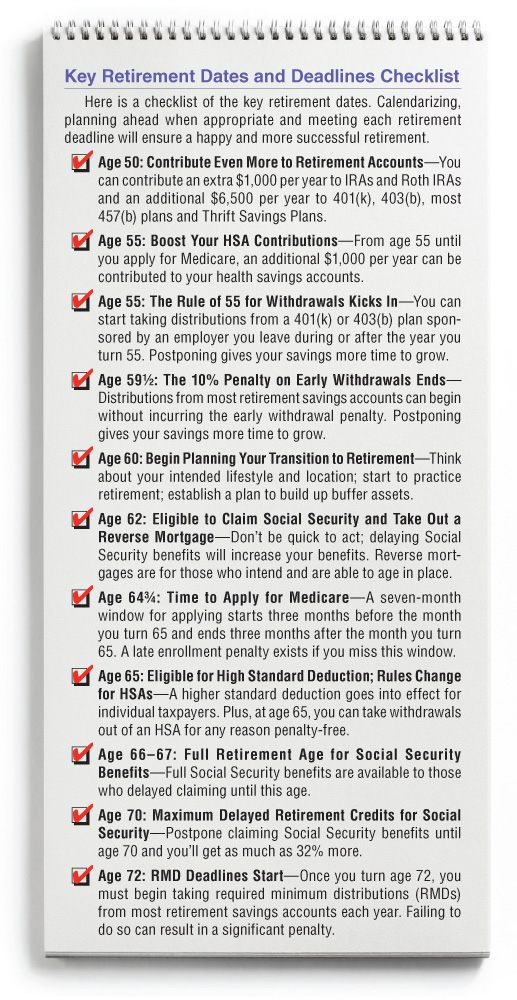
Americans aged 50 to 72 will face several age-based milestones related to retirement. Some of these key retirement dates create opportunities. Some present options for flexibility. Others are hard retirement deadlines with penalties if they are missed.
 Awareness of these retirement dates, understanding which are hard deadlines and thinking through their implications will have a big impact on your golden years. As we go through each key retirement date, we suggest you add them to your calendar to avoid missing any of them.
The tax code provides an incentive for middle-aged adults to increase how much they have saved for retirement. Starting at age 50, an additional $1,000 per year catch-up contribution can be made to an individual retirement account (IRA) or a Roth IRA. Workers can also begin making a $6,500 per year catch-up contribution to a 401(k), Roth 401(k), 403(b), 457(b) or Thrift Savings Plan (TSP) account.
There are caveats to be aware of.
IRA and Roth IRA contributions are capped. In 2022, the maximum contribution is $6,000 plus an additional $1,000 catch-up contribution for those 50 and older. The contribution amount is subject to cost-of-living adjustments, but the IRA/Roth IRA catch-up contribution is not. The combined $7,000 limit is cumulative; total contributions to one or both types of accounts cannot exceed it. You must have earned income to make contributions. Income phaseouts exist for traditional and Roth IRA contributions.
Contributions to workplace retirement plans like 401(k), Roth 401(k), 403(b) or 457(b) plans as well as Thrift Savings Plan accounts are also capped. In 2022, the maximum contribution is $20,500 plus an additional $6,500 catch-up contribution for those 50 and older. Both the maximum contribution and the catch-up contributions are subject to cost-of-living adjustments. If you switch jobs during the year, you must keep track of your cumulative contributions to all workplace retirement plans you participated in—your cumulative contributions and catch-up contributions for the calendar year cannot exceed the limits.
Another opportunity to catch up on your savings goes into effect once you reach age 55. An additional $1,000 catch-up contribution can be made to a health savings account (HSA). Most will only be able to take advantage of this extra catch-up contribution for a 10-year period—due to the deadline of filing for Medicare at age 65—but it can still be beneficial to do so.
Contributions to health savings accounts are tax deductible. Withdrawals from HSAs are not taxed if used to pay for qualifying medical expenses. These expenses include Medicare premiums (but not supplemental policies).
The maximum contribution is $3,650 for self-only and $7,300 for family coverage in 2022. These amounts are subject to cost-of-living adjustments. The $1,000 catch-up contribution is not indexed to inflation. The contribution limits apply to the cumulative amount you and your employer contributed. The contribution limit falls to $0 beginning the first month you are enrolled in Medicare.
HSA contributions come with several restrictions. You must be enrolled in a qualifying high deductible health plan (HDHP) and not covered by Medicare. In 2022, the minimum deductibles for qualifying plans are $1,400 for self-only coverage and $2,800 for family coverage. The maximum out-of-pocket amounts are $7,050 for self-only coverage and $14,100 for family coverage.
A lesser-known retirement date is the rule of 55.
In general, a 10% additional tax is assigned to withdrawals taken from qualified retirement plans, such as 401(k) and 403(b) plans prior to the account owner reaching age 59½. The so-called rule of 55 allows you to take distributions from a 401(k) or 403(b) plan account on a penalty-free basis if you no longer work for the employer and the separation occurred in or after the year you turned age 55. (It’s age 50 for qualified public safety employees.)
Though no penalty applies, the withdrawal will still be taxed as ordinary income. Funds held in other accounts [such as a 401(k) account at an employer you worked at prior to turning 55] will still be subject to the early withdrawal penalty.
Before taking advantage of the rule of 55, keep in mind that the longer you can delay taking withdrawals, the more time your portfolio can benefit from compounded returns. The larger the account balance, the bigger the withdrawals you will be able to take in the future.
Once you reach age 59½, the 10% additional early withdrawal penalty no longer applies. You become eligible to take distributions from 401(k), 403(b), 457(b) and Roth 401(k) plan accounts; Thrift Savings Plan accounts; IRAs, Roth IRAs, SIMPLE IRAs and SEP IRAs.
There are a few asterisks that come with this key retirement date. For instance, if you’ve held your Roth IRA for less than five years, any earnings (interest, capital gains, dividends, etc.) are taxable if a withdrawal is made. Both withdrawals of principal and earnings can be penalized on Roth IRA conversions completed within the past five years. An additional 25% tax is assessed if you take a distribution from your SIMPLE IRA in the first two years you participate in the SIMPLE IRA plan.
Distributions from retirement accounts, except for Roth IRAs and Roth 401(k)s, are taxed as ordinary income. As such, they have the potential to push you into a higher tax bracket.
As is the case with the rule of 55, keep in mind that the longer you can delay taking withdrawals, the more time your portfolio has to benefit from compounded returns.
A 2021 poll by Gallup found that the average retirement age for U.S. workers was 62. This was two years earlier than the age non-retirees expected they would retire.
Many things can alter a person’s actual retirement age from their planned age. Involuntary departure from employment, such as a layoff, can occur. Health issues can alter the planned date. Changes in the value of retirement savings can lead to the planned retirement date being accelerated or delayed.
Because of this, it makes sense to circle your 60th birthday as a key retirement date. Starting to plan for how you transition to retirement on this benchmark birthday will give you time to think through key decisions. Those decisions include, but are not limited to, what you’re going to do with your free time, where you are going to live, how you are going to have health insurance (especially if retiring before age 65) and how you are going to live off savings instead of salary.
One way to begin developing such a plan is to practice retirement. Estimate what your living expenses will be, add in any overages for current expenses (e.g., work-related, higher taxes, etc.) and see if you can live on the amount. If there are certain activities you expect to engage in, spend time (or more time) doing them now to gauge your true interest. You may even want to make those activities the focus of your vacation time to see if doing them frequently is too much.
Similarly, if you are considering relocating, spend your vacation time in those areas. With services like Airbnb and Vrbo, you may be able to stay in a residential area and get a local’s perspective. Be sure to visit at different times of the year to ensure you’re comfortable with the climate and activities.
Financially, start building up an allocation to buffer assets or at least set a date for doing so on your calendar. These are assets with none to small levels of price volatility. Examples include money market funds, certificates of deposit (CDs) and short-term bonds with a strong credit rating. The purpose of an allocation to buffer assets is to give you a pool of assets you can withdraw from should your portfolio incur a significant drop in value just before or soon after you retire. Buffer assets allow you to avoid selling stocks when their prices are down.
Remember to write down these important retirement deadlines ahead of time so you’re well-prepared for the future.
Two key retirement dates happen at age 62. This is the earliest age you can claim your Social Security retirement benefits. It is also the earliest age you can take out a home equity conversion mortgage (HECM), which is the most common type of reverse mortgage. In both cases, just because you can doesn’t mean you should.
Social Security benefits are reduced each month they are claimed before full retirement age (FRA) is reached. FRA currently graduates from 66 for those born in 1954 or earlier to 67 for those born in 1960 or later. The reduction in benefits from claiming at age 62 ranges from 25% to 30% of the FRA amount. Spousal benefits decrease by between 30% and 35%.
Married couples need to consider the impact of claiming strategies on the lower-earning spouse. If both spouses will receive benefits based on the higher-earning spouse’s earnings record, then the longer that the higher-earning spouse delays claiming, the larger the cumulative monthly amount received will be. It will also increase the survivor’s benefit.
The decision for when to claim Social Security should be thought through. We’ve published several articles on claiming strategies in the AAII Journal, such as “Social Security Basics” by William Reichenstein and William Meyer in October 2013. Consulting an online tool or a planner with expertise in claiming strategies may also make sense.
A reverse mortgage allows you to access the equity in your house. It provides a line of credit you can tap to avoid withdrawing from your portfolio during down market periods, cover unexpected large expenses or provide a buffer against outliving your savings. Unlike a home equity loan, an HECM does not need to be paid back.
The cost of an HECM makes it best suited for those who intend to stay in their current residence as they age. Your house will need to be maintained, must be owned by you and you must stay current with both property taxes and homeowner’s insurance.
It is critical that you shop around and make sure you understand all terms before taking out a reverse mortgage. Both costs and home valuations can vary by vendor. The Consumer Financial Protection Bureau filed a complaint and proposed a consent order against American Advisors Group (AAG) in October 2021 alleging that the company used inflated home estimates to get consumers to take out reverse mortgages. AAG is one of the country’s largest providers of reverse mortgages.
This is the age you are first able to apply for Medicare. The enrollment period for Medicare starts three months before the month you turn 65 and ends three months after the month you turn 65. During this seven-month enrollment period, you can sign up for Medicare Part A, Part B and Part D.
Missing this key retirement date can result in a late enrollment penalty. The penalty increases the longer you wait to enroll in Medicare Part B. (Only people who have health insurance from their, or their spouse’s, current employer may be able to delay enrolling in Part B, according to the Centers for Medicare & Medicaid Services.) You will also be forced to wait until Medicare’s next general enrollment period if you don’t qualify for a special enrollment period. The general enrollment period occurs during the first quarter of each calendar year. Therefore, it is crucial that you are aware of the age to apply for Medicare so you don’t miss this important retirement deadline.
A penalty will also be assessed on Part D coverage if you don’t sign up for Medicare drug coverage and you do not have credible prescription drug coverage.
Once you turn 65, you can begin taking a higher standard deduction on your federal taxes. In 2022, married or widowed taxpayers can claim an additional $1,400. The additional standard deduction is per person. In 2022, a married couple filing a joint return would be able to claim a standard deduction of $28,700 if both spouses are 65. (The standard deduction for joint filers below the age of 65 is $25,900 in 2022.)
Depending on where you live, you may also become eligible for various state and local tax breaks or exemptions, making age 65 a potentially pleasant key retirement date.
The rules regarding health savings accounts change once you near or turn age 65. Contributions can no longer be made once you enroll in Medicare. You can, however, take withdrawals from HSAs for any reason without incurring a penalty once you turn 65. Only withdrawals used to pay for qualified medical expenses avoid taxation, however.
Depending on when you were born, you will become eligible to claim your full retirement benefits from Social Security between the ages of 66 (for birth years 1943–1954) and 67 (1960 or later), increasing at two-month intervals in between. As previously stated, claiming prior to reaching FRA results in reduced Social Security benefits.
Postponing Social Security past full retirement age until you reach age 70 will result in an even larger benefit. Those born in 1954 or earlier will see their benefits rise by 32% above what they would have received at FRA. For those born in 1960 or later, the increase is 24%, with a graduated percentage for years in between.
Mandatory withdrawals—known as required minimum distributions (RMDs)—from retirement savings accounts start at age 72. Accounts subject to RMDs include 401(k) plans, 403(b) plans, 457(b) plans, traditional IRAs, SEP IRAs, SARSEP IRAs, SIMPLE IRAs and Roth 401(k) plans. RMDs from 401(k), profit-sharing, 403(b) or other defined-contribution plans can generally be postponed beyond age 72 for those who are still working and own less than 5% of the company. Roth IRAs are exempt from the RMD rules.
If you are still working and own less than 5% of the company you work for, you may be able to delay the first RMD from a defined-contribution plan until April after the year you retire.
The first distribution can be delayed by three months, making the first RMD deadline technically April 1 of the calendar year after you turn 72. Your second RMD must still be taken by December 31 of the same calendar year if you delay the first RMD.
You do not want to miss this key retirement date. Failure to take the full RMD will result in a 50% tax on the amounts not withdrawn.
Meeting important retirement deadlines doesn’t have to be confusing if you plan early. Beginning to consider your retirement plans at age 50 and calendarizing the key dates will help you to avoid unnecessary headaches and lead to a happier post-career period of life.
Financial Planning

Financial Planning


MARK R from AZ posted over 4 years ago:
ANTHONY A from NC posted over 4 years ago:
ROBERT A from NC posted over 4 years ago:
ANTHONY A from NC posted over 4 years ago:
JAMES W from IL posted over 4 years ago:
ROBERT A from NC posted over 4 years ago:
Robert D from LA posted over 3 years ago:
You need to log in as a registered AAII user before commenting.
Log InCreate an account