

Related
AAII How-To
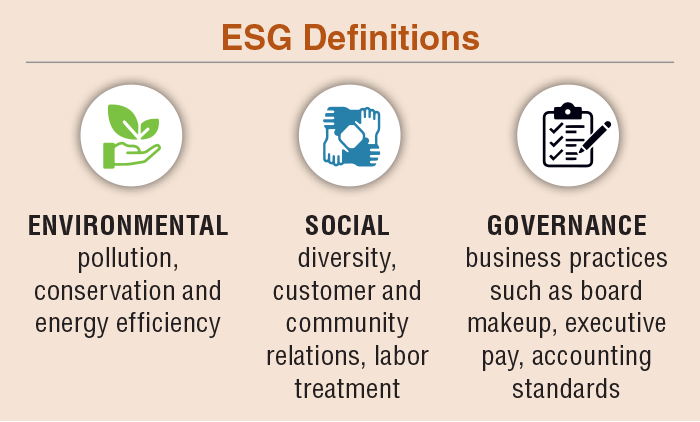
Because ESG ratings aren’t standardized and there are different definitions for green and brown stocks, socially conscious investing is necessarily a very personal decision.
Charles Rotblut leads a class in AAII's new Essential Investing Video Course. Go to https://www.aaii.com/ves for more information and to subscribe.
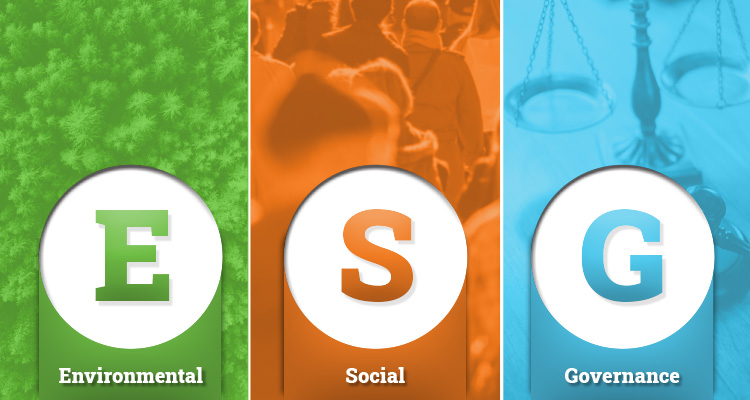
Larry Swedroe is the chief research officer at Buckingham Wealth Partners. His latest book, co-authored with Samuel C. Adams, is “Your Essential Guide to Sustainable Investing,” (Harriman House, 2022). Assistant editor Anine Sus and I spoke with Larry about the challenges that investors interested in environmental, social and governance (ESG) strategies face and how they may be able to overcome them.
—Charles Rotblut, CFA
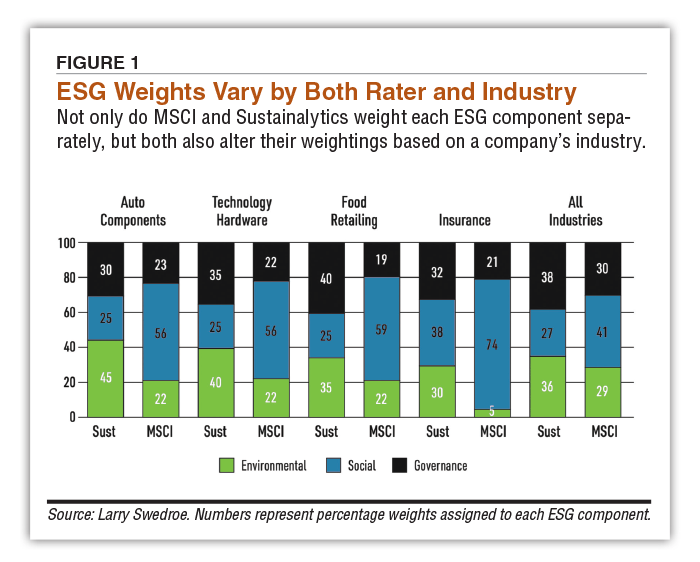
Charles Rotblut (CR): One thing that surprised me in your book was the dispersion among the environmental, social and governance (ESG) ratings made by the major companies assigning them [Figure 1]. How does an ESG investor make decisions?
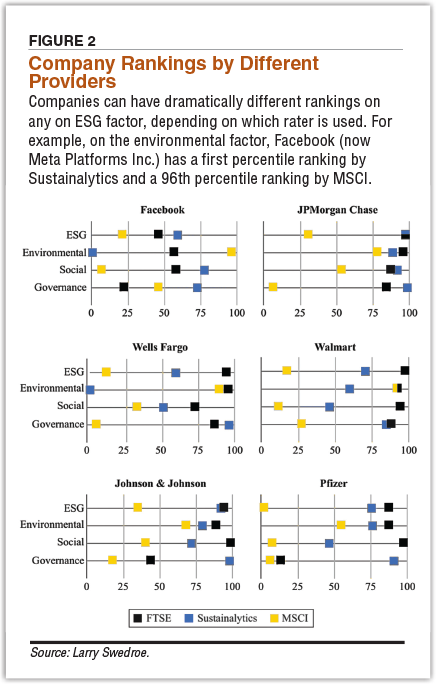
Larry Swedroe: We do have a wide dispersion of ratings for the same companies [Figure 2]. As an analogy, let’s say you’re talking about Amazon.com. It doesn’t really produce anything, but it probably runs very energy-efficient warehouses and server centers. It may also be a very good company from governance and social responsibility standpoints. Let’s use these assumptions for purposes of the analogy.
One company may say, “They don’t pollute much. We’ll give them a high rating.” Another company considers Amazon’s “Scope 3” emissions [classification devised by global consensus]. Scope 1 is what goes into the products it makes. Scope 2 is everything, including the employees, supplies, where the supplies came from and how much the suppliers emitted. Scope 3 includes the entire product chain until the product arrives at the customer. Amazon’s delivery trucks factor into Scope 3 (which could lead to a poor rating).
Let’s say you have one rater who decides, “We’ll give the ‘E’ portion of ESG 70% of the score, the ‘S’ portion 20% and ‘G’ 10%.” This would result in a completely different rating than if another was rating equally on the E, S and G or if they put more weight on governance than environmental.
Then you have social issues related to things like the diversity of the employment base. How do they measure that? Do they look at the number of women and minorities that are employees? Do they look at the ones who are managers? Do they look at the people on the board? Do they look at pay gaps? Or some combination? And if it’s a combination, how do they weight them?
Then you can get even more complex on some issues. Your green is somebody else’s brown. I’m very environmentally friendly, but I like to drink alcohol and I like to gamble. Everyone’s personal values are very different and that creates all kinds of problems when looking at ratings.
Unfortunately, there’s no real way for the individual investor to know how MSCI, Sustainalytics or S&P are rating things. So, it’s going to be very difficult for the individual investor. My own personal view is you acknowledge the problem and decide to just to accept the scores of one company, or build your own portfolio of individual stocks based on your personal values.
I don’t see a resolution to the problem of the ratings disparity because everything is really a personal value judgment. Even if the U.S. Securities and Exchange Commission (SEC) or the Financial Accounting Standards Board (FASB) were to mandate rules for screening, methodology and weighting, everybody’s values are still different.
It’s an interesting question without an easy answer. Someone might say, very simply, “I want to do good. I’ll go with Morningstar’s gold ratings, and that’s fine for me.”
Anine Sus (AS): Would having regulations set for ESG and sustainable investment labels help?
I think it would. It would tell you what the standards were. It would make everything much more transparent, which is where I think we need to get to. I don’t think regulations should force people to weight characteristics one way or another, but rather be totally transparent.
Some funds add “ESG” to their name, and all of a sudden everybody thinks they’re sustainable. The research is showing, in some cases, that these funds have worse scores; they’re not really sustainable investments.
There are a lot of people who say, “I really want to help the planet and I’m worried about climate change, so I’m going to screen out energy companies.” To me, this would be a bad decision. We want to support companies that are creating technologies that improve the planet. The industry that’s working to create a greener planet (as it produces the most green patents) is the one that everyone vilifies: energy.
If you screen energy companies out, you raise their cost of capital, making it more difficult for them to invest. A better strategy would be to use a best-in-class kind of rating system. This could lead you to consider investing in the energy companies that are making the most progress toward a greener planet.
There are seven major socially responsible investing (SRI) raters. One of them can decide, “I’m going to rate across the markets,” while another one could do best-in-class ratings. I don’t think it’s really the SEC’s or FASB’s place to make that decision. But for me, I’d much rather see a best-in-class approach, rather than a market approach where if you have poor pollution scores you get screened out.
CR: You mentioned mutual funds using ESG as branding. What about sustainability mandates? Should investors seek them out if they want to use a mutual fund or exchange-traded fund (ETF) with an SRI or an ESG focus?
Again, I think these are all very personal decisions. I would suggest, if you’re looking for a simple answer, Morningstar’s ratings are probably as good as any. They may not be ideal, but they are a simple way to do it.
The other alternative is to build your own portfolio. You can work with a financial adviser who can help you design that portfolio and still make sure it’s well-diversified. There is an expected return price to pay but it may be very well worth it for you to say, “That’s a price I’m willing to pay to express my values and live by them.”
AS: At the corporate level, you offered a few suggestions for making companies more sustainable, such as using carbon taxation to reduce the economic incentive to pollute. Are there any other systemic issues you think could be solved by changing economic incentives?
I think the system is working quite well because if you get a good ESG score, capital investment flows in, you end up paying lower interest rates, your debt is cheaper and your price-earnings (P/E) ratio goes up. Your cost of capital for equity is cheaper and you gain a competitive advantage. You’re also better able to attract employees, as the research shows. You get employees who feel, “I really like working for a company that’s trying to express the same values that I have.” That leads to higher productivity and more profitability.
The problem is, of course, that a carbon tax is very regressive. It won’t matter to me if oil and gas prices double because I can afford it, but it’s different for the person who is living on the margin. If the cost of driving a car or heating their home goes way up, they’ve got a problem. Plus, if you put those taxes on, how is the government going to spend that money? Unfortunately, I’m a believer that governments generally do a very poor job of spending efficiently.
The way to solve the problem is to simply put on a big carbon tax and then rebate it through an income tax. You can make it progressive by increasing the earned income tax credit, giving a cash grant or even tilting a tax rebate to lower-income families. Make sure it’s a no-net tax to the economy.
There certainly will be some impact as you transition, some industries will benefit and some will get hurt, but you will drive the incentives very clearly. There should not be any negative impact on the overall economy, and you should end up making the planet greener at the same time.
CR: Speaking of green, some of these companies that brandish their ESG characteristics seem to get a halo effect in terms of better perception and higher returns. But over the long term, it seems this effect gets reversed, with the return premium leading to underperformance.
Just to make sure people know what we mean, corporations and mutual fund companies are putting ESG labels on for branding. That’s helping their bottom line, but they may or may not actually be becoming better corporate citizens or allocating that capital appropriately in the way green investors want. The practice is called “greenwashing.”
The ESG movement really began about 20 years ago. It was a very slow increase in the amount of assets coming in until about five years ago. Starting around 2017, tens of billions of dollars started coming in, every month, and it went up like a hockey stick. In 2022, there’s an estimated $35 trillion invested in ESG.
The data up until 2016 showed that green stocks underperform brown or “sin” stocks. The Government Pension Fund of Norway, the largest government-run pension, did its own study in 2017 because it was environmentally friendly. It found that ESG cost it returns.
The research showed that sin stocks—the trinity of tobacco, alcohol and gambling—had outperformed the market by 2% to 3% per year. The reason is quite simple: If lots of people screen out a stock, it’s going to have a lower price-earnings ratio than would be the case if they didn’t screen it out. Since earnings don’t change when people don’t buy a stock, all that happens is that the cost of capital becomes more expensive. If I decide I’m happy to invest in those companies, I get a higher return because I paid less for each dollar of earnings.
That behavior created the sin premium. There was a study that built a portfolio of vice stocks. This portfolio outperformed the market by quite a bit. The same thing occurs on the reverse: If capital is flowing in, valuations are driven up. Ultimately, higher valuations without any higher earnings means you get lower returns. Popularity is a curse. So, the sin premium is created by tastes and preferences of people screening out or screening in.
Then, you had this massive cash inflow coming into green stocks. If you get enough cash flow coming in, the price-earnings ratios of the green stocks go up, while the price-earnings ratios of the brown stocks may stay the same or go down. This results in the green stocks outperforming. But when you reach a new equilibrium and there’s no more new cash coming into one versus the other, you get lower or much lower expected returns for the green stocks. And the higher you push up green stocks versus sin stocks, the bigger the sin premium will get.
The studies that were completed using data for the last four or five years have started to show that because of the large amount of cash flows into green stocks, the sin premium has disappeared.
Now you’re getting higher prices on green stocks. They can’t keep going higher and higher—price-earnings ratios can’t keep going to the sky. Eventually, we’ll reach a new equilibrium where, let’s say, 80% of the money is invested in ESG versus maybe 40% or 50% today. Then the 80%/20% mix stays there. In this situation, those higher price-earnings green stocks must have lower expected returns than the lower price-earnings brown stocks. But the green stocks will still have less risk, so risk-adjusted returns may be a bit different. It’s important to keep in mind that if you buy the brown stocks, you get higher expected returns as compensation for having to hold your nose while owning those brown stocks.
I think we’re probably in the early or middle innings of this transition to a new equilibrium. Green stocks could at least manage to match the performance of brown stocks with less risk. If it takes 20 years, then the valuation benefit is relatively minor, and you have a big sin premium. If that transition happened in the next three years, price-earnings ratios would go way up and green would likely outperform.
My crystal ball is always cloudy, so I can’t make that prediction. I can just tell you what the evidence and theory say. My own gut is that probably in the next several years we’re in for continued large cash inflows to green stocks. But the sin premium has definitely increased in the last five years because valuations of green stocks are much higher and valuations of brown stocks, relatively speaking, are now lower.
CR: It also seems like what’s green and what’s brown is changing. As you mentioned, energy companies are getting into renewables. Some alcohol companies are very environmentally friendly. There are some blurred lines.
Yes. The research shows that companies are recognizing that if they don’t get greener or more favorable on the whole spectrum of ESG, not just the E, then they will be less competitive in attracting the best talent, they’ll have higher interest costs as well as lower price-earnings ratios. These factors put them at a competitive disadvantage across the board. And by the way, if you become more energy-efficient, your profitability goes up because you’re spending less money than your competitors who aren’t doing the same. So, all these reasons are creating this virtuous circle that I think is a very positive influence. ESG investors should feel good about what’s happening because it’s clearly having an impact.
Companies are noticing and taking action to make sure they can stay competitive. That’s creative capitalism at its best. You get much better actions rather than governments mandating things. Incentives work.
AS: For an individual investor who wants to incorporate sustainable investing into their portfolio, what general guidance would you give them?
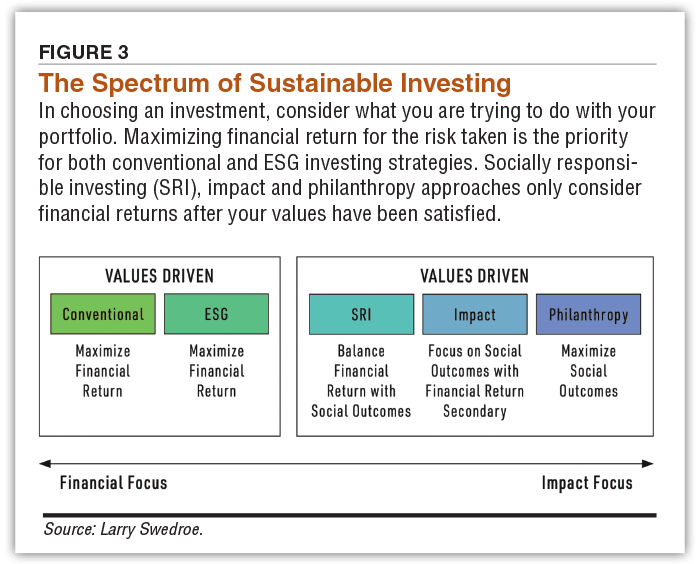
Personally, there’s no right answer. I think each individual has to sit down and decide which of the issues are most important to them and how they want to invest [Figure 3].
For example, Dimensional Fund Advisors runs a really good series of funds that are socially responsible—they’re called sustainability funds. These funds don’t screen anything out; they give more weight to the companies that have good scores versus bad scores. They also put more weight on the factors of value and profitability that history says have had higher expected realized returns. So they’re trying to give investors the best of both worlds, where you can keep your expected returns up by tilting to these factors that are expected to outperform. You can have a very broadly diversified portfolio, because you haven’t screened out entire industries and penalized companies that are best-in-class for their industry.
To me, that’s a great strategy, but somebody else might say, “I don’t want to own an energy company.” Well, then you can’t use Dimensional’s funds or lots of other funds. There still may be a fund family that does exactly what you want. For example, there are Christian-based funds that follow the values of a particular denomination.
You’re going to have to make the decision of how much emphasis you want to have on specific traits. If you really want to drive it personally, there are solutions too. At my firm, for instance, we have lots of individual investors who want to specifically tailor their portfolios. We use fund families or fund managers like Aperio and Parametric to build portfolios. Then we tilt those portfolios to get higher expected returns. Other clients say, “Hey, I like the Dimensional approach,” which gives broader diversification.
I don’t think there’s a right answer. There’s one right answer for each person, depending upon how deeply they feel about these issues and how deep into the weeds they want to get.
We think you’d like this related webinar! Individual Investor Show: The ESG Playbook for the Socially Conscious
AAII How-To

AAII Community


PETER J from MN posted over 4 years ago:
JOHN L from NJ posted over 4 years ago:
S A from OH posted over 4 years ago:
RON F from CA posted over 4 years ago:
You need to log in as a registered AAII user before commenting.
Log InCreate an account