

Related

AAII Stock Ideas
Profiting From Analysts' Revisions to Earnings Estimates


Investing Gurus
Earnings estimate revisions indicate whether analysts are more optimistic or pessimistic about a company’s prospects.
by Charles Rotblut | May 2022

Charles Rotblut leads a class in AAII's new Essential Investing Video Course. Go to https://www.aaii.com/ves for more information and to subscribe.
Earnings estimate revisions indicate whether analysts are more optimistic or pessimistic about a company’s prospects. Positive revisions occur when analysts think future earnings will be higher than previously determined. Negative revisions occur when analysts think future earnings will be lower than their previous prediction.
At the industry and sector level, earnings estimate revisions can shed light on broader trends. While individual companies can exert some control over their future results, factors often beyond the control of a single company have a greater influence at the sector and industry level.
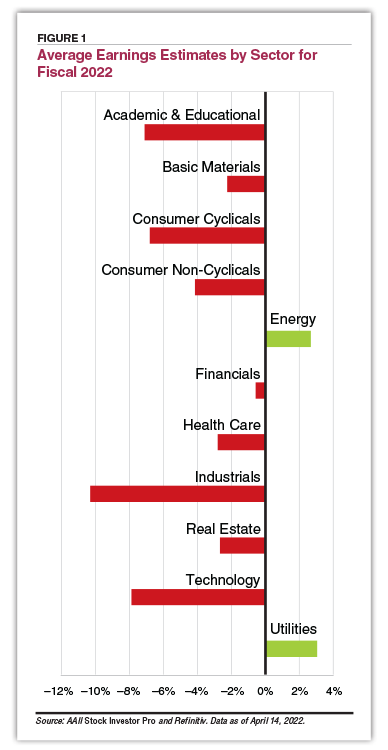
The chart here provides a sector snapshot of how analysts were adjusting their current fiscal-year forecasts as of mid-April 2022. The universe is the nearly 4,300 companies with at least one full-year earnings estimate.
As of mid-April 2022, only the energy and utilities sectors were benefiting from average positive earnings estimate revisions. Energy companies have been benefiting from higher oil and gas prices as well as increased drilling. Increased energy usage related to economic growth is helping utility companies.
Industrials have seen the largest downward earnings estimate revisions, with an average change of –10.3% for the companies in this sector. Higher costs and supply chain disruptions are culprits. Similarly, supply chain problems are likely to blame for the –7.9% revision to technology companies’ earnings. Shortages of semi-conductors and electronic components have both been headwinds.
When reviewing the chart, realize that revisions are not growth. Analysts can expect earnings to grow and still revise their forecasts downward. This occurs when growth is anticipated to be less than previously forecast. Similarly, positive revisions occur when a loss that is smaller than previously thought is expected to be announced. Revisions show the magnitude and direction of change in forecasts, not whether earnings or losses are expected to be reported.
See this issue’s AAII Stock Ideas column for a discussion of four stock screening approaches based on tracking estimate revisions.
AAII Stock Ideas
Investing Gurus

MANJUNATH S from CA posted over 4 years ago:
CHARLES R from IL posted over 4 years ago:
You need to log in as a registered AAII user before commenting.
Log InCreate an account