



Each year, we provide AAII members with an update on the robo-advice industry, products and portfolio performance. In this year’s update, we discuss the ongoing consolidation and maturing of the industry, offer robo-advice suggestions for different types of investors and, yes, provide comparative performance numbers.
Condor Capital Wealth Management publishes The Robo Report, a free, comprehensive quarterly newsletter reporting on the digital advice industry. Our project started in 2015 when we opened and funded accounts at major robo-advice providers to track their performance, trading and other activities. Since the project’s inception, we have expanded the report to 58 accounts across 35 digital advice providers. As we grow, our mission remains the same: to bring transparency to the digital advice industry.
About the Portfolios Tracked
With a few exceptions, the portfolios we track in our report represent moderate to moderately aggressive portfolios. We aim for portfolios that contain allocations of 60% equities and 40% fixed income. While most portfolios are close to this target, the primary universe ranges between 50% and 75% in equities.
To allow for better comparison, the full report contains allocation information, equity-only returns, fixed-income only returns and a return above and below a normalized benchmark. The normalized benchmark is a benchmark that is customized to each portfolio based on the portfolio’s equity percentage. The performance discussed in this article examines the period ending March 31, 2022.
Innovation: What’s Next?
Robo-advisers have modernized some aspects of portfolio management. Automated tax-loss harvesting, seamless onboarding, interactive digital financial planning and automated smart dividend reinvestment to keep portfolios closer to target weightings are features that have been around for several years now and are found at many robo-advisers.
Looking forward, direct indexing is a tool we hope to see robo-advisers further innovate and bring to retail investors. Direct indexing is the practice of replicating the underlying constituents of an index instead of buying a mutual fund or exchange-traded fund (ETF). Personal Capital and Wealthfront already offer a version of direct indexing. The tool has some exciting implementations—specifically, as environmental, social and governance (ESG) investing increasingly garners interest from investors, ESG-based screens can be applied through direct indexing and allow for highly customized portfolios based on individual investor preferences. While firms like Morgan Stanley, Vanguard, Charles Schwab and BlackRock have all acquired companies in the past few years with direct-indexing technology, we have largely yet to see it implemented in innovative ways for retail clients.
Maturity, Consolidation and the Democratization of Financial Advice
Independent start-ups have always led innovation. The reality is that there are not very many independent players left in the robo space in light of a steady pace of consolidation and closures. Late last year, Wealthfront was acquired by UBS. In 2020, Personal Capital was acquired by Empower Retirement. These two acquisitions greatly slimmed the ranks of major independent players. Betterment remains independent, as do micro-investing apps Acorns and Stash. With venture backers likely looking to find an exit, the remaining independents may be looking to public markets. SoFi, which offers a wide variety of fintech solutions, went public via a special purpose acquisition company (SPAC) in 2021. Acorns was also on the SPAC path but abandoned the deal prior to closing. Even Betterment has entered into a different corporate phase with founder and longtime CEO Jon Stein resigning.
The legacy of Stein and other robo entrepreneurs like Wealthfront’s Andy Rachleff and Acorns’ Jeff Cruttenden is significant, as they changed the retail investing landscape. High minimums at traditional advisers made professionally managed portfolios out of reach for many individuals. Meanwhile, high fees made some investors question the value proposition of their traditional advisers. Furthermore, as robo-advisers have sought to front-load benefits, there are now multiple free, high-quality digital planning tools available. Fidelity Spire, Personal Capital, Schwab and Wealthfront all offer quality planning tools without needing to enroll in a managed account program. Robos have truly democratized professional money management and financial planning for the masses.
Traditional Advisers Remain Resilient to the Robo Threat
What robos have not done is taken the place of the traditional adviser. The average account size at Betterment is $49,000; at Wealthfront, $77,000; and at Acorns, it is as low as $1,400. Clients at these levels of wealth can still greatly benefit from planning and professional advice but are not typically attractive clients to traditional advisers, who aim for those with assets of $500,000 or more. Traditional advice firms are generally not built to profitably serve clients with smaller amounts to invest. However, not all robo-advisers have successfully solved this puzzle either.
Product struggles and closures underline the fact that clients with smaller sums to invest are both challenging to serve profitably and difficult to attract. John Hancock, BBVA and Fifth Third Bank all abandoned robo-advice offerings in 2021. Meanwhile, UBS has struggled to find a winning robo-advice strategy. First, UBS launched SmartWealth, a robo-adviser based in Europe in 2016, but later it closed in 2018. That same year, UBS partnered with SigFig to launch its U.S. digital advice product, Advice Advantage. However, UBS’ recent purchase of Wealthfront leaves the fate of Advice Advantage up in the air.
Slowing growth may be an additional issue for some robo-advice providers. After a surge in new accounts and clients in the wake of the pandemic, 2021 appeared to show slowing user growth among some of the earliest and most successful robos. For example, Acorns and Stash both appeared to have a significant slowdown in the number of clients added in 2021. In 2020, Acorns added nearly 1.4 million clients, growing at a rate of nearly 50% year over year. In 2021 they added just 267,000 new clients, representing slightly over 6% growth.
Despite the industry facing hurdles as it matures, digital advice is now a permanent part of the advice landscape. Having spent significant time using these platforms and tracking their performance, we are in a unique place to provide some insight into the products we find the most compelling in different areas.
A Review of the Strongest Providers
We consider SoFi to be one of the best overall options. The portfolio has performed well over longer periods. While the digital planning and the interface leave something to be desired, it does provide access to certified financial planners (CFPs) for no management fee. As has been well-documented, fees can be an underappreciated detractor from long-term performance, making SoFi a great choice for the long haul. However, SoFi is backed with significant venture capital, and generating profits may not be a priority for the company at this stage. If the company shifts focus from acquiring customers to generating profits, it may start to charge customers for more of its services. That said, in its current form, the SoFi platform is a very attractive option.
Fidelity Go is another top pick, combining strong performance with an overall well-rounded platform. Fidelity Go offers a robust retirement planning tool in addition to planning for a home and education savings, among other goals. The planning tool is thorough and allows clients the ability to build out realistic and detailed plans on a goal-by-goal basis. The digital planner at Fidelity Go is a capable tool and is competitive with other top digital planning tools available on the market. Consistent performance, a competitive fee structure and useful digital planning tools are the hallmarks of a good robo.
For First-Time Investors
Betterment is perennially one of our favorite platforms for first-time investors. For a low fee of 0.25% annually, Betterment offers a wide variety of investment options including excellent digital planning tools and access to CFP-designated advisers for either a one-time fee or a subscription to Betterment Premium. Betterment also offers a variety of themed portfolios, including a smart beta portfolio and an income-focused portfolio. Perhaps most notably, Betterment offers three ESG-themed options, including Climate Impact, Social Impact and Broad Impact.
We believe Betterment is a great choice for first-time investors due in large part to its intuitive user experience and simplicity. Betterment’s user experience includes a combination of an intuitive dashboard and easy-to-use planning features while still having the ability to complete quality goal-based plans.
Best Digital Planning
Wealthfront is one of the leaders in digital innovation and we believe it has best-in-class digital planning thanks to a sleek, simple dashboard approach. Additionally, the standard portfolio at Wealthfront has achieved impressive outperformance this year by being well-positioned for the current difficult market environment.
Wealthfront’s planning tool has specific modules for goals like retirement, education savings and taking time off to travel. Additionally, Wealthfront can model a home purchase and, with the help of an integration with fintech real estate firm Redfin, automatically update the estimated value of a user’s real estate. Another feature we like is Self-Driving Money. Self-Driving Money is a set of automated or semiautomated features to help investors sweep and invest excess cash held in their bank account. Wealthfront has continued to iterate and improve its planner over the years, and it continues to be best in class.
For Those With More Complex Needs
Although Vanguard’s Personal Advisor Services has never had the most modern or best online experience, those with more complex financial situations can benefit greatly from the live advisers available to clients at no additional cost. Vanguard Personal Advisor Services was an early champion of the hybrid advice model and continues to have tremendous value for an exceptionally low management fee of just 0.30%.
With Personal Advisor Services, at a minimum investment of $50,000, users can work with a live adviser to model multiple financial goals. Also, investors can view a comprehensive illustration of their assets for a full picture. While Vanguard’s user interface is not as sleek and simple as some of its robo competitors, live planners can work one-on-one with clients to set up comprehensive plans.
Portfolio Performance During a Tumultuous Start to the Year
It has been a rocky start to 2022 in terms of performance. In light of stocks and bonds declining, many investors are asking themselves how to best protect their assets in a rising inflationary and interest rate environment. Investors at Wealthfront will be familiar with the notable allocation to commodities-related asset classes found in their portfolios. For example, our moderate growth allocation had about 10% allocated to the Vanguard Energy Index ETF  (VDE). This ETF returned over 38% for the year-to-date period ending March 31, 2022, propelling Wealthfront to an impressive –0.7% return for equity-only performance. On the other hand, the average robo-adviser returned –6.1% for equity-only performance during the same period.
In addition to the specific allocations to commodities, Wealthfront, Personal Capital and Schwab are all overweight in value and benefited accordingly in the first quarter of 2022. Growth names were the hardest hit during the quarter, as rising rates make future cash flows less valuable today. For example, the Russell 3000 Growth index underperformed the Russell 3000 Value index by 8.4% in the quarter. Schwab and Wealthfront have long held a value tilt to their portfolios. Investors need to be aware that while value has significantly outperformed this year, growth has generally outperformed value for the past decade. However, Wealthfront’s top-quartile performance over longer time periods, in addition to top performance in the short run, has led to a differentiated track record worthy of note.
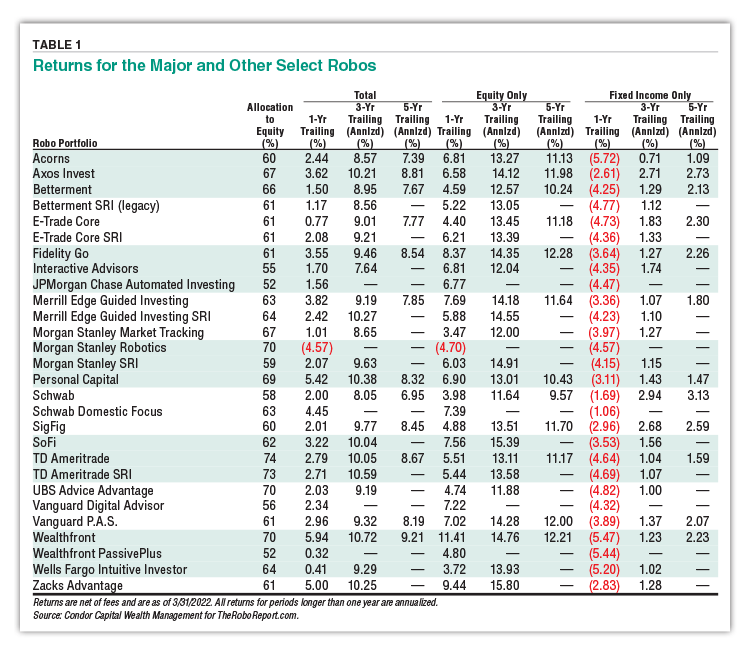
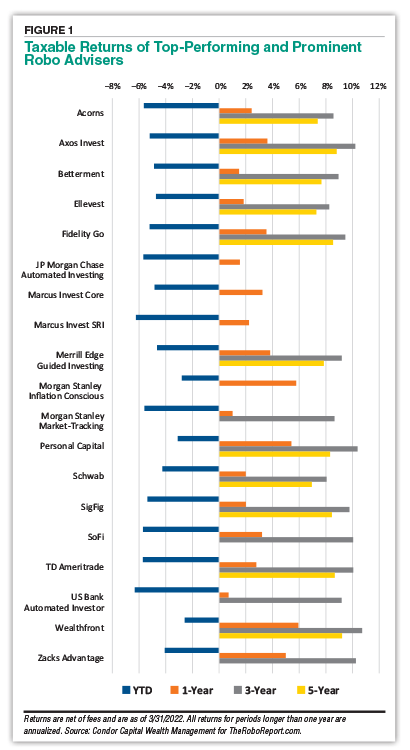
Table 1 summarizes the performance of the major robo-adviser portfolios over the past one-year, three-year and five-year periods as of March 31, 2022. In addition to reporting total portfolio performance, it shows returns for the equity portion only and the fixed-income portion only. Figure 1 charts the performance of the top-performing and most prominent robos for easier comparison.
Zacks Advantage Stands Out in Three-Year Performance
Zacks Advantage had excellent performance thanks to a strong domestic bias in its equity portfolio. Whereas the average robo allocated about 64% of the equity side of the portfolio to U.S. equities, Zacks allocated over 88% to U.S. stocks, propelling performance as the S&P 500 index outperformed the MSCI EAFE index—a developed international markets index—by over 10% on an annualized three-year basis. The SoFi portfolio and Morgan Stanley’s socially responsible investing (SRI) portfolio were the next two best equity performers thanks to significant allocations to growth stocks, which has been well-documented in previous editions of The Robo Report. While value stocks have outperformed year to date and have shrunk the performance gap with growth stocks, growth has still outperformed over longer periods.
From a fixed-income perspective, Schwab, Axos and SigFig boasted between 2.9% and 2.7% in returns, whereas the average robo returned about 1.3% for the three-year period ending March 31, 2022. The outperformance was due to Schwab and SoFi’s allocation to Treasury inflation-protected securities (TIPS), while Axos’ portfolio was allocated to short-duration high-yield investments, all of which proved especially valuable due to the rising rate environment in 2022.
Wealthfront and Fidelity Go Post Strong Five-Year Returns
Wealthfront and Fidelity Go allocated over 72% and 71% to domestic stocks, respectively, as a proportion of the total equity portfolio. This was at a time when the S&P 500 returned about 16% per annum, while the MSCI EAFE returned 7.3% per annum for the five-year period ending March 31, 2022. Interestingly, however, the trends in growth versus value were less decisive. Wealthfront is allocated roughly 25% to growth equities, while Fidelity Go held closer to a market-neutral allocation with 37% in growth at a time when Russell 3000 Growth returned 20.1% and Russell 3000 Value returned just 10.1%. Wealthfront took the top performance spot despite being overweight in value. This has been supported by energy and dividend stocks, which have had significant outperformance in 2022.
Schwab has long had strong fixed-income performance and was the top fixed-income performer over the five-year period. Schwab demonstrates more diversified bond portfolios than most robos, which opted for standard intermediate-duration investment-grade bond funds as their primary holdings. Schwab’s portfolio was well designed for an inflationary environment, as just shy of 40% of its bonds were allocated to TIPS ETFs, which have principal amounts that are boosted by rising consumer price index (CPI) numbers. Investors need to keep in mind, however, that Schwab continues to be a less-than-stellar choice due to the company’s business model, which involves holding high allocations to cash in its robo portfolios.
Looking Ahead
Robo-advisers have become a compelling option for those just starting out in the world of long-term planning and investing. We believe many investors will have their first advice experience at a robo-adviser. As the industry transitions into a new phase, we’ll be watching how innovation and consolidation changes the landscape. At the same time, we’ll continue to provide unbiased research into the industry and specific products.
Links to the robo-advisers mentioned in this article:
JPMorgan Chase Automated Investing
Merrill Edge Guided Investing SRI
Morgan Stanley Market-Tracking
Vanguard Personal Advisor Services

Related

Financial Planning
Are You Protected If Your Broker Goes Bankrupt?
Related

Alternative Investments
Special Purpose Acquisition Companies (SPACs) Explained
Discussion
FREE REPORT

MICHAEL D from CA posted over 4 years ago:
ROBERT A from NC posted over 4 years ago:
You need to log in as a registered AAII user before commenting.
Log InCreate an account