

Related

Portfolio Strategies
The breakeven inflation rate is a helpful guide for determining minimal rates of return required to maintain wealth in real terms.

The breakeven inflation rate is a predictive measurement that helps investors gauge the expectations of the future direction of inflation from current bond yields.
The measurement is market-based, meaning its foundation is what investors are willing to pay now as either a premium or discount for a traditional Treasury note or bond against a Treasury inflation-protected security (TIPS).
The breakeven inflation rate is expressed as a percentage, but it is not calculated as one. The breakeven is a percentage-point spread, or difference, between bond yields. The calculation is simple: Nominal yield – Inflation-protected yield = Breakeven inflation rate.
It is quoted as a percentage because typically the breakeven rate is compared to inflation, which is expressed as a percentage.
Technically, a breakeven rate can be calculated using any two interest-bearing securities because the rate is an interpolation, an approximation of value based on values that are already known. But the comparison should be based on two bonds with the same maturity and credit risk.
The breakeven inflation rate as commonly used refers to U.S. Treasury notes and bonds. This is because, as the Treasury department explains, it “would equate for the period the dollar return gotten from nominal Treasury securities and the dollar return gotten from TIPS.” Treasuries are useful in this case because they are equal in credit risk.
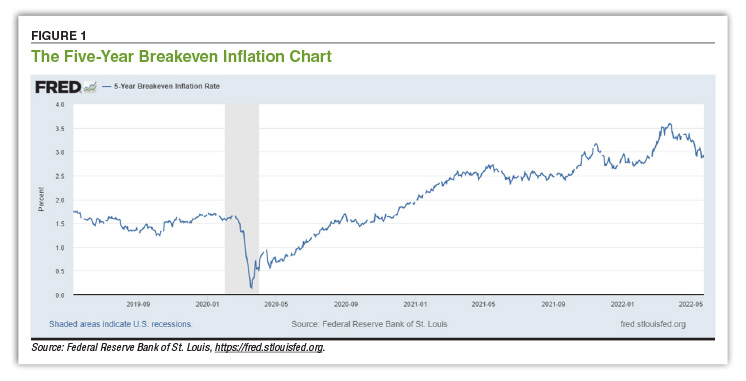
Both the five-year and 10-year breakeven inflation rates are the difference between the yields of nominal (fixed-income) Treasury bonds and TIPS, using securities with maturities of five or 10 years, respectively. A five-year breakeven inflation chart is shown in Figure 1.
TIPS are bonds that pay a guaranteed rate of return above inflation. The principal of a TIPS increases with inflation and decreases with deflation. When a TIPS matures, you are paid the adjusted principal or original principal, whichever is greater.
The breakeven inflation rate is the rate of inflation that would make the returns of a nominal bond and a TIPS bond of the same maturity equal. This equal return would only occur if the breakeven rate actually matched inflation over both bonds’ time span.
When the breakeven inflation rate is positive, it indicates investors’ anticipated level of inflation. When the breakeven rate is negative, it indicates investors’ anticipated level of deflation.
The consumer price index for all urban consumers (CPI-U) is used as a measure of inflation and deflation. The CPI-U is a monthly measure of the average change over time in the prices paid by consumers for a market basket of consumer goods and services. The CPI-U is based on the spending patterns of urban consumers.
The U.S. Bureau of Labor Statistics maintains a number of price indexes based on region and city size, in addition to those available for major products, such as food and beverages, housing, apparel, transportation, medical care, etc.
The general consumer price index (CPI) is focused on consumption by urban households, according to the Bureau of Labor Statistics. What differentiates the CPI-U is the inclusion of expenditures by “urban wage earners and clerical workers, professional, managerial, and technical workers, the self-employed, short-term workers, the unemployed, retirees and others not in the labor force.”
For purposes of the economy, the Federal Reserve works to maintain a stable value of the U.S. dollar with just enough inflationary pressure to encourage consumption and investment. Deflation would encourage saving and the deferral of purchases, as the value of money will be higher later than it is now. We normally want low and stable inflation.
Bonds and other debt securities regularly trade at market prices different from their principal, or par, values. A bond’s par value is the specific amount of capital owed from the issuer to the bondholder at the security’s maturity.
Bonds trade at premiums and discounts to their par values when their coupon (the specified interest paid at regular intervals by the bond) differs from the prevailing market interest rate. With the exception of adjustable-rate bonds, most bonds do not alter the interest they pay out.
As the market’s expectations of inflation change, only the price of the bond can change to meet the investor’s demand to compensate for inflation’s impact on the future stream of the coupon and principal payments. This is why bond prices are impacted by inflation.
If inflation increases, the Fed may move to raise interest rates, which hurts prices of nominal bonds because the fixed interest payments from the bonds don’t adjust for the market’s new expectations for inflation.
If inflation slows, the Fed may cut interest rates, boosting yields.
The price of a bond will change inversely with the market interest rate until its yield is comparable with the market’s yield. If a $1,000 bond with 10 years to maturity carries a 7% coupon, it will carry a market price of only $870 in a market with a prevailing 9% interest rate. The drop in the price of the bond is necessary to raise the yield to maturity from 7% to 9%.
Of course, as the bond nears its maturity, its price will move toward its par value since, no matter what, that principal is owed to bondholders eventually.
Investors use the breakeven inflation rate to consider what a bond will need to yield in interest in real (inflation-adjusted) terms to match the market yield, which is based on interest rates the government adjusts relative to inflation.
The use of breakeven inflation rates should be qualified by the data set behind it and the accuracy of the calculation used to derive it. The five-year and 10-year breakeven inflation rates are calculated by the St. Louis Fed and are available online through its Federal Reserve Economic Data (FRED) database.
It is important to note that a variety of short-term factors influence the breakeven inflation rate. However, over time, the breakeven rates are reliable indicators of market expectation for future inflation.
The five-year and 10-year breakeven inflation rates are widely followed because they fit a sweet spot wherein the expectations of inflation appear more concrete, even though there isn’t a definite way of knowing the future.
Bonds with shorter maturities will return to their principal earlier and thus be less affected by future inflation despite being under its sway in the present as any debt security is. Beyond a 10-year maturity date, it is hard to predict inflation accurately, but bonds with longer maturities will see their prices move the most in response to inflation.
Investors are showing more interest in the bond market as the emphasis on stocks erodes under the pressure of a slower economy, due at first to constraints imposed by a new, unforeseen economic problem—a black swan event—and due now to the Fed’s desire to ease the flow of cheap money. Money was and, relative to history, still is cheap based on the interest rates set by the Fed.
The coronavirus pandemic is one such black swan event that has pressured the economy to an extent that the Fed is changing interest rates in response. The preceding decade or so of historically low interest rates is ending.
The breakeven inflation rate is important to understand as a measurement of what the market currently expects inflation to be. Specifically, the five-year and 10-year breakeven inflation rates offer useful snapshots.
Inflation can diminish or eliminate the investment you’ve made in fixed-income securities or sink the plans you’ve made for a fixed-income retirement.
The breakeven rate is helpful to both stock and bond investors because it can be used for determining minimal rates of return required to maintain wealth in real (inflation-adjusted) terms; it’s also useful to retirees to gauge how much their portfolio withdrawals will need to increase each year.
Portfolio Strategies
Investor Professor

Stock Strategies

ROBERTO P from CHE posted over 4 years ago:
You need to log in as a registered AAII user before commenting.
Log InCreate an account