

Related

First Cut Stocks
Benjamin Graham's Defensive Investor Utility Screen

Stock Strategies
Graham felt that inexperienced investors should confine their holdings to companies that have long histories of profitability, are in a strong financial condition and hold a leading position in their respective industry.
by Matt Markowski | July 2022

Benjamin Graham defined defensive investors as those unable to devote much time to the process or those who are unfamiliar or inexperienced with investing. As such, Graham felt defensive investors should confine their holdings to the shares of “important” companies. Such companies have long histories of profitability, are in a strong financial condition and hold a leading position in their respective industry, ranking at least in the top third in size among their industry group.
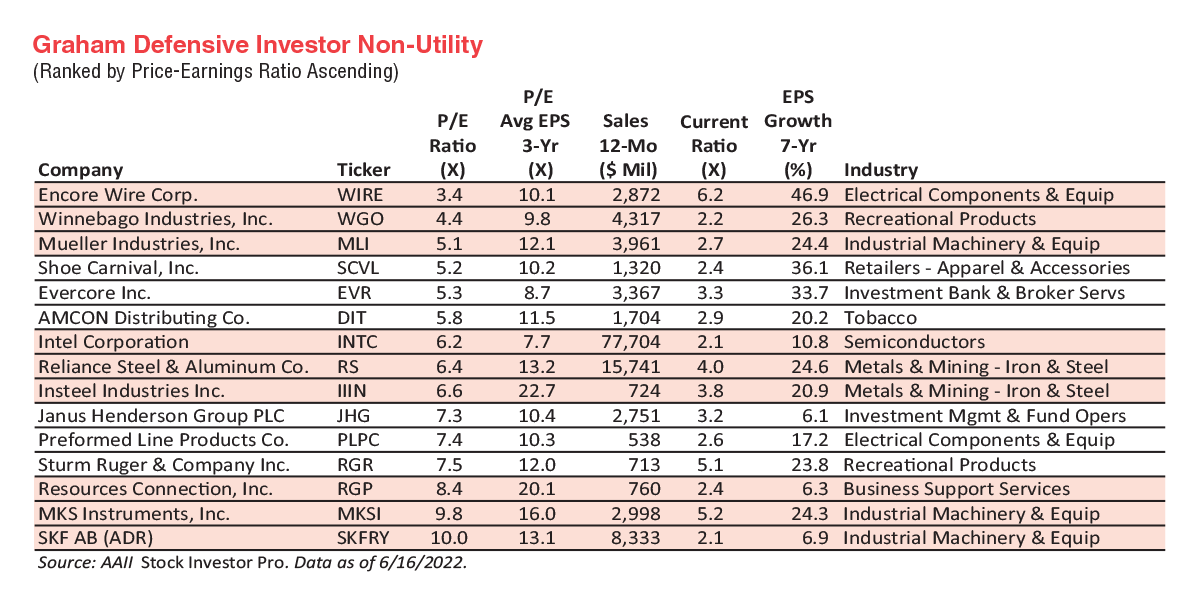
Based on the principles outlined in his book “The Intelligent Investor,” AAII developed the Graham Defensive Non-Utility screen. The screen, along with the similar Graham Defensive Utility screen, is pre-built into AAII’s Stock Investor Pro fundamental stock screening and research database program.
The non-utility, or industrial, screen aims to find stocks with low intrinsic value, focusing on companies of adequate size (based on annual sales) with strong balance sheets; earnings stability; strong, uninterrupted dividend records; and moderate price-earnings and price-to-book ratios.
The Graham Defensive Investor Non-Utility screen requires a history of positive earnings and dividends for each of the last seven years. Graham also wanted to see defensive companies grow their earnings. Therefore, average annual growth in earnings per share of at least 3% over the last seven years is required. The screen restricts stocks to a maximum price-earnings ratio of 25 and specifies that the product of a company’s price-earnings ratio and price-to-book-value ratio cannot be higher than 38.
In addition, companies must have sales of at least $400 million over the last 12 months and a current ratio for the last fiscal quarter greater than or equal to 2.0. The long-term debt-to-working-capital ratio for the last fiscal quarter of passing companies must be greater than 0% and less than 100%. Finally, utility companies are excluded.
Go to AAII Guru Screens for an updated list of stocks passing this screen.
First Cut Stocks
Stock Strategies


No comments have been added yet. Add your thoughts to the discussion!
You need to log in as a registered AAII user before commenting.
Log InCreate an account