

Related

First Cut Stocks
Benjamin Graham's Defensive Investor Non-Utility Screen

Stock Strategies
Benjamin Graham’s approach focused on finding the intrinsic value of a stock. He believed investors should buy stocks whose prices are close to their intrinsic value, and preferably those that are priced lower than their intrinsic value.
by Matt Markowski | July 2022

Benjamin Graham’s approach focused on finding the intrinsic value of a stock. He believed investors should buy stocks whose prices are close to their intrinsic value, and preferably those that are priced lower than their intrinsic value.
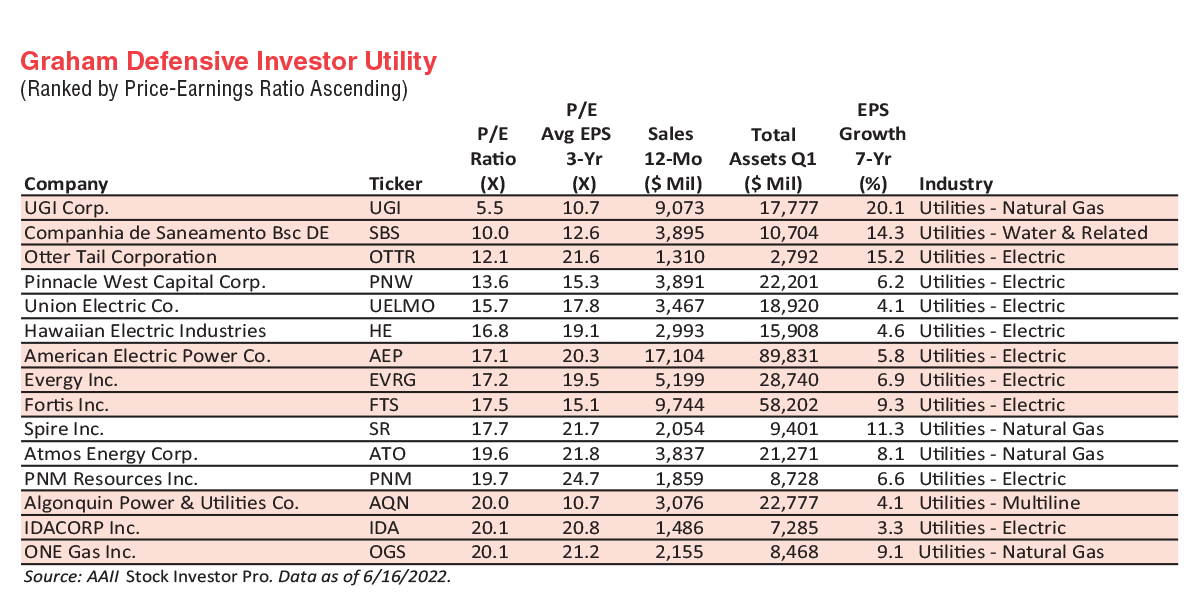
The AAII Graham Defensive Investor Utility screen focuses on companies within the utilities sector. The screen requires a history of positive earnings and dividends for each of the last seven years. Earnings per share are required to have average annual growth of at least 3% over the last seven years. These requirements are the same as the AAII Graham Defensive Investor Non-Utility screen.
The utility screen differs from the non-utility screen by requiring companies to have total assets for the last fiscal quarter greater than or equal to $200 million and a long-term debt-to-equity ratio for the last quarter less than 200%. This reinforces Graham’s idea that defensive investors should only be looking for “important” companies with long histories of profitable operations that are in a strong financial condition.
On the valuation side, the product of a company’s price-earnings ratio and price-to-book-value ratio cannot be higher than 38. We arrive at this value by multiplying the maximum price-to-book ratio of 1.5 by the maximum price-earnings ratio of 25. As a proxy for the maximum price-earnings ratio, Graham used the inverse of 10-year AA corporate bond rates. He felt that defensive investors should establish a portfolio whose earnings yield—the inverse of the price-earnings ratio—was at least comparable to the yield on 10-year AA bonds.
Current long-term high-grade corporate bond yields differ from those prevailing when Graham set his price-earnings objective, and therefore the cutoff needs to be adjusted. When bond yields increase, Graham’s formula requires a lower price-earnings ratio. Conversely, lower bond yields mean that an investor could accept a higher price-earnings cutoff, which makes more stocks available for consideration.
Go to AAII Guru Screens for an updated list of stocks passing this screen.
First Cut Stocks
Stock Strategies


No comments have been added yet. Add your thoughts to the discussion!
You need to log in as a registered AAII user before commenting.
Log InCreate an account