


Related

Portfolio Strategies
An allocation to cash can make sense in many portfolios both to reduce risk and, for retirees, to facilitate increased risk.
by Brian Haughey | March 2024

Companies often grapple with the question of how much cash, or cash equivalents, to hold on their balance sheets. In addition to providing a resource to allow a firm to weather unexpected financial emergencies, a sufficiently large cash reserve (“dry powder”) can enable firms to acquire competitors or other strategic targets at favorable prices when opportunities occur. However, too large a reserve position can result in complaints that the firm is using capital inefficiently, and that it should be returned to investors. This was the case in 2013 when Apple Inc.  (AAPL) was criticized by activist investors who demanded that the cash position be used to finance a stock buyback program.
Investors, too, face a related dilemma. Sitting on a large cash position may appear to be a foolish strategy when equity markets are appreciating. The fear of missing out (FOMO) can lead investors to commit all of their available funds to the market. This occurs even when the markets become increasingly risky and noted investors advocate for being patient. The late Charlie Munger would say, “It takes character to sit with all that cash and to do nothing. I didn’t get to the top where I am by going after mediocre opportunities.”
On the other hand, famous fund manager Peter Lynch cautioned against attempting to time the market. He suggested that, in general, you should be fully invested unless you need cash in the next two or three years.
While holding cash has its advantages and disadvantages, it can make sense in many portfolios to both reduce risk and, conversely for retirees, to facilitate increased risk.
The performance of mutual funds and similar investment portfolios tends to suffer in bull markets, when compared to the returns of a market index, because of the drag associated with a cash position. For example, suppose cash returns 5% and the broad stock market returns 10% in a given year. A passive mutual fund may have 95% of its assets invested in a market-capitalization-weighted portfolio. The remaining 5% is allocated to cash to facilitate shareholder investments and redemptions. This mix will return 9.75% [(95% (AAPL) 0.10) + (5% (AAPL) 0.05)] and underperform the broad market’s 10% return.
A cash allocation will benefit a portfolio, however, in a flat or declining market. For example, if cash earned 5% but the market return was –10%, the fund’s return of –9.25% [(95% (AAPL) –0.10) + (5% (AAPL) 0.05)] might offer some slight solace.
In general, therefore, a cash position will usually reduce overall portfolio returns. But not always.
When you believe that the equity markets are likely to appreciate, it is natural to wish to be fully invested. However, maintaining an opportunistic cash reserve enables you to capitalize on the inevitable bargains that regularly appear in the market. As I noted in “Be a Wiser Investor Than the Crowd” (March 2022 AAII Journal), even high-quality stocks can be volatile, offering opportunities to the patient investor.
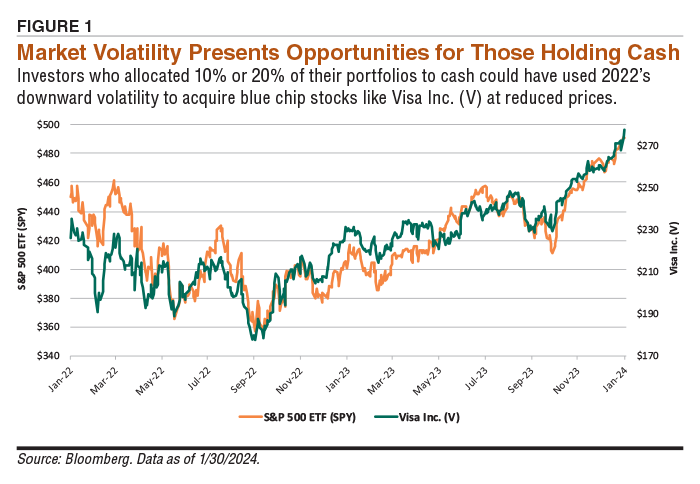
For example, an investor who purchased Visa Inc. (V) in late September 2022 at $177 per share—following a 24% decline from its $235 price that February—would have enjoyed a 56% run-up to a price of $277 by late January 2024 [(277 ÷ 177) – 1]. This contrasts with the 18% returned by Visa starting in February 2022 [(277 ÷ 235) – 1] and the 7% [(490 ÷ 457) – 1] returned by the SPDR S&P 500 ETF (SPY) over the same two-year period. See Figure 1.
While market timing is not for everyone, using a modest opportunistic cash position to implement a core-and-satellite strategy can enhance portfolio returns. For example, an 80% or 90% allocation to passive equity or bond funds and a 10% or 20% allocation to cash can enable an investor to take advantage of price declines in blue chip stocks that are expected to be temporary, offering the potential to boost returns with comparatively little additional risk.
While a cash position can be used to potentially boost portfolio returns, it can also be used to reduce portfolio risk. While equity investors should pay attention to market risk, bond investors also need to be concerned about volatility. As I discussed in “The Risks of Investing in Bonds” (May 2020 AAII Journal), and as bond investors were reminded in 2022, an increase in interest rates can lead to negative bond returns. These can often be significant as demonstrated by the 31.2% decline in the iShares 20+ Year Treasury Bond ETF (TLT) over the 12 months through December 2022.
It is true that the likelihood of a bond market decline, due to an increase in interest rates, is significantly less today than it was in early 2020. Indeed, the current inverted yield curve suggests that interest rates are likely to decrease over the next few years. Nevertheless, six-month Treasury bills offering returns in excess of 5.0% and one-year Treasury bill yields of around 4.7% compare favorably to average long-term bond index returns of 5.5%. Because of their low modified duration, money market funds and Treasury bills have little price exposure to changing interest rates, although a decrease in interest rates would result in reduced future returns on reinvested capital. An allocation to cash would, therefore, reduce the overall risk of a bond portfolio in the short term while offering attractive returns.
Similarly, investors concerned about equity market risk who choose to allocate a proportion of their portfolios to cash, and high-quality cash equivalents, can be confident that the cash position won’t lose value. It can also act as a quasi-hedge by allowing investors to purchase stocks in the future at lower prices in the event of a market downturn. A cash allocation, therefore, might be attractive to cautious equity investors.
A key concern of many retirees is the risk of running out of money before retirement ends. While stocks are likely to outperform many other asset classes in the long run, there is always the chance that retirees seeking to generate current income may be forced to sell stocks in a market downturn, locking in what might otherwise be a temporary loss.
While holding cash can be conservative, a cash position in a retirement portfolio can also enable retirees to take on more risk.
The conventional wisdom from many retirement planners is to invest a large proportion of your portfolio in stocks when you are younger in order to take advantage of their greater expected long-term returns relative to those offered by bonds. As you get closer to retirement, the advice calls for increasing your allocation to bonds, because of their perceived safety. One such recommendation would be to have a percentage allocation of 100 minus your age to stocks, so that you might have a 75% equity allocation at age 25, while at age 65, you would have 35% in stocks. Indeed, so-called life cycle, or target date, funds adjust the percentage weights to stocks and bonds in such a fashion automatically over time. While such a strategy is likely to reduce overall portfolio volatility—which can be desirable as you approach and are in retirement—it is also likely to reduce future portfolio growth and the future income you can withdraw from your retirement portfolio.
As noted, one rationale for such a strategy is the fear that when faced with equity market declines, a retiree with a large equity position seeking income would have to liquidate equities at depressed prices. Meanwhile, those with a large bond portfolio could continue to recognize income from bond coupons and indeed may benefit from increases in bond values resulting from reductions in interest rates that might accompany an equity market decline.
By combining an appropriately sized cash position with the remainder of the investment portfolio allocated to equities, an investor can be reasonably confident of a stable income even in a market downturn while allowing for additional growth in the portfolio. This is particularly the case when compared to an investor with, say, a 65% allocation to bonds.
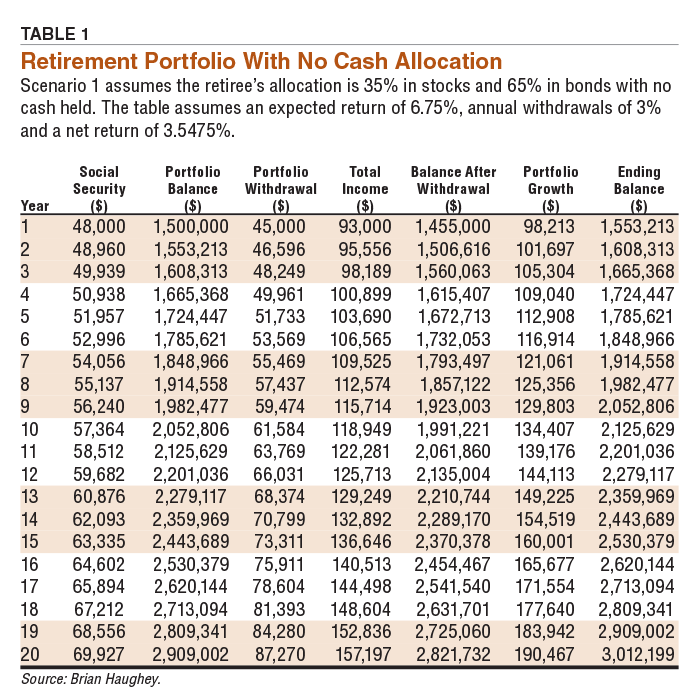
Consider Joan, a recent retiree, who has $1.5 million in her portfolio. We will assume that she lives on $93,000 per year and ignore the effect of taxes in our discussion. Social Security pays her $4,000 per month, or $48,000 per year, including a spousal benefit. She plans to withdraw 3% annually, or $45,000 ($1,500,000 (AAPL) 0.03) in the first year, from her portfolio. Her beginning annual income in retirement, therefore, is $93,000 ($48,000 + $45,000).
If we assume a long-term return on stocks of 10% and 5% on bonds, her expected portfolio return is 6.75% [(35% (AAPL) 0.10) + (65% (AAPL) 0.05)]. Her annual income will increase as her portfolio grows and her Social Security benefit is adjusted for inflation (assumed here to be 2% annually). If the portfolio withdrawal is made at the start of each year, then the portfolio—and the amount withdrawn—will grow at 3.5475% annually [(1 – 0.03) (AAPL)(1 + 0.0675) – 1].
After 20 years, the amount withdrawn is expected to have increased to $87,270 (growing for 19 years at 3.5475%). The ending portfolio value will be $3,012,199, as shown in Table 1.
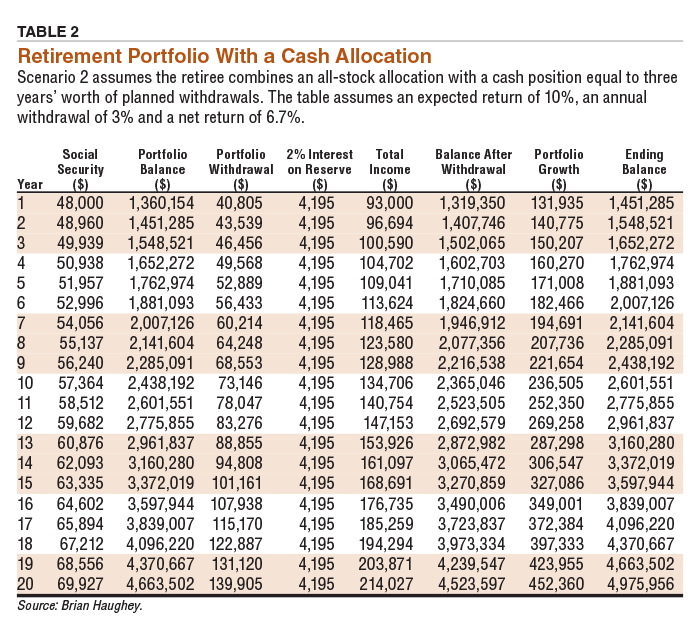
Now assume that Joan’s twin brother Harry, also married and with the same Social Security benefits, adopts a more aggressive 100% allocation to dividend-paying stocks. He is comfortable following an aggressive approach, recognizing that his Social Security benefits can be viewed as an allocation to fixed income. However, aware that the market may decline in the future and that dividends might be reduced, Harry decides to deposit an amount equal to the first three years of withdrawals that Joan will make into a money-market account yielding 3%. This deposit is $139,845 ($45,000 + $46,596 + $48,249).
Harry is confident that even in a three-year bear market, he won’t have to sell any stocks if his dividends are reduced, as he can withdraw from the reserve to supplement his Social Security benefits. [Editor’s note: AAII’s Level3 withdrawal strategy calls for holding the equivalent of two to four years of withdrawals in safe assets such as cash.]
He will receive $4,195 annually from interest earned on this cash reserve. Harry’s initial portfolio balance, after establishing his reserve, will be $1,360,154 ($1,500,000 – $139,846). His portfolio will grow at 6.7% per year after he makes his 3% annual withdrawals [(1 – 0.03) (AAPL) (1 + 0.10) – 1]. By year 20, Harry’s withdrawal amount is expected to be $139,905, and his ending portfolio value is expected to be $4,975,956, as shown in Table 2. Compared to the corresponding amounts for Joan, these amounts are 60% and 65% higher, respectively.
It should be stressed that this is a simplified analysis that ignores the effects of taxes and assumes that the expected long-term returns are actually earned. It also assumes no additional top-ups to the reserve fund are made, which may be unrealistic. However, a more sophisticated analysis would require little additional complexity in the model. Also note that if interest rates decline, the income from the cash reserve would decrease, while Joan’s high-quality bond allocation is likely to increase in value in the same circumstances.
Whether a strategy such as Harry’s is appropriate for you depends on your risk tolerance, the likelihood and duration of any bear markets you anticipate and the returns that you expect to earn. Nevertheless, combining a cash reserve with an allocation to high-quality, dividend-paying stocks is certainly worth considering.
Maintaining a cash position can make sense for many investors, particularly when short-term interest rates are close to or above their long-term averages. By reducing the allocation to stocks and bonds, a cash position can reduce portfolio risk while offering investors the opportunity to take advantage of price declines in individual stocks or the overall market.
Meanwhile, an appropriately sized cash reserve position to meet anticipated liquidity needs for several years can enable investors to maintain a larger equity allocation in their retirement portfolio than they might otherwise be able to hold.
It should be noted that this discussion is for educational purposes only and is not intended as investment advice. Please consult with your tax adviser and retirement planner.
Portfolio Strategies

Retired Investor

Portfolio Strategies

GREGORY M from CA posted over 2 years ago:
D S from NE posted over 2 years ago:
ROBERT A from NC posted over 2 years ago:
JOHN L from NJ posted over 2 years ago:
WILLIAM H from IN posted over 2 years ago:
AL P from NY posted over 2 years ago:
BERNARD R from UT posted over 2 years ago:
JAMES F from FL posted over 2 years ago:
AROON P from FL posted over 2 years ago:
GEOFFRY O from TX posted over 2 years ago:
GENE M from MA posted over 2 years ago:
DAVID L from UT posted over 2 years ago:
BRIAN H from NY posted over 2 years ago:
Peter N from TN posted over 2 years ago:
Andrew S from UT posted over 2 years ago:
JEAN H from IL posted over 2 years ago:
DOUGLAS H from IL posted over 2 years ago:
JAMES C from LA posted over 2 years ago:
DAVID D from TX posted over 2 years ago:
David L from AK posted over 2 years ago:
You need to log in as a registered AAII user before commenting.
Log InCreate an account