

Related

Portfolio Strategies
Index Fund Options for AAII's Asset Allocation Models


Portfolio Strategies
Excluding a low to moderate number of stocks from a passive portfolio following an index has minimal influence on investor performance.
by Andrew Gomes | March 2024

Excluding a low to moderate number of stocks from a passive portfolio following an index has minimal influence on investor performance.
Researchers performed simulations using a historical investable universe from 1964 to 2021, focusing on the top 1,500 common shares by market capitalization. A market-cap-weighted return index of the defined investable universe was constructed to serve as a passive benchmark. After removing randomly selected stocks from the universe each year, the researchers recalculated the market-cap-weighted portfolio return using the remaining stocks. They then compared the performance of the increasingly restricted market-cap-weighted portfolios to the passive benchmark’s performance.
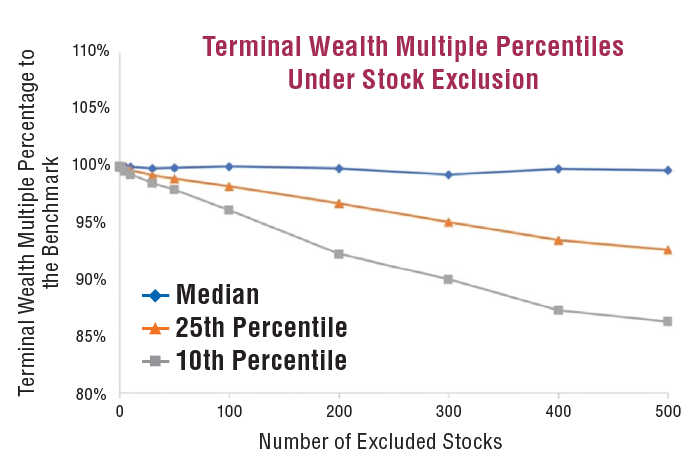
The results showed that the returns of passive portfolios with up to 100 excluded stocks remained comparable to the returns of the benchmark portfolios. The analysis was extended to industry-concentrated exclusions, demonstrating similar patterns. Long-only factor portfolios were also found to be minimally affected by a moderate number of exclusions, while more extreme exclusions were shown to negatively impact performance, depending on construction methods.
The researchers also tested custom portfolios, which allow investors to deviate from benchmark indexes. Four customization options were studied: tax-loss harvesting, factor enhancements, socially responsible investing restrictions and single-stock exclusions. The researchers found that a modest approach to these customizations preserves expected performance properties in passive portfolios.
The results suggest that index investors can comfortably exclude a moderate number of stocks without significant deterioration in investment performance.
Source: “Exclude with Impunity: Personalized Indexing and Stock Restrictions,” by Yin Chen and Roni Israelov; Financial Analysts Journal, October 19, 2023.
Portfolio Strategies
Portfolio Strategies

JIM L from MI posted over 2 years ago:
ROBERT A from NC posted over 2 years ago:
JOHN L from NJ posted over 2 years ago:
ROBERT A from NC posted over 2 years ago:
You need to log in as a registered AAII user before commenting.
Log InCreate an account