

Related

Portfolio Strategies
Saving for goals you want to reach within the next five years entails different risk considerations and allocation choices than long-term goals.

Charles Rotblut leads a class in AAII's new Essential Investing Video Course. Go to https://www.aaii.com/ves for more information and to subscribe.
Not all financial goals are long-term in nature. A down payment on a house or buying a new car are frequently short-term goals for those in their 20s and 30s. Adults who are middle-aged or older may also have short-term goals they wish to account for in their wealth-building plans.
A one-page PRISM Wealth-Building Plan can easily be created to help you achieve your short-term goal. It follows the same approach as would be used for achieving a long-term plan. What’s different are the considerations to take into account and the allocation choices.
Having a written plan will help you reach your goal. It does not matter whether the goal is short-term, long-term or somewhere in between. A written plan clarifies your thoughts and creates a road map you can use to achieve your goal.

The one-page PRISM Wealth-Building Plan presented in this article uses a young adult who is saving for a down payment on their first house. Elizabeth is a twentysomething who is early in her career and wishes to buy her first house or condominium within the next five years. She estimates that she will need at least $35,000 for her first down payment. While the goal, amounts and length of time will vary for each person, Elizabeth’s plan provides an example of how PRISM can be applied to short-term goals.
We discuss the issues Elizabeth needs to address in her plan such as saving, the difference in risk considerations compared to a long-term goal and the types of investment choices that might be most suitable. For those of you who are both older and/or wealthier than Elizabeth, we also discuss using a portion of longer-term savings to fund a shorter-term goal.
Our focus in this article is the timing of when a large payment will need to be made. We define short-term goals as those that are expected to be reached within five years. A down payment is a common example of this. Weddings, car purchases and once-in-a-lifetime trips are among the events that fall into this category.
Long-term goals are those that are not expected to be incurred until well into the future—at least 10 years, if not 15 years or more. Retirement for someone in their 20s or 30s is a long-term goal. A middle-aged adult or a retiree may view leaving an inheritance as a long-term goal.
The key differentiator is time. A person who needs a certain sum of money in three years may find themselves with a substantial shortfall due to market volatility if fully allocated to stocks. Volatility isn’t an issue for a long-term investor from a financial standpoint (though it may be a hindrance from a psychological standpoint). Rather, inflation is a bigger risk for the long-term investor.
The first step, and the cornerstone of the PRISM Wealth-Building Process, is identifying and prioritizing goals. Elizabeth’s goal is saving to buy a house.
As a young adult, Elizabeth has additional financial goals. She is aware of the importance of saving for retirement. Elizabeth would like to continue to build her emergency savings as well as set aside “fun” money to cover trips, concerts, etc. She notes these as other key goals on her one-page PRISM Wealth-Building Plan so that she does not lose sight of them while focusing on her first house purchase (Figure 1).
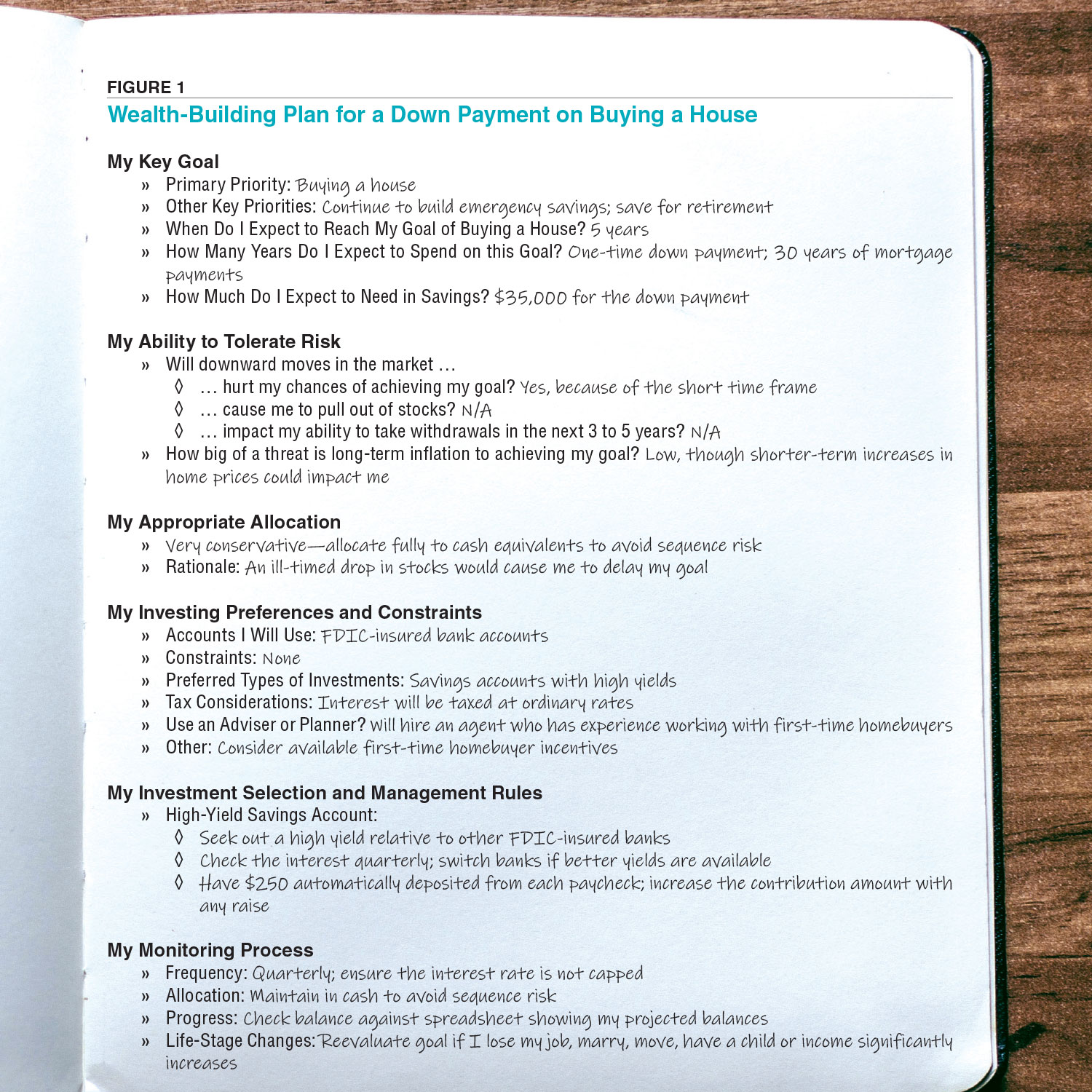
Elizabeth notes how much she needs to allocate to savings each month to achieve her goal. Though it will require tough choices on spending, she intends to set aside $500 per month ($250 per pay period) for the down payment fund. She will increase this amount when she receives a raise in the future.
She hopes to buy her first house (or condominium, depending on what is available and affordable at the time she is looking) within five years. Though Elizabeth does not have an exact time for making the purchase—and realizes that life events could change her goal—writing down an approximate purchase date helps to establish a time frame that can be used to recognize risk tolerance and allocation. It also helps Elizabeth to set key milestones to reach along the way.
The estimated amount needed for a down payment is $35,000. Elizabeth would ideally like to make a larger down payment to avoid having to pay private mortgage insurance (PMI), but she is concerned that rent increases will make it harder to accumulate a large enough amount to do so. She also intends to look into first-time homebuyer incentives.
Since Elizabeth will be taking out a mortgage, she writes down 30 years as the length of time she will be spending on the goal. A down payment on a car would be followed by five years of spending (assuming a 60-month loan). An affluent adult who intends to take a once-in-a-lifetime trip might have a spending horizon of a month or a few months instead.
The length of time before a goal is expected to be reached is directly related to the ability to withstand volatility in the total value of one’s savings. Investors saving for long-term goals can tolerate high levels of volatility (from a financial standpoint) because their portfolios have time to recover from periodic drops in the stock and bond markets.
Sequence of returns risk—an ill-timed series of bad returns—is a threat for those with short-term goals. How big a threat it is depends on whether the level of wealth prevents one from fulfilling their goal. An affluent person may be able to make up the shortfall by spending dollars intended for other goals. A young adult like Elizabeth typically lacks such financial flexibility. For her, a wealth shortfall means not being able to buy a house as planned.
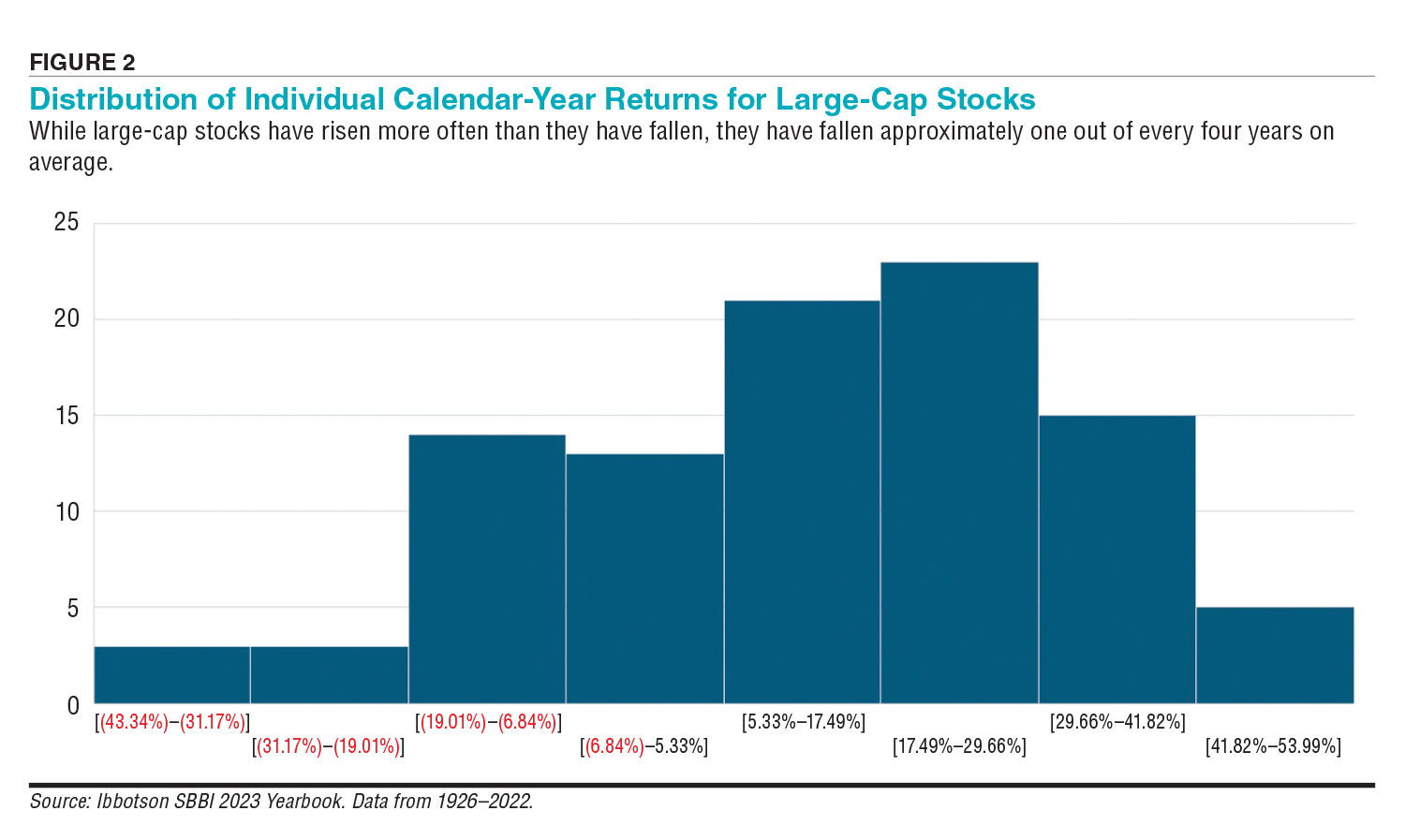
The frequency at which down markets occur matters. Large-cap stocks have fallen once out of every four years since 1926, on average.
The magnitude of drops also matters. When large-company stocks have experienced a down year, their declines have mostly been greater than 5%. Calendar-year drops have exceeded 10% nearly half the time. While the major stock indexes have always recovered from losses, the amount of time this takes may be much longer than the time until you plan to start spending on your goal.
Most years, the stock market is up. Stocks can go for many years without experiencing a calendar-year decline. Large-company stocks, for instance, only declined once—a modest 4.4% loss—over the 13 years between 2009 and 2021. Stocks can have tough stretches too. Large-cap stocks fell on a calendar-year basis four times between 2000 and 2008. Figure 2 illustrates the distribution of calendar-year returns for large-cap stocks since 1926.
Your short-term spending goals likely won’t align with calendar years. More importantly, the timing of when a drop occurs and how long it takes for stocks to recover matters greatly when it comes to short-term goals. It has taken, on average, about 14 months for the S&P 500 index to recover from a “garden variety” bear market (a drop of 20% to 40%), according to Sam Stovall of CFRA Research.
Those who have the flexibility to push back their spending goals or allocate dollars intended for other goals can accept a high chance of sequence risk occurring. In contrast, those who either lack the same flexibility or do not wish to delay their goals should guard against it.
Inflation is a big risk for long-term investors because it erodes purchasing power, meaning every dollar buys less goods and services. Most years, its erosive effects are not severe when it comes to short-term goals. But inflation can still spike over shorter periods as it did in 2021 and 2022.
Those with short-term goals will still need to focus on maximizing the return they receive even when opting for so-called safe assets. The ability to save more and/or incorporate some flexibility with the timing and/or the cost of the goal also helps.
Long-term investors with short-term goals can use diversification to seek higher returns while maintaining a cushion against shorter-term volatility.
Being a renter, Elizabeth is well aware of the impact shelter costs have on inflation. Her preference is not to postpone the purchase. This makes her averse to sequence risk for this goal. Elizabeth therefore marks her risk tolerance as low.
Elizabeth wants to buy a house as soon as she has saved enough for a down payment. She also does not have excess wealth she can allocate toward buying a house beyond what she has specifically saved for it. These two factors significantly influence her allocation decisions.
For someone in this situation who is unable or unwilling to shift the timing of their goal, avoidance of sequence risk takes precedence. A drop in wealth will delay her plans to purchase the house and cause her to pay rent for a longer period. She therefore should favor assets that preserve wealth rather than grow it. (The same could be said for someone who is seeking to buy a car in the next few years.) Elizabeth opts to stay very conservative by allocating to cash equivalents. Savings accounts and money market funds earn interest but will not realize capital gains or losses.
A person who is willing to delay their goal or has other sources of wealth they can tap to make up for any shortfall could opt for a much more aggressive allocation. A bucket approach could also work well in this situation. This would involve allocating the amount needed to fund the short-term goal to short-term investments or cash equivalents while aggressively investing the remainder.
Step 3 of the PRISM Wealth-Building Process identifies investment management preferences and constraints. Though an allocation to cash equivalents is far less complicated than stocks, exchange-traded funds (ETFs), etc., there are still decisions to think through.
Cash equivalents include savings accounts, certificates of deposit (CDs), money market accounts, money market funds and Treasury securities. Savings accounts are the most basic and offer ease of withdrawals. CDs commonly have early withdrawal penalties that must be considered. Most money market accounts are insured by the Federal Deposit Insurance Corp. (FDIC), but money market funds are not. [Money market funds fall under the Securities Investor Protection Corp. (SIPC) umbrella.]
Elizabeth, like many in their 20s and 30s, prefers to do her banking with a smartphone app. When choosing a bank account, it is important for her to ensure that not only the bank but also the high-yield savings account are FDIC insured. [Credit union accounts should be covered by the National Credit Union Administration (NCUA).]
Some banks limit the number of withdrawals that can be made in exchange for a higher yield. These restrictions should be noted.
She is already a client of an online bank with a high-yield savings account. She opts to set up a separate savings account for her down payment. Some people may find it preferable to open an account at a separate bank so that they don’t see the balance when accessing their primary bank account.
Because Elizabeth is a young adult and is saving for a house, she does not need a financial adviser or planner. She does make a note to hire a real estate agent with experience in helping first-time homeowners to ensure she is made aware of any first-time homebuyer incentives and credits she may be eligible for.
The rules here are different from what would be listed if stocks, mutual funds, ETFs or bonds were held.
Elizabeth should make sure her account is FDIC insured. She should compare interest rates to ensure she is receiving a competitive rate—and one that is well above the national average. Elizabeth also notes the importance of checking her statement once per quarter to ensure the interest rate is not fixed or capped. Some banks offer a seemingly attractive rate to new depositors but then do not raise it.
She also sets up rules regarding how she will save. Elizabeth sets up automatic deposits to have $250 from her biweekly paycheck transferred directly into her savings account. This “Odysseus contract” removes the option of having those dollars immediately available in her checking account.
Elizabeth adds a note reminding herself to increase the amount saved whenever she receives a pay raise.
A person with greater wealth could choose to fund their short-term bucket over set intervals. Doing so semi-annually or annually may be preferable for a person who is financially able to handle some sequence of returns risk as it gives those dollars more time to benefit from possible capital appreciation.
Among the big lessons any young adult who is early in their wealth-building journey should learn is the importance of not looking at their savings balances too often. Looking too frequently triggers emotional urges to do something when not acting is the better strategy.
Elizabeth writes down that she will check her statements quarterly to ensure the deposits are being credited and the interest rate remains competitive and is not capped. (Switching bank accounts does not incur the fees that transferring a full account out of a brokerage firm does.)
She also checks her balance against a simple sheet showing the cumulative amount she should have saved each quarter. As long as Elizabeth doesn’t interfere with her direct deposits, she will remain on track.
Life-stage changes that could alter her plan include losing her job, moving, getting married, having a child and/or a significant increase in her salary. She notes these as a reminder to determine whether she needs to alter her original goal.
For someone who has already accumulated wealth, progress could be checked by ensuring that an adequate amount is allocated to short-term investments. Those in this situation may also wish to note any change in wealth that might alter their plans, in addition to any life-stage changes.
This article shows how to create an effective one-page plan for funding a short-term goal. The goal of buying a house is one that many in their 20s and 30s have. Others in this age group may wish to save for a new car or another big expense. The same one-page plan shown here can be used for those goals; only the amounts and time periods will need to be changed.
Elizabeth has other financial goals—including building retirement savings and boosting emergency savings. As a young adult, she may also have financial responsibilities like paying down her student debt. The format discussed here can be easily modified to help accommodate those goals as well. The key is having a plan that is easy to implement and consistently follow.
Portfolio Strategies

Editor's Note

PRISM Wealth-Building Process

ROBERT A from NC posted over 2 years ago:
BARRY J from TX posted over 2 years ago:
BARRY J from TX posted over 2 years ago:
BARRY J from TX posted almost 2 years ago:
You need to log in as a registered AAII user before commenting.
Log InCreate an account