


Charles Rotblut leads a class in AAII's new Essential Investing Video Course. Go to https://www.aaii.com/ves for more information and to subscribe.
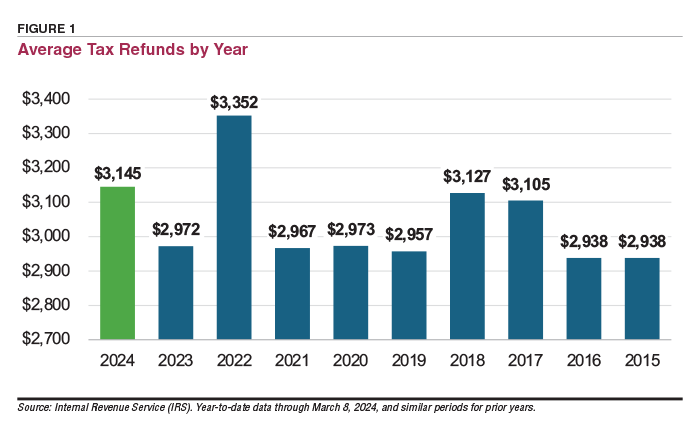
The average tax refund for the current tax season was $3,145 as of early March 2024. This represents a 5.8% increase from approximately the same point in 2023.
More notably, it puts the 2024 tax season on pace to have the second-largest average tax refund in at least 10 years. The only year with larger average refunds issued since 2015 was 2022. Refunds were higher because of the coronavirus pandemic’s impact on tax-year 2021.
Larger average refunds are being issued this year because of the inflationary adjustments made for tax-year 2023. Tax brackets—as well as deductions, credits and exemptions subject to inflation adjustments—were raised by approximately 7% in 2023. These changes included a 6.9% hike in the standard deduction, an increase The Wall Street Journal described as the largest “since core features of the tax system were first indexed to inflation in 1985.”
Next year’s tax season has the potential to be characterized by comparatively large average refund checks too. Tax bracket thresholds, the standard deduction and other credits and exemptions were raised by 5.4% for the current tax year (2024). This is the second-largest adjustment made in the last three decades, according to The Wall Street Journal.
Refunds are issued when a taxpayer has paid too much in taxes. In a perfect financial world, taxpayers would make sure their withholdings or estimated taxes are very close to their projected taxes. This would ensure the taxpayer has full use of their aftertax income throughout the year. The complexity of the tax code, income from nonemployment sources and deductions realized throughout the year make it tough to estimate what will be owed. Plus, many taxpayers like getting a refund—especially a big one.
If you received/are expecting a large refund for tax-year 2023 or you have a large tax bill, consider taking steps now to better optimize your tax withholdings. Those who are employed can adjust their Form W-2. The Internal Revenue Service (IRS) has a helpful calculator at www.irs.gov/individuals/tax-withholding-estimator.
Retirees and others who make estimated payments can use AAII’s tax guide at www.aaii.com/guides/taxguide to help determine how much they should be paying this year.



Discussion
FREE REPORT

No comments have been added yet. Add your thoughts to the discussion!
You need to log in as a registered AAII user before commenting.
Log InCreate an account