



Related

AAII How-To
You can control the impact that taxes have on your stocks, funds and ETFs to avoid letting taxes drive your investing decisions.

Derek Hageman leads a class in AAII's new Essential Investing Video Course. Go to https://www.aaii.com/ves for more information and to subscribe.
Your investment decisions shouldn’t be driven by taxes. But you can control the impact that taxes have on your stocks, funds and ETFs to help soften the inevitable blow when taxes come due.
In general, long-term capital gains and qualified dividends on investments held in taxable accounts are taxed at a 0%, 15% or 20% tax rate depending on a married couple’s or individual’s income. An additional net investment income (NII) surtax applies to taxpayers with income above the thresholds of $250,000/$200,000 for joint and single filers, respectively. This surtax applies to both short- and long-term capital gains, as well as taxable interest, dividends, non-qualified annuities, rents and royalties and passive income from partnerships.
One way to manage the impact of taxes is to take advantage of asset location. Asset location refers to the type of account an asset is held in. Less tax-friendly investments such as corporate bonds, real estate investment trusts (REITs) and funds with high tax-cost ratios are better suited for tax-preferred accounts like individual retirement accounts (IRAs) and Roth IRAs. Tax-friendly investments like municipal bonds, index funds and master limited partnerships (MLPs) are better suited for taxable accounts. Long-term holdings of stocks and stocks paying qualified dividends may also be candidates to hold in a taxable account.
AAII’s My Portfolio tool can track your unrealized gains and losses on stocks, mutual funds and exchange-traded funds (ETFs). All members can create portfolios to track: Simply add your holdings, purchase date(s) and the number of shares you own.
The main tab of My Portfolio is labeled “Portfolio.” In this tab’s menu is an option to see Gain/Loss Since Purchase. Clicking on it will show your current unrealized profits or losses for each stock or fund you hold.
Qualified dividends are those paid by a domestic corporation or a qualified foreign corporation. Qualified dividends are taxed at a favorable 0%/15%/20% rate.
To prevent individuals from gaming the system, the qualified dividend tax rate only applies if the stock has been held for a period of at least 61 consecutive days during the 120-day period beginning 60 days before the ex-dividend date. (A minimum holding period of 91 days exists for preferred stocks.)
Following the dividend declaration, the ex-dividend date is the first date on which a purchaser of a stock is not entitled to receive the next dividend payment. The IRS stipulates that when counting the number of days that the recipient has held the stock, the day the recipient disposed of the stock should be included, but not the day the recipient acquired it.
AAII members can access dividend information for common stocks traded on U.S. exchanges at AAII’s Stock Evaluator. To see the payable dates, type a company’s ticker symbol or name into the search box located at the top of most pages on AAII.com, and choose the stock when it appears on the drop-down list. The Evaluator opens on the stock’s Snapshot tab. Select the Charts tab from the horizontal menu bar. At the chart, select the Events drop-down menu—located below price quote—and choose Dividends. This annotates the chart with the dividend payment for the time plotted on the chart, as shown in Figure 1. Hovering over any of the circled D’s on the chart brings up a box listing the payable date and per share dividend amount.
Clicking over to the News & Events tab on the Stock Evaluator allows you to find the record date, payable date and dividend amount. (Date ranges can be set to help find specific press releases and news articles.) Similar data can be found for REITs, though note that REIT distributions are generally taxed at ordinary income rates.
Investment returns generated by a mutual fund or ETF can be distributed in the form of dividends, interest and/or capital gains. Funds are required to distribute dividends, interest and net realized gains each year. The distributions are taxable whether you take them in cash or have them automatically reinvested. Investors have no control over the timing or the amount of such distributions.
Most ETFs are more tax-efficient than mutual funds. This is because they use in-kind distributions when replacing holdings. In such transactions, shares of a security are exchanged with an authorized participant (which is typically a large trading firm) instead of being sold. Not all ETFs are tax-efficient, however.
The tax efficiency of a mutual fund or ETF can be determined by its tax-cost ratio. The tax-cost ratio measures how much a fund’s three-year annualized return is reduced by the taxes paid on distributions, assuming the maximum marginal tax rate. A tax-cost ratio of 0.0% indicates that the fund did not pay any taxable income or make capital gains distributions. A 3.0% tax-cost ratio for a fund with annualized returns of 10% means that on average for each of the past three years investors in the highest tax bracket realized aftertax returns of approximately 7%. The lower the ratio, the more tax-efficient the fund.
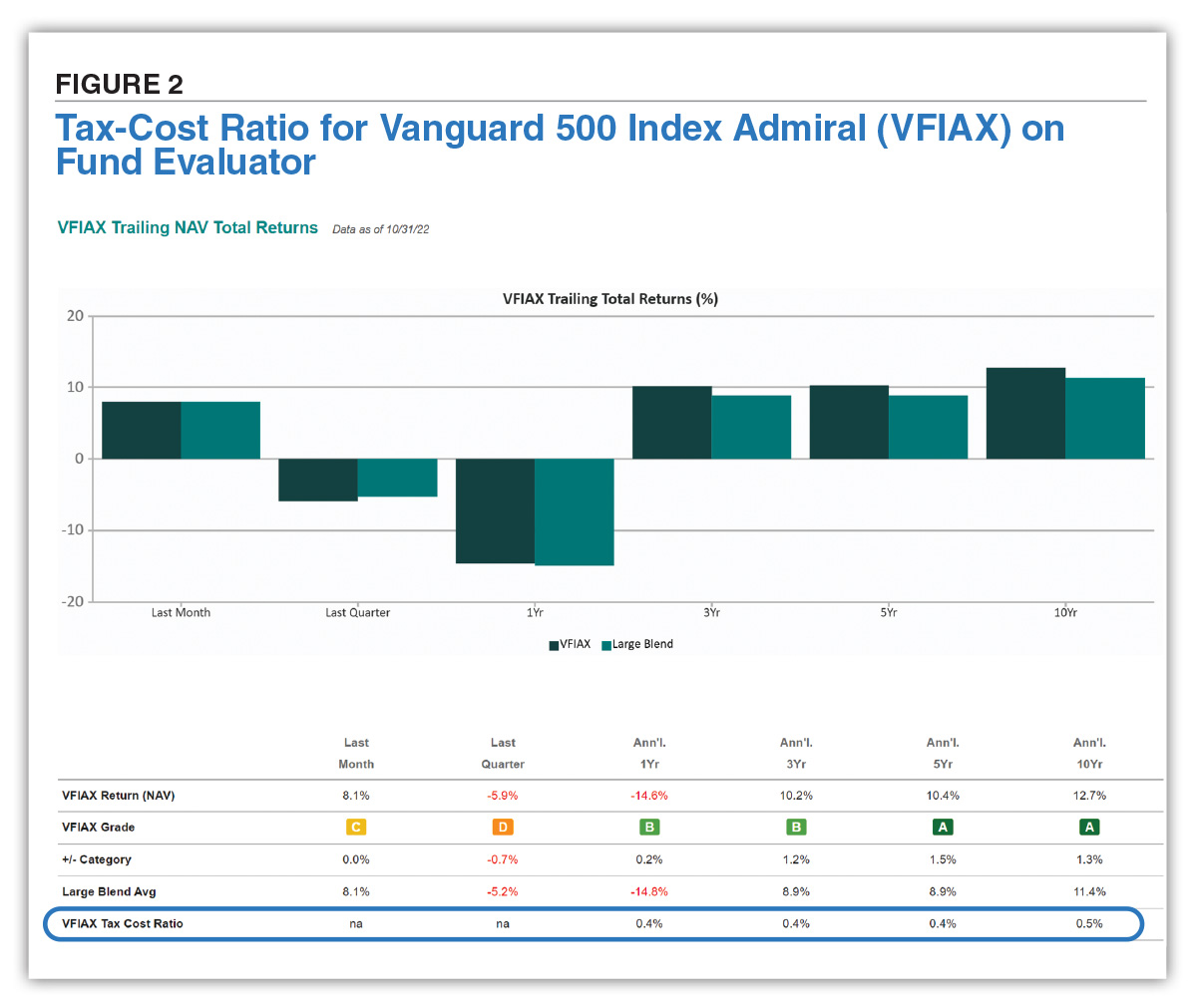
AAII members can find the tax-cost ratio for any U.S.-listed mutual fund or ETF on a fund’s Evaluator page. To access it, type a fund’s ticker symbol or name into the search bar located at the top of most pages on AAII.com and select the fund when it appears on the drop-down list. Then, scroll down until you get to the Trailing NAV Total Returns section. The tax-cost ratio is displayed in the table located in this section.
Figure 2 shows the tax-cost ratio for Vanguard 500 Index Admiral fund  (VFIAX), a widely held mutual fund. Its three-year average annualized tax-cost ratio is 0.4%, meaning investors who held the fund in a taxable account lost an average of 0.4 percentage points of their return to taxes over the last three years.
To compare tax-cost ratios for similar funds, go to our Mutual Fund Guide or ETF Guide. In both, you can see tax-cost ratios for all funds in a category in a sortable listing. A+ Investor and Platinum subscribers will also find the tax-cost ratio conveniently included in the results of the Funds+ Screener and ETF+ Screener.
AAII How-To

Investor Professor

Portfolio Strategies

No comments have been added yet. Add your thoughts to the discussion!
You need to log in as a registered AAII user before commenting.
Log InCreate an account