


Related

ETFs and Mutual Funds
Using a bottom-up approach to pinpoint companies set to be much bigger in five to 10 years.

Charles Rotblut leads a class in AAII's new Essential Investing Video Course. Go to https://www.aaii.com/ves for more information and to subscribe.
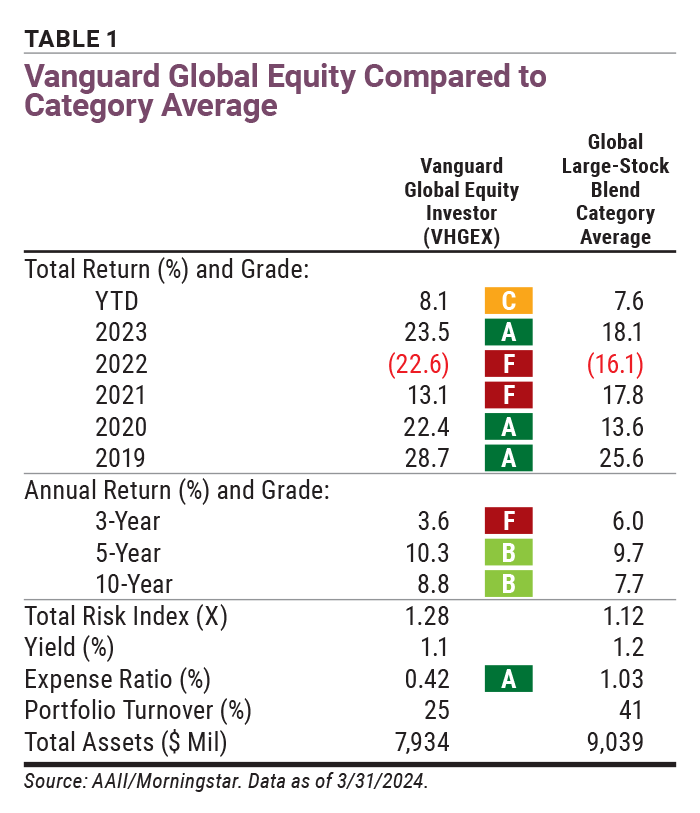
Growth stocks exerted muscle in 2023 and are showing no sign of slowing down. In early April, Charles Rotblut and Cynthia McLaughlin sat down with Michael Masdea to discuss the Vanguard Global Equity fund  (VHGEX). Masdea is a portfolio manager for Wellington Management, a subadviser to the fund. He focuses on the growth allocation in the portfolio. The fund invests in U.S. and foreign securities and a mix of growth and value stocks.
Cynthia McLaughlin (CM): Could you briefly explain your approach to growth investing?
Michael Masdea: It’s our belief that, over time, profit growth is what really drives securities. As so, we see a world where demographics are getting more challenging. This means more of the global economic growth is going to have to come from productivity.
We try to leverage our backgrounds. My comanager Brian Barbetta and I have a combination of engineering and technology experience. We also have private and public investing experience. Both of us have spent decades focused on disruptive innovation. It is our belief that this is one way to find structural growth in a world where growth is becoming more challenged. Finding truly innovative companies and really big things happening in the world allows you to identify companies that are going to be much bigger in five to 10 years, have much bigger profit pools and quite a bit of profit growth. It’s our belief that this is what ultimately drives profitability over time.
Sometimes the market gets a very short-term focus. Over the course of an economic cycle, it’s really that type of profit growth—structural profit growth—that doesn’t depend on the economy. It’s our fundamental belief and why we bring that aspect to this portfolio.
CM: How does company size fit into your investing style? Small cap versus mid cap versus large cap, for instance?
In an ideal world, you buy a stock when it’s a small cap and sell it after it becomes a mega cap. In reality, we are open to stocks of any market capitalization with a minimum level of liquidity. We need to be able to buy and sell without the stock’s price moving substantially. If there is a stress situation, we want to be able to get out of that security. We tend to look more at the float, meaning the percentage of a company’s shares available for trading, and the liquidity of the security. There are situations where a larger-cap stock is less liquid than a smaller-cap stock. It’s not always 100% correlated with market-cap size.
When we first started this strategy, nearly nine years ago, we expected to see a smaller-cap bias. That is because we expected a lot of innovation on the small-cap side. We certainly found that, but we also found a tremendous amount of innovation on the larger-cap side.
One of the dynamics that has driven the renaissance of large-cap innovation is the access to data, and the ability to spend money to innovate. As things like machine learning and artificial intelligence (AI) are introduced, it allows these large companies to get better more quickly. It’s a virtuous cycle. That’s why you’ve seen these large companies get even larger.
One of the interesting things about generative AI is there are companies throughout the economy that are leveraging these technology tools. This is one of the fun things we look at. We look for that paper company, packaging company, logistics company or materials company leveraging innovation to grow faster than its peers. Generative AI has the ability to continue benefiting these very large companies.
AI is bringing down the cost and the access, making it so that we can go out and do something today by leveraging these tools in a meaningful way without having to spend a lot of money. This is democratizing at the same time. It might take $100 billion to develop one of these models, like we’re seeing from ChatGPT, but there are going to be folks leveraging that model and spending very little money to do really interesting things that would have required hundreds of millions of dollars in the past. I think we’re going to continue to see lots of interesting things happening across the whole market-cap spectrum.
I also think it’s going to be interesting to see what happens with regulation around these large caps that are becoming so big and important. There’s a lot more noise around the role that government should play. We’ve already seen the government intervening in the semiconductor market.
Dynamics are making it unclear how it’s going to pan out in terms of the market-cap distribution. We try to be agnostic, open our eyes, do the fundamental research and work on a company-by-company basis to figure it out.
Charles Rotblut (CR): Since many of these types of companies invest heavily in innovation, what metrics do you look at to determine a valuation?
We’d like to look at free cash flow, but the reality is we need to understand what a company’s business model is going to look like in five to 10 years. We want to see a very profitable business model that we can value. You can look at free cash flow or earnings.
Ultimately, the company needs to not over dilute its share count. It needs to have a model where its investment rates aren’t sustained at the level where it is not possible to drive earnings in the future.
We spend a lot of time trying to understand what a company looks like in five to 10 years. What does its business model look like and how does it get there? What is the revenue required to get there? How are we going to derive its profit and does that fit with what we think is possible? Does that fit with the way management thinks about managing the business?
Then we can model an earnings-based valuation for the company. You can either look at free cash flow or earnings to make sure that they’re actually going to be able to produce profit growth that will justify a much higher security price.
CM: What would lead you to sell a stock?
There are three reasons we sell a stock.
Sometimes we make mistakes. We’re estimating what we think the future is going to look like five to 10 years out. Good investors are right, half the time. We’re wrong on the fundamentals sometimes and this causes us to sell the stock.
The second reason is if the valuation no longer makes sense. If growth is already priced in by the market, we will sell the stock.
The final reason we sell is if we lose faith in the people who are running the company or the ability of the company to execute what we think is necessary for success. Such a critical piece of a company is the combination of management and culture. We tend to hold securities for five to 10 years.
CR: When looking at innovative companies, what suggestions can you give investors about avoiding pitfalls?
I can tell you what we do. I think one of the biggest pitfalls is getting caught up in the hype and not really grounding yourself around the reality of how things work.
I’ll give you an old example. We were looking at virtual reality and augmented reality 10 years ago. I’m a tech geek. Nothing got me more excited than this world of virtual augmented reality. Part of my job is to figure out if it is going to be a reality or not and why.
One of the things that we considered back then is whether a company was going to be successful as a virtual/augmented reality company. It wasn’t just about creating goggles. It was about a whole experience within an ecosystem.
It was very clear back then that the whole ecosystem wasn’t on board. The company was not developing the software and it was not creating the ecosystem to be successful. That was a huge hype cycle that we knew was going to burst.
When you’re investing in innovation—things like AI, electric vehicles (EVs), climate change or a revolution in health care, such as the sequencing of the DNA and what it’s unleashing—you really need to make sure you’re not investing in an idea. You need to understand whether there is a reality behind this idea. Are all the pieces coming into place? What does it look like for them to be successful?
It’s a fascinating time right now with AI. There are clearly areas where there are use models that are working. There are also very clearly areas where there is a tremendous amount of hype. You’ll sit down with a company and ask what they are doing on AI. They’ll talk about how they’re leveraging AI, but it’s really nothing. They’re spending a small fraction on the technology and it really hasn’t made a meaningful difference.
I think making sure you don’t get caught in the hype cycle is the most important thing you can do. Sometimes the hype is built on reality, but a lot of times it’s not.
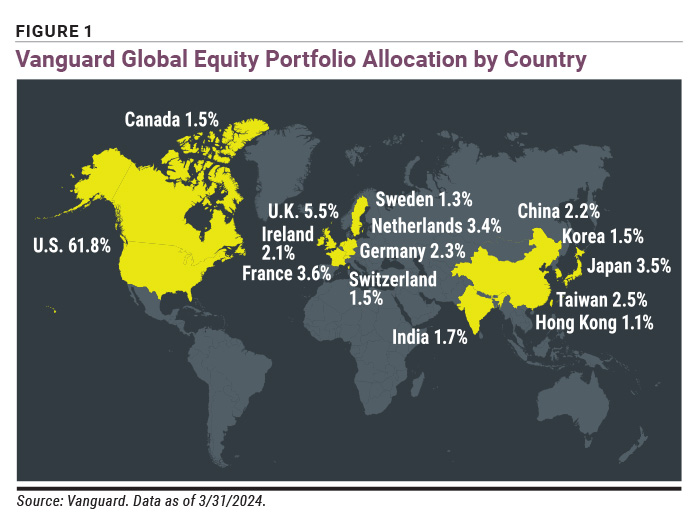
CM: Since the Vanguard Global Equity fund has a global portfolio, how do you determine how much to allocate to domestic versus foreign markets and, within foreign, how much to developed versus emerging markets?
We have 55 career global industry analysts with over 1,000 years of experience combined. We really tap into them. This is a bottom-up portfolio. It is not a top-down portfolio, where you identify a trend and invest in it. It’s company by company. Our analysts cover all regions, all sectors and all market caps. We sit down with them to try to understand which companies have the ability to grow, don’t depend on the economy and are going to be much bigger in five to 10 years. Then we spend a lot of time digging in.
To the point about emerging markets and developed markets, the interesting thing is that we find innovation everywhere. We find it in emerging markets, in developed markets and everywhere in between. If you look at venture capital—which we find to be a decent indicator of where innovation is happening—the majority of investing is now outside of the U.S. Much more innovation is happening around the world: throughout Southeast Asia, parts of Europe and into India and other areas.
The trend is clear that, over time, we expect increasing innovation and increasing structural growth to be found outside the U.S. That said, there’s a lot happening in the U.S. right now, especially as you get into AI and generative AI. With health care, there’s a lot going on in Japan, China and other areas. It’s an incredibly rich innovation world out there right now, everywhere. We see that trend over time moving more and more toward developing markets and some of the non-U.S. markets.
CR: Do you operate without a set allocation? Are you letting the individual companies determine what your allocation is?
Yes, we don’t have any top-down rule. We’ve had a substantial overweight to China at various points in the life of our fund. We’ve also had substantial underweights to China. Both came from a bottom-up approach of analyzing the companies. We need to know the companies and the sectors really well. We work with these industry analysts who have spent 20 years of their lives focused on one sector and the companies.
We do, of course, look at the overall portfolio to understand concentration, risk, correlation risks and other things that might emerge from our bottom-up process. For example, we might have a massive bet on a currency that we’re not expecting.
CM: Both recently and since 2010, the S&P 500 index has outperformed global indexes. Some investors would view this as a reason to not invest in foreign markets. What is your counterargument?
I wouldn’t argue for or against that. I would argue that the right thing to do is to find the companies that are growing their profits sustainably with profit valuations that are reasonable relative to what we’re modeling. It’s quite possible that we are in an era when owning the S&P 500 and owning domestic securities in the U.S. is a better way to invest. It’s also quite possible that we’re on the verge of a massive explosion in emerging markets.
I’m not good at timing markets. I find it to be very difficult to make top-down calls on markets and industries and where to be exposed. I’ve found that it’s easier to get good performance by doing work on companies and understanding which companies have a lot more control over their destiny. I especially prefer companies that are innovative rather than holding a collection of companies and an index.
What we try to really understand is whether a company has geopolitical risk. Does it have risk from regulation? Does it have a differentiated approach that’s going to allow it to grow much faster than its peers? These are the types of questions that we ask. We find that doing that on a bottom-up, company-by-company basis, you end up with a certain exposure to the U.S., emerging markets and others.
CM: In terms of multinational companies, is there any consideration in favor of an international company versus a U.S.-based company that does a lot of business with foreign entities?
We look at the business first to make sure this is a business we believe can grow. That is the starting point. We spend time thinking about management and the structure of the company.
When you talk about domicile and multinational, geopolitical issues increasingly play a pretty big role in how to think about the risks or opportunities facing a company. A decade ago, or even more, we were headed to a world where everything was global. There was a tremendous advantage to knowing how to navigate that. We are now in a world where it’s going in the opposite direction and there are potential disadvantages with exposure to certain geographies. We really think about an individual company’s path to success, and how that’s aligned with the current geopolitical dynamics.
A good example is semiconductors and what’s happening with the semiconductor supply chain. You have companies like Nvidia Corp. (NVDA) that are not able to sell a decent chunk of its production into China anymore because of geopolitical concerns about the power of AI and the role that it will play in governments going forward. The multinational piece is very important. You have to go a couple layers deeper to understand how it’s going to impact the business and to understand if that’s an advantage or a disadvantage.

CM: Are there any misperceptions or misconceptions about allocating to or investing in foreign markets that you would dispel?
That’s a great question. One of them is that a lot of people think there’s not much innovation happening in foreign markets. I don’t think that’s true at all. There’s quite a bit of innovation and really interesting growth in companies. We’ve seen this over the many years of investing.
We’ve seen a real maturation of the quality of management, in the governance structures, as you move outside the U.S. This was not the case a long time ago.
We’ve seen a real improvement in liquidity in foreign markets. I think they are very accessible markets as we look to the future. They’re going to be really important to growth in the global economy.
This doesn’t mean that the U.S. and Europe still won’t be important. Rather, I think there are markets with tremendous potential and all the pieces that are falling in place. We’re seeing a tremendous amount of growth and improving corporate governance in Japan right now, for example. That’s only accelerating. India is a fascinating market right now and it is quickly evolving. Many opportunities are there.
There are a lot of positive trends happening outside the U.S.
CM: Is there anything we haven’t asked you that we should?
That’s a good question. I would say two things. There is tremendous opportunity when you look beyond the short-term dynamics of the marketplace. We often see the market being too focused on the short term and missing the long-term opportunity. That tends to be very fertile ground for someone like me to find good opportunities.
The other one is accelerating innovation cycles. They are really getting faster and bigger. The technology is less dependent on human intervention to be successful, and that’s accelerating.
I think there has been, for many decades going back to the 1900s, reversion to the mean. It was a pretty sound philosophy to investing. We’re in a world now where the assumption that everything’s going to revert to the mean is probably not correct—certainly not in a lot of the names we’re looking at.
There’s more sustainable growth in certain transformative technologies than people are probably assuming. There are some parts of this software development cycle that continue to consume the income statements of many industries. That’s not going to revert anytime soon.
For complete stats on the Vanguard Global Equity fund, see its Fund Evaluator page.
ETFs and Mutual Funds


BARRY J from TX posted over 2 years ago:
ROBERT A from NC posted over 2 years ago:
BARRY J from TX posted over 2 years ago:
You need to log in as a registered AAII user before commenting.
Log InCreate an account