


Related


First Cut Stocks
A high dividend growth rate must be assessed for sustainability, while extremely high dividend yields may signal that the market is expecting a cut in the dividend payment.
by John Bajkowski | May 2024

The Dividend Aristocrats are a subset of the S&P 500 index composed of companies that have consistently increased their dividends. Cash dividends directly contribute to the total return and help to limit downside price risk, provided the market feels that the dividend is secure.
There are currently 68 Dividend Aristocrats. Dividend Aristocrats must be members of the S&P 500, have increased their dividends every year for at least 25 consecutive years, have a float-adjusted market capitalization of at least $3 billion and have an average daily trading value of at least $5 million.
The First Cut table below shows both the 10 Dividend Aristocrats with the highest five-year historical dividend growth rates and the 10 Dividend Aristocrats with the highest dividend yields (indicated annual dividend divided by price). The five-year average yield shows the typical yield for each stock. The earnings growth rate illustrates the trend in bottom-line profit growth.
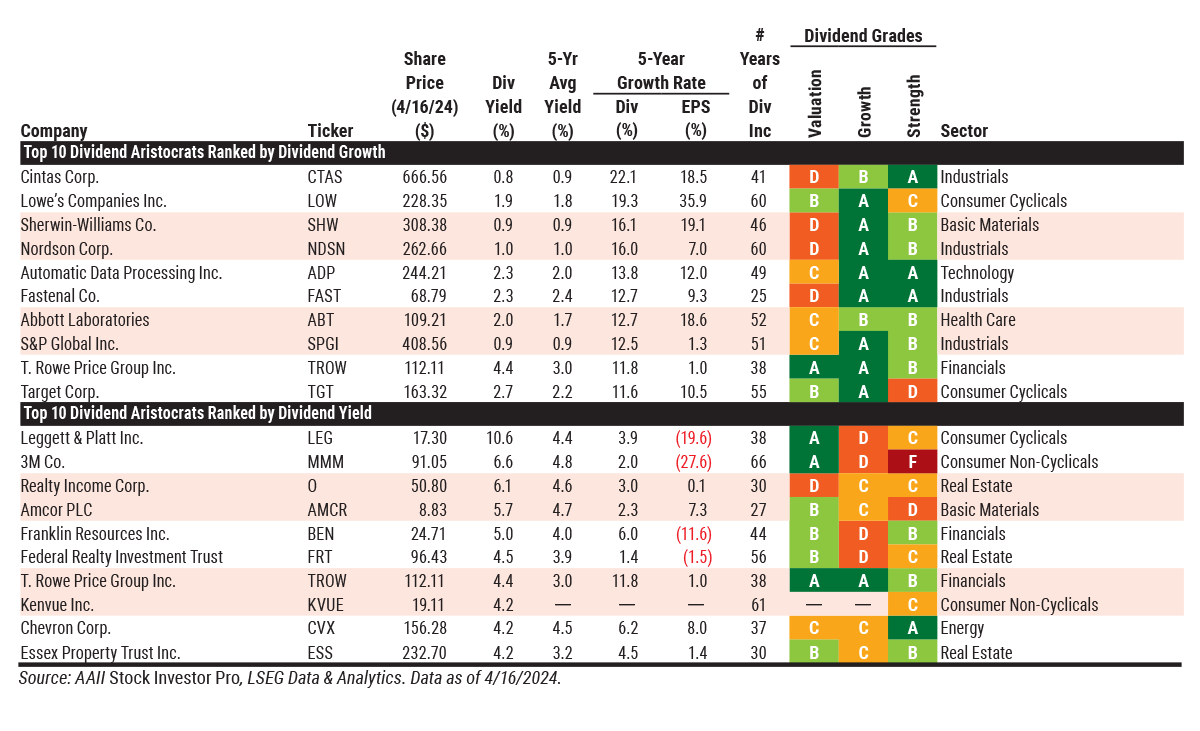
AAII’s Dividend Investing grades dividend stocks on three areas. The Dividend Valuation Grade considers the current dividend yield relative to its historical average, providing higher grades for companies that have been repurchasing their shares. The Dividend Growth Grade considers both recent and long-term dividend growth, cash flow and return on assets. The Dividend Strength Grade considers elements such as the dividend payout ratio, level of financial liabilities to assets, interest coverage ratios and dividend sustainability.
Not surprisingly, the Dividend Aristocrats with higher historical dividend growth have lower dividend valuations. Cintas Corp.  (CTAS) has a current dividend yield of only 0.8%. T. Rowe Price Group Inc. (TROW) is the only Dividend Aristocrat to make it into both groups. It has a current yield of 4.4% and an 11.8% five-year dividend growth rate. The stocks with higher dividend yields tend to have lower dividend growth rates; four of them have had earnings contract over the last five years. Investors need to exercise caution when ranking for extreme values. The future sustainability of a high dividend growth rate must be assessed, while extremely high dividend yields may signal that the market is expecting a cut in the dividend payment.
First Cut Stocks


No comments have been added yet. Add your thoughts to the discussion!
You need to log in as a registered AAII user before commenting.
Log InCreate an account