

Related

Behavioral Finance
Developing emotional intelligence and being mindful of cognitive biases can help investors navigate the market more effectively and make better-informed decisions.
by Andrew Gomes | May 2024

Developing emotional intelligence and being mindful of cognitive biases can help investors navigate the market more effectively and make better-informed decisions.
Emotional intelligence, optimism bias and risk perception interconnect to influence investing decisions, revealing the significant impact of psychological factors on financial behaviors.
Researchers examined investors’ decision-making processes by assessing their levels of emotional intelligence and its correlation with optimism bias and risk perception, utilizing a combination of surveys and behavioral analysis. Emotional intelligence is the ability to perceive, understand and manage one’s own emotions and those of others.
Figure 1. Conceptual Framework
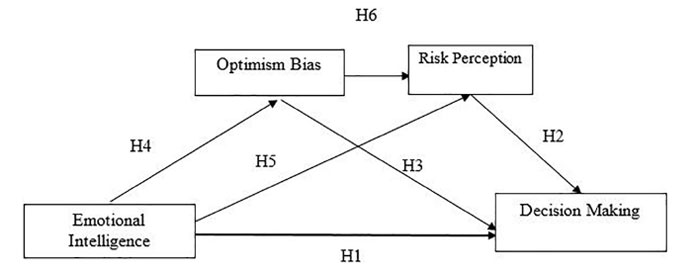
The study illuminates the nuanced relationship between emotional intelligence and decision-making by introducing two mediating variables: optimism bias and risk perception. Optimism bias, the tendency to harbor a positive outlook despite reality, can significantly skew investment decisions. This bias, when coupled with an individual’s emotional intelligence, can lead to a distorted assessment of investment opportunities. Similarly, risk perception, an individual’s subjective judgment about the severity and probability of risks, acts as a critical mediator.
The findings align with the broader principles of behavioral finance, which assert that emotional intelligence significantly impacts investment decisions. Higher levels of emotional intelligence correlate with more nuanced risk perception and a balanced approach to optimism bias. Investors with higher emotional intelligence are better equipped to navigate the complexities of the financial markets, making decisions that are more informed and prudent.
For investors, this underscores the importance of self-awareness and emotional regulation in navigating the often-tumultuous financial markets.
Source: “Mediating Role of Optimism Bias and Risk Perception Between Emotional Intelligence and Decision-Making: A Serial Mediation Model,” by Chaoran Chen, Muhammad Ishfaq, Farzana Ashraf, Ayesha Sarfaraz and Kan Wang; Frontiers in Psychology, June 3, 2022.
Behavioral Finance

Behavioral Finance
Behavioral Finance

JOHN L from NJ posted over 2 years ago:
ROBERT A from NC posted over 2 years ago:
Don P from USA posted over 2 years ago:
You need to log in as a registered AAII user before commenting.
Log InCreate an account