

Related

Stock Strategies
Most prior rate-hike cycles have been followed by recessions, so-called hard landings. Only one of the 11 previous rate-tightening cycles has resulted in a perfect soft landing.

Charles Rotblut leads a class in AAII's new Essential Investing Video Course. Go to https://www.aaii.com/ves for more information and to subscribe.
As we went to press, the Federal Open Market Committee (FOMC) had raised its target for the federal funds rate by a cumulative 225 basis points (bps). More rate hikes are expected this year, including following the two-day meeting scheduled for September 21 and 22.
Most prior rate-hike cycles have been followed by recessions, so-called hard landings. This month’s trend chart—from FRED, the St. Louis Federal Reserve’s economic database—shows this. The shaded columns are periods when recessions have occurred. The time span and the annotations chosen are based on a February 2022 presentation by economist and former Federal Reserve vice chairman Alan Blinder at Princeton University.
Only one of the 11 previous rate-tightening cycles has resulted in what Blinder described as a “perfect soft landing.” This was the 310-basis-point tightening cycle that occurred between December 1993 and April 1995. Real (inflation-adjusted) gross domestic product (GDP), according to Blinder, slowed from about 4.5% to 1.3% before rebounding.
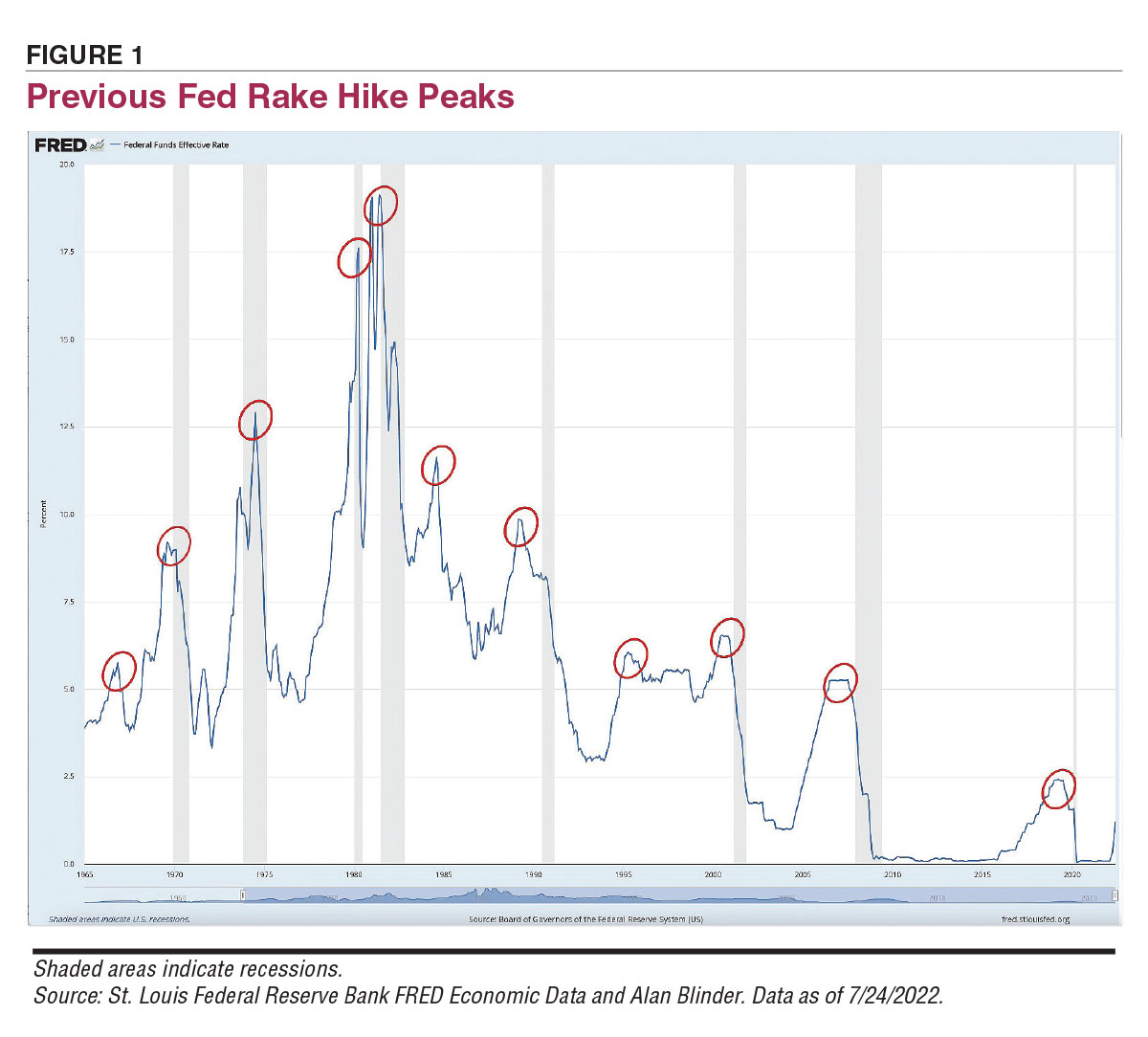
Two rate-hike cycles were followed by very hard landings. Real GDP contracted by 2.7% following the 1972–1974 rate-hike cycle. Interest rates were raised by 960 bps over that period. During the Great Recession of 2007–2009, real GDP plunged by 3.8%. The severe economic downturn was preceded by the 425-basis-point rate-hike cycle between June 2004–June 2006. In both cases, there were other compounding factors (surging food prices and the oil embargo in the 1970s, and the joint bursting of the housing bubble and near collapse of the financial system in the 2000s).
Six rate tightening cycles were followed by not-as-hard contractions of 2.2% (the 1977–1980 tightening cycle) or less.
Notably, there is a lack of a clear correlation between the cumulative amount that interest rates have been raised and the severity of the economic contraction that followed. The Fed raised rates by 540 bps between 1967 and 1969, but real GDP fell by just 0.6%. The 425-basis-point rate hike in the mid-2000s was followed by a 3.8% contraction. This is partially due to the impact other factors have on the economy.
Thus, while the historical odds are against a soft landing, it’s difficult to predict whether the economy will feel a bump or a significant jolt following the current rate-tightening cycle.
Stock Strategies


STEVEN H from CA posted over 4 years ago:
You need to log in as a registered AAII user before commenting.
Log InCreate an account