

Related

Beginning Investor
How to build up your savings, pay down debt and eventually allocate money to investments.

When you should begin getting serious about your finances is also when you might have the most debt in your life—just after graduating college. Many of my peers are still overwhelmed with student loan debt in their 30s. I was lucky to have less than most, but if I didn’t prioritize paying it down when I first got a job, I would be in a very different financial situation today. This article teaches you how to build up your savings, pay down debt and eventually allocate money to investments.
The U.S. average amount of student loan debt in 2024 is $37,850, according to BestColleges. When it comes to student loans, federal loans are more common and a better choice than private loans. This is because the government can provide more “perks” than a private entity.
In Erin Lowry’s book “Broke Millennial,” she discusses the positives of choosing federal loans: 1) They are subsidized, which means they do not accrue interest while you are in school; 2) they provide grace periods so you can delay making the first payment until you are out of school; and 3) once you begin paying the loan back, the repayment plan will be based on your income, which allows you to pay what you can afford in smaller increments.
To get to know your debt a little better, you should know what the interest rate is on your student loans. The interest rate is the percentage you will pay on top of your initial loan value—it is essentially the cost of borrowing the money in the first place. According to Education Data Initiative, the current average student loan interest rate is 6.87%. Interest rates can fluctuate based on the economic environment, but generally anything above 6.0% is considered high-interest debt. This cutoff will determine what you should pay down first if you have other debt with lower interest rates.
For some perspective, investment returns generally outpace these loan interest rates: Large-cap stocks have an aftertax return of 8.5% over the long term. In this case, the return is good for your investments, but that level of interest on your student loans would quickly increase your level of debt to an amount no one wants to say out loud!
Though it may be tempting to start paying off your debt right away, you must make sure that you have some emergency savings in place. AAII founder James Cloonan also encouraged this in “A Lifetime Investment Strategy.” If you begin paying your student loans with no other money to your name, you will go further into debt any time you need to replace your laptop, pay a medical bill or deal with another fun surprise that comes to take its share of your earnings.
Having a budget in place to know exactly how much money you are making each month will help you determine how much you can save for emergencies and what you can allocate to pay off your debt. The amount you are able to pay on your student loans each month should be included in your fixed expenses. Fixed expenses cover what you know you will have to pay each month like rent, utilities, insurance and subscriptions. Once you have the total amount, subtract all your fixed expenses from your monthly income to see what is left.
It is generally advised to save around 20% of your monthly income. However, when paying down debt, you may not be able to reach this goal. That is OK! Instead, it might help if that 20% also includes your monthly loan payment to start. Whatever is leftover can be added to your emergency savings.
Using AAII’s PRISM Wealth-Building Process, Figure 1 presents a one-page plan for saving while paying down debt and investing once the value of your savings exceeds your amount of debt.
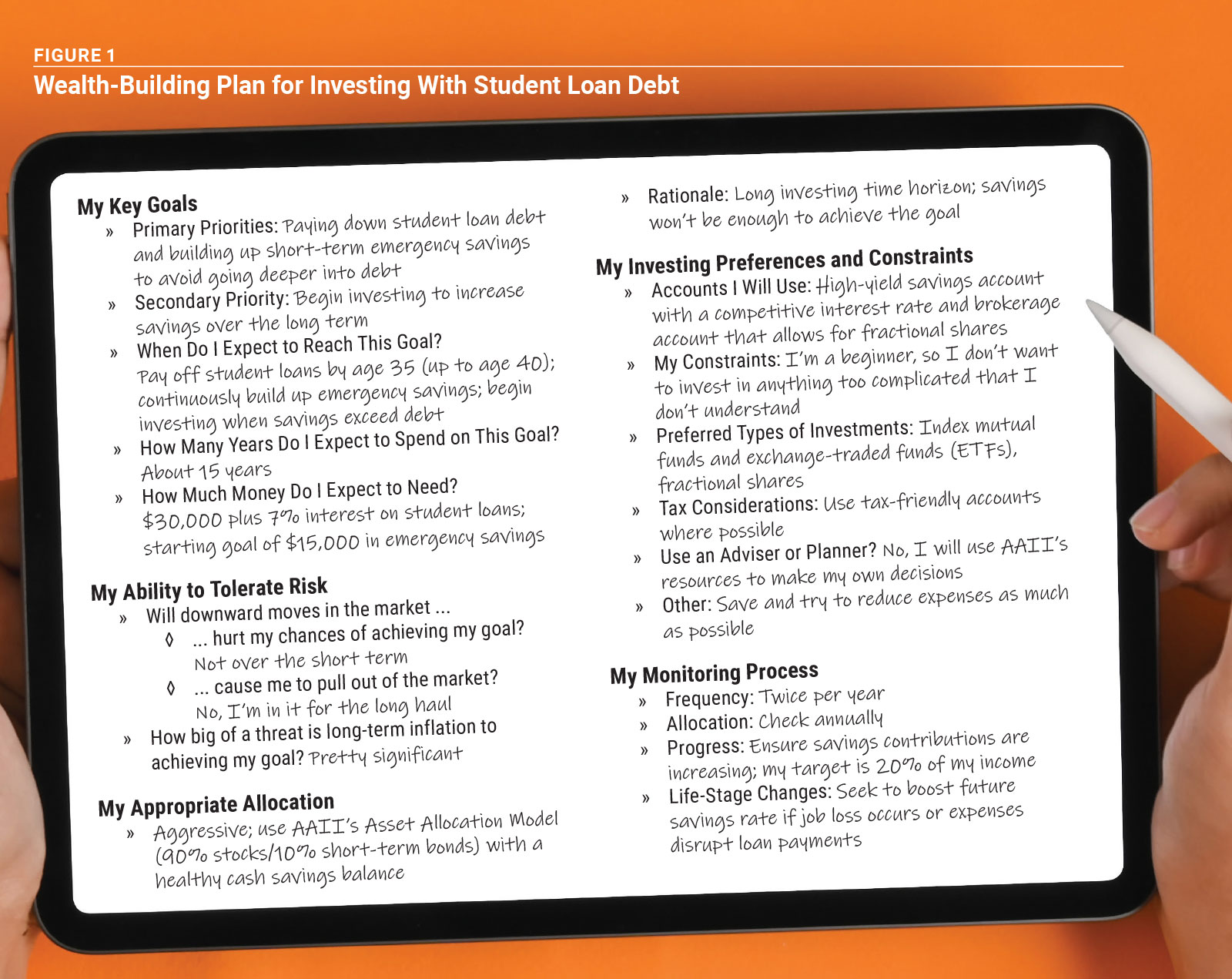
For this example, we assume student loans of $30,000 with interest of 7% and a goal of paying them off by age 35 (with some leeway up to age 40). In addition to building up an emergency fund, a high-yield savings account with a competitive interest rate would be used to ensure that your savings’ buying power doesn’t lose value due to inflation over a longer investing period.
As a beginning investor, you can take advantage of fractional shares, which allow you to buy a portion of a share of a stock or an exchange-traded fund (ETF) based on the dollar amount rather than a whole share. When you’re ready to choose your brokerage account, find out which brokers allow fractional shares before jumping in. Note that fractional shares are not available for every stock or ETF, even if offered by your broker. Index mutual funds and ETFs are also a good place to start if you have enough money for whole shares.
Though the one-page plan makes it easier to visualize your goals, it doesn’t diminish the repercussions of not paying off student loans in a timely manner. They are extremely difficult to get rid of, even if you end up declaring bankruptcy.
If you pretend that your student loans don’t exist when you start your career and allow them to sit pretty until you think you will have enough money to pay them, not only will your debt increase exponentially, but you will be denied access to achieving other adult goals like buying a car or a house. In order to level up, you first need to dig yourself out of the hole. Student loans will haunt you, your finances and, specifically, your credit report, until you pay them off—or until America figures out how to make college more affordable for individuals. Good luck on your repayment journey!
Beginning Investor

Beginning Investor

Beginning Investor

KENT M from AZ posted over 2 years ago:
ROBERT A from NC posted over 2 years ago:
BARRY J from TX posted over 2 years ago:
You need to log in as a registered AAII user before commenting.
Log InCreate an account