

Related

Computerized Investing
Fees, more than anything, will affect your long-term returns, so pay close attention to them when choosing your broker.
by Anine Sus | October 2023

 Opening a brokerage account is the first step to making your debut in the world of investing. Though it can be daunting, it will be one of the most important investing decisions you make in your lifetime. Don’t worry—your decision won’t be written in stone for the long term; I discuss how fees work for transferring or closing an account if one doesn’t work out. AAII has resources that can help beginners find the right broker, and this article acts as a conduit for the most pertinent information.
First, you should choose a broker that supports what you want to invest in. You might not know exactly where the best place for your money is, but you can choose a broker with all the basic investment vehicles available to you on a commission-free basis, or for a relatively low fee. Depending on how involved you want to be in the investing process, you can choose a broker who will do the investing for you, or choose a broker based on how you want to invest. Personally, I heavily referenced “Comparing Discount Brokers and Apps Given Recent Industry Changes” in the January 2021 AAII Journal when opening my brokerage account.
Almost all the brokers listed in Table 1 of the article from 2021 have no minimum dollar amount required to open an account, and some have no account fees whatsoever.
Fractional shares are gaining in popularity among brokers; they allow you to buy securities in dollar amounts instead of whole shares. If you are starting to invest with a small amount of money, you might gravitate toward a broker that offers fractional shares to take the price of an entire share of a stock or exchange-traded fund (ETF) out of the equation. Keep in mind that just because a broker offers fractional shares doesn’t mean that every single investment is available for fractional share purchases.
Stocks and ETFs are offered on a commission-free basis by most brokers, so your decision can be determined by looking at other fees brokers will charge.
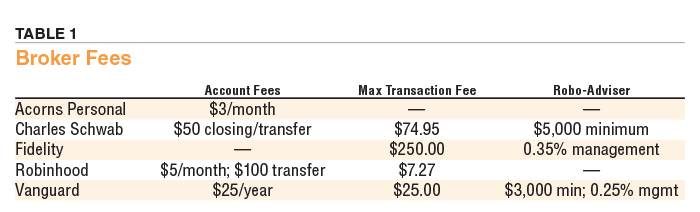
Many brokers charge to transfer your account to another broker or close the account. For example, Charles Schwab has a $50 fee per transfer or closure. Others charge $75 or base their fee on a percentage of your account balance. There are some trades where transaction fees apply, so choosing a broker with a low maximum transaction fee is also a good idea to make sure your broker won’t be taking too much off the top.
Some newer brokers like Acorns charge a monthly fee to manage your account for you, so all the fees are paid up front instead of per trade. You can also choose from brokers’ premium services if you feel you need broker-assisted investing advice or a robo-adviser (more on that further in this article). Calculate any flat fees as a percentage of the size of your account: The $3 per month that Acorns charges may not seem like much, but it equates to a costly 3.6% annual expense on a $1,000 balance.
The table below includes updated fee information for the top brokers as of 2023.
How much money you put in your brokerage account and when are entirely up to you and your financial situation. Once you know how much money you have available to invest, you can set up automatic payments to add money on a monthly basis, a biweekly basis, or some other interval depending on what your broker allows. For instance, Fidelity allows users to schedule automatic contributions no more frequently than monthly, while Schwab allows you to schedule deposits weekly. You can connect your checking or savings account to your brokerage account to transfer funds into it. I personally have mine connected to two of my savings accounts: my emergency savings account that I first used to fund it and my high-yield savings account I opened to save for my short-term goals.
Once you fund your brokerage account, be sure to actually invest that money into a stock, ETF, mutual fund or other security, otherwise the money will be sitting in your cash balance and won’t be doing much for you. You would think this is self-explanatory, but author of “Financial Feminist” Tori Dunlap related a horror story about an older woman who made contributions to her retirement account for decades but never selected securities to invest that money in. Ultimately, when it came time for her to retire, she didn’t have enough money—even with Social Security benefits. Don’t let that be you!
Before artificial intelligence (AI) really popped off, there were robo-advisers. As the name suggests, robo-advisers are nonhuman entities that give you financial advice and can manage your brokerage account for you. These are options for hands-off investors who don’t want to be involved in the decision-making process because they don’t have the time or the patience for investing. If you want control over what you’re investing in and feel the need to be more involved, a robo-adviser likely isn’t for you.
Each year, AAII enlists Ken Schapiro of The Robo Report to provide an overview of the robo-adviser industry and how a selection of robo-run portfolios are performing. The latest, “Turmoil in the Robo-Advice Industry, Plus the Best Robo Platforms” in the June 2023 AAII Journal, highlights Wealthfront as the best overall robo-adviser. It turns out that Wealthfront was also one of the first robo-advisers developed in 2008, so the company has had the advantage of time to fine-tune its services compared to other, newer robo-advisers on the market.
Though math and numbers are not my chosen language, in order to invest, you must be able to understand the materials your broker sends to ensure your investments are in good hands. This includes account statements, tax documents and anything else with a lot of numbers that mean nothing until you learn how to decipher them.
Brokers are required to send you account statements on a quarterly basis, but you might receive them more often if you have high trading activity. My Schwab brokerage account provides monthly account statements, and on a quarterly basis it includes any “regulatory inserts” pertaining to taxes and any changes in the pricing of services or alterations to my account agreement.
Account statements include the starting value of your account for the period and any change in the value over this time, both in dollar amounts and percentages. Negative numbers will be in parentheses, indicating a negative change—but not a “real” loss unless you sell a security that has fallen in price since you bought it. You will find other charges here, like transfer fees for adding and/or removing money from your account. If your investments pay dividends, you can see their yields and the estimated amount of income you will receive from each holding for the year.
Account statements also provide the amount of your investment income that is federally taxable or tax-exempt. When it comes time to do your annual taxes, pay attention to the fine print on the Form 1099 your broker sends. It will include the interest and dividend income your account has accrued, along with any taxable capital gains you received. You could owe foreign taxes on some of your investments depending on where the companies are headquartered, which requires you to use a different method for filing. (I found this out the hard way!)
To narrow your search further, you can research if your desired broker provides the platforms and avenues for the interaction you will need.
Not every broker provides phone services, and some don’t provide 24/7 phone services, so you want to make your decision based on how you’d like to handle any communication with your broker. As a millennial, I loathe talking on the phone, so I chose email as my primary communication channel. In this case, it’s best to find a broker with 24/7 email options available, just for peace of mind in case something goes wrong. I’ve been investing for about a year and a half and haven’t had any reason to contact my broker—everything has gone smoothly so far!
If the broker has an app and you prefer investing from your smartphone, make sure you like the app and what it offers before making your decision. If you want a physical office in your area that you can pop into, this is another consideration. Newer brokers on the market are primarily hosted online and don’t have any brick-and-mortar locations—it allows them to offer you more cost-effective services in the long run.
Choosing a beginner brokerage account is a big decision for your financial future. If done right, this account should carry you through your investing years. If something changes—either in the account’s rules or in your situation—you don’t have to stay with your first broker out of any kind of loyalty. You should always do what works best for you and your investments. Ultimately, your wealth will be determined by what you don’t have to pay in fees. Fees, more than anything, will affect your long-term returns, so pay close attention to them when choosing your broker.
Computerized Investing

Computerized Investing


ED F from MA posted over 3 years ago:
ROBERT A from NC posted over 3 years ago:
BARRY J from TX posted over 3 years ago:
You need to log in as a registered AAII user before commenting.
Log InCreate an account