

Related

Financial Planning
The financial domain has a special place among the domains of life well-being because it is important on its own and because it underlies all other domains.
by Meir Statman | August 2024

I often note that the biggest risks in life are not in the stock market. If you want real risk, I say, get married. And if you want more risk, have children.
People laugh because the point is obvious. Yet that point is regularly lost when we speak about financial well-being, neglecting life well-being. I was motivated to write my latest book, “A Wealth of Well-Being: A Holistic Approach to Behavioral Finance” (Wiley, 2024), by reflecting on my own financial and life well-being and those of others. I share what I have learned and hope that my words will help you reflect on and enhance your financial and life well-being. We need financial well-being to enjoy life well-being, but it is life well-being that we seek.
Financial well-being comes when we can meet current and future financial obligations, absorb financial setbacks and keep driving toward financial goals, such as adequate retirement income. Life well-being comes when we live satisfying lives, full of meaning and purpose.
Life well-being has many domains, including those of family, friends, health, work, education, religion and society. People vary in their perceptions of life well-being and the relative importance of its domains. Religion is an important life well-being domain for some people, whereas others are atheists. Work is a prominent well-being domain for some people, whereas others count the days till retirement. Some sacrifice well-being in the domain of finance for well-being in the domain of family, choosing flexible work schedules that accommodate family. Others choose the opposite, sacrificing well-being in the domain of family for well-being in the domain of finances, working long hours that keep them away from family.
Life well-being is composed of three parts: experienced, evaluative and meaning (Figure 1). Experienced well-being, also known as emotional or hedonic well-being, refers to our momentary emotions such as happiness, sadness and anger. Evaluative well-being refers to our satisfaction with our lives. Meaning well-being, also known as eudaemonic well-being, refers to our assessment of the meaning and purpose of our lives. Life well-being, as used in my book, is about all the parts of well-being.
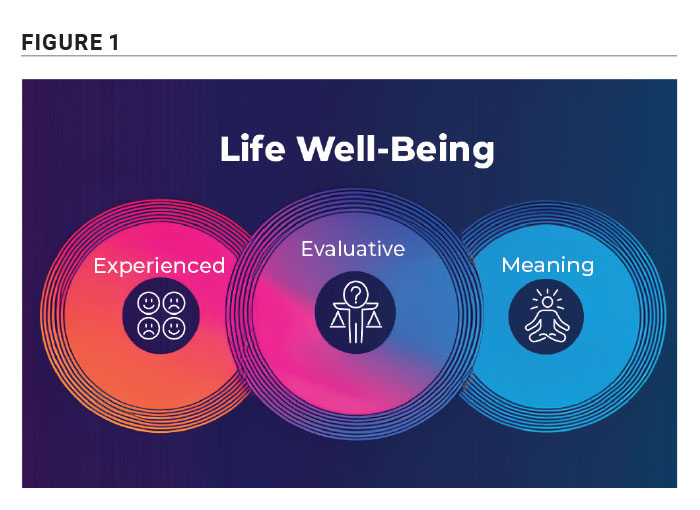
The financial domain is often overlooked or downgraded by both ordinary people and scholars. “To me, well-being means balance between work, friends/family, my relationships and my health,” said Jean, a 31-year-old American woman. “Each of these things definitely factors in, with maybe my relationships being the most important part.”
Jean did not mention the financial domain among the domains underlying her life well-being. And even when mentioned, that domain does not rank high. One survey found that the financial domain ranks no higher than the domains of family, work and health. Another found that it mattered little, much less than the domains of family, friends and health. Still another found that it ranks last.
Yet a survey reveals that 55% of Americans ranked finances as the major source of stress in life, followed at some distance by stress over work, health, family and social life. Indeed, high perceived financial well-being—measured by low stress over present finances and high security in future finances—is a key predictor of life well-being. It is comparable in magnitude to the combined effects of high job satisfaction, good physical health and solid supporting relationships.
The financial domain has a special place among the domains of life well-being because it is important on its own and because it underlies all other domains. We need finances to support ourselves and our families by paying for food and shelter. We need finances to maintain our health and that of our families by paying for the services of physicians and hospitals. We need finances to pay for an education that would qualify us for well-paying and satisfying jobs, careers and vocations. We even need finances to experience and express our religion.
Doug Lynam used to be a monk. Now he is a financial adviser. “For too long,” he wrote, “religion and money have been held separate, as if the very existence of one sully the other. But the cold hard truth of modern life is that we need money … even monks. I discovered this fact the hard way when our community went bankrupt.”
Ample finances enhance both evaluative and experienced well-being, as documented by psychologist Matthew Killingsworth. He measured evaluative well-being by the answers to the question: “Overall, how satisfied are you with your life?” And he measured experienced well-being by the answers to the question: “How do you feel right now?”
Killingsworth found that higher income enhances evaluative well-being, confirming a conclusion reached earlier by Nobel laureates psychologist Daniel Kahneman and economist Angus Deaton. But he overturned their other conclusion that experienced well-being ceases to increase once annual income reaches $75,000. Instead, Killingsworth found that higher income enhances both evaluative and experienced well-being at any level of income.
Killingsworth noted that Kahneman and Deaton asked people to recall yesterday’s experienced well-being. Yet, a gap likely exists between yesterday’s experienced well-being as recalled right now and yesterday’s experienced well-being as experienced right then. So, he instead measured current experienced well-being by smartphone answers to the question: “How do you feel right now?”
Higher income enhances experienced well-being by increasing positive feelings and diminishing negative ones. Higher annual income in the range below $80,000 is associated with higher positive feelings in four out of the list of five positive feelings: confident, good, interested and proud. It is associated with lower negative feelings in the entire list of seven negative feelings: afraid, angry, bad, bored, sad, stressed and upset.
Higher annual income in the range above $80,000 is associated with the entire list of five positive feelings, including inspired. It is also associated with lower negative feelings in four of the seven negative feelings: bad, bored, sad and upset. This implies that higher income, from low to moderate, enhances experienced well-being mostly by reducing suffering, as indicated by lower negative feelings. Higher income, from low to moderate, also enhances experienced well-being by a greater sense of control, measured by answers to the question: “To what extent do you feel in control of your life?” and greater financial security, measured by answers to the question: “Did you have trouble coping with regular bills during the last 15 days?”
Killingsworth found that higher income enhances both evaluative and experienced well-being, not ceasing at any level of income. Nevertheless, the magnitudes of well-being increments associated with income increments are lower when income is higher. For example, the difference in well-being between a family with a $20,000 annual income and one with triple that, $60,000, is about the same as the difference in well-being between a family with a $60,000 annual income and one with triple that ($180,000).
Ample finances enhance well-being by utilitarian, expressive and emotional benefits. Utilitarian benefits are the answer to the question: “What does something do for me and my pocketbook?” Expressive benefits are the answer to the question: “What does something say about me to others and myself?” Emotional benefits are the answer to the question: “How does something make me feel?”
The three kinds of benefits are evident in the words of Divya, a 33-year-old American woman. “My financial status enabled us to purchase this home that is well out of reach for many individuals in my age group and place in life. I felt proud that my family could make the decision to purchase this type of home.”
This home provides Divya with utilitarian benefits such as shelter, expressive benefits such as an emblem of high social status that is “well out of reach for many individuals in my age group and place in life” and emotional benefits in pride “that my family could make the decision to purchase this type of home.” Moreover, financial capital underlies all these benefits. Divya said, “My financial status enabled us to purchase this home.”
Meredith, another 31-year-old American woman, illustrated these benefits further, comparing her financial situation during her college days to her situation today. All throughout college she made $7.00 per hour, which was enough to pay for drinking on the weekends and going out with her friends. She knew she was poor, but it didn’t matter because all her friends were also poor.
Meredith’s well-being is higher now that her savings exceed those of people in her social comparison group: “Every time I see articles stating that most Americans don’t have enough in savings for a six-month emergency fund, I feel a LOT better about myself because I easily have that, and more.”
The wealthy—owners of extravagant financial capital—enjoy utilitarian benefits unavailable to owners of mere ample financial capital. Documentary filmmaker Abigail Disney, an heiress to the Disney fortune, acknowledged these benefits. “If you move up from coach to business to first class, you won’t want to go back to coach. And once you’ve flown private, wild horses will never drag you through a public airport terminal again.”
The wealthy also enjoy expressive and emotional benefits beyond those available to owners of mere ample financial capital. Disney continued, “I’ve never been much of a materialist, but I have wallowed in the less concrete privileges that come with a trust fund, such as time, control, security, attention, power and choice. The fact is, this is pretty standard software that comes with the hardware of a human body.”
Life well-being is enhanced when the three kinds of benefits are in balance. “Regarding the need for wealth, it is definitely better to accumulate as much as possible,” said Qiang, a 40-year-old Chinese man. “However, the need for wealth should not become a form of burden. It is something that cannot be overly pursued or ignored.” And Michael, a 71-year-old American man, said “I’ve seen people pursue [wealth] as a goal and screw themselves. You can’t exist without money, but achieving wealth was never a goal. Living a good life and being happy was more important.”
High aspirations, such as for high income in satisfying careers, motivate us to aim for high future life well-being at the cost of low present life well-being, as we apply ourselves to our studies and careers. Life well-being increases when situations improve to equal aspirations or when aspirations diminish to equal situations.
Gaps between aspirations and situations underlie the U-curve of life well-being by age, declining from young adulthood until middle age and then increasing afterward into old age (Figure 2). High aspirations relative to situations when we are young reduce life well-being but motivate us to push up future situations and life well-being, such as by acquiring education, switching jobs, initiating enterprises or migrating within a country or to another country.

Gaps between aspirations and situations widen in middle age as we find that we have not advanced in our professions as much as we had aspired, that our business plans did not succeed or that our paintings fit better over sofas than on museum walls.
Aging brings frailty, declining independence, loss of loved ones and the approach of death. Indeed, we tend to predict high life well-being in young age and low life well-being in old age. Yet we press down our aspirations following middle age as we become increasingly aware of our narrowing time horizon. We gravitate toward activities that are more pleasing than self-improving and we gradually accept ourselves for who we are rather than who we were supposed to be.
“That aging can make us better than ever may be the biggest dirty little secret of all time,” wrote consultant and essayist Bob Brody. He noted that eight out of every 10 deaths from the coronavirus in the U.S. have happened to adults age 65 and older, but at 68, much to his surprise, he finds his life to be decidedly wonderful.
He is now old enough to know that human lives, like all of nature itself, go in cycles. When he has a bad day, he knows what he never recognized as a young man: that tomorrow is likely to be better. And the older he gets, the more comfortable he feels in his own skin, accepting himself as he is. The many uncertainties that afflicted him while young—about his identity, role in the community and philosophy of life—have largely evaporated.
I am 77 years old now and can testify that my life well-being follows the U-curve. My life well-being today is higher than it was when I was young and much higher than it was when I was middle-aged.
We can think of life well-being as a portfolio of life domains, resembling the common portfolio of investments. Each domain, like each investment, offers returns, imposes risks and has links to other domains, resembling correlations among investments.
Few investors enjoy superb returns in all their investments, and few people enjoy superb well-being in all its domains. The return of marriage in the family domain might be exhilarating, uplifted by love and respect, but the return of children in that domain might be disappointing, diminished by children who lost their way. Yet the overall return of a life well-being portfolio, like that of an investment portfolio, reflects the returns of all its domains.
We often dwell on particular investments in our portfolio, sometimes on winning investments but more often on losing ones. We struggle to accept that it is the overall portfolio return that matters. We enhance our financial well-being by emphasizing the benefits of diversification among investments in our portfolio. Similarly, we often dwell on particular life domains in our life well-being portfolios, sometimes on winning domains but more often on losing domains. We can enhance our life well-being by accepting that it is our overall well-being in our life well-being portfolio that matters.
All people and families suffer painful domains, diminishing life well-being. Our family is not exempt. Barbara, our older daughter, lives with bipolar disorder. Her condition was undiagnosed for years, during which we were told that her difficulties stem from family dynamics. It seemed that the only question yet to be answered was whether blame lie with Navah, my wife, or with me. We let our anguish seep into our marriage, diminishing our well-being in the marriage part of our family domain beyond diminishing our well-being in the children part of that domain.
We enjoy greater well-being now, as Barbara’s situation is stable. She says “I love you” at the end of every conversation. Navah enhances the well-being of many people living with mental illness and their families as a volunteer at the National Alliance on Mental Illness (NAMI). We are fortunate to have an ample financial domain, able to support Barbara without constraining our budget, and we are even more fortunate in the children part of the family domain as Ruth, Barbara’s younger sister, loves and supports her.
Financial Planning

Behavioral Finance


ROBERT A from NC posted over 2 years ago:
THOMAS B from NY posted over 2 years ago:
CRAIG B from WI posted over 2 years ago:
John M from MI posted over 2 years ago:
BARRY J from TX posted over 2 years ago:
LISANNE P from OR posted over 1 year ago:
You need to log in as a registered AAII user before commenting.
Log InCreate an account