

Related

PRISM Wealth-Building Process
Bonds can help you achieve your financial goals by providing reliable cash flow, protecting your principal and creating growth through compounding interest.
This is a compelling time to purchase bonds, with yields high and interest rates expected to decline. Are you waiting for an interest rate cut? How will this affect your financial holdings? The answers initially depend upon your objectives and your financial situation.
It is tempting to keep cash invested in taxable money market funds paying 5% or more, or in tax-exempt money market funds paying around 3.22%, which may be a higher tax-equivalent yield depending on your marginal tax bracket.
Why would you want to purchase a longer-term bond or a certificate of deposit (CD) at a lower yield? That is a question many investors face, as short-term interest rates are at or near 5%, and longer-term interest rates yield less. However, buying short-term debt may be a questionable long-term strategy. With inflation abating and the economy softening, short-term interest rates may significantly decline. Countervailing forces include a rising national debt, war on many fronts and many unknowns.
There are two ways of buying bonds: through individual bonds or through packaged bond funds and exchange-traded funds (ETFs).
Buying individual bonds presents an investor with a financial choice that no other investment offers. The balance is between choosing a buy-and-hold investment that provides a predictable cash flow, no fees, no taxes and no transaction costs versus trying to time the market with risky assets.
One of the primary features of individual bonds is that they come due at a fixed time. In addition, high-quality bonds provide a foreseeable cash flow. We believe that bond investors should focus on cash flow as the basis of their financial plan.
Let’s look at an example of a specific high-quality individual bond. (This discussion generally describes individual bonds. Bond mutual funds and ETFs are a different animal.)
Consider the following tax-exempt individual municipal bond:
If your objective is cash flow and you are not a bond trader, you will not care what the value of the bond is during the entire time that the bond is outstanding. You will not care about the value of the bond because you know that, unless there is a default, your bond will pay its face value (100) when it is called or comes due. Bonds are unlike any other asset class; you know that your principal will be returned at face value at its due date. You can have peace of mind by ignoring the ups and downs of the bond market. If you reinvest the interest payments, you will have compounding growth.
As The Wall Street Journal reported at the end of July 2024, the combination of the highest bond yields in a generation and investors’ desire to cut risk elsewhere in their portfolios is resulting in record amounts of money flowing into both indexed and actively managed bond funds.
Bond funds and bondholding ETFs are quasi-stock investments because they never come due. Bonds are traded within the investment vehicle to maintain a more or less constant duration. These trades may generate capital gains or losses that are then passed on to the holder of the mutual fund or ETF. There are trading costs and management fees as well that weigh on fund performance.
Timing the market is sure to result in fees, taxes and possible bad timing. When it works, market timing can be spectacular, but for many individuals it is a failed effort. As one of our long-term bond clients wrote: “B, [daughter-in-law] trades a lot [in the stock market]. She tells me by how much she beat the market—but … In the end we come out pretty even.”
Bond mutual funds and ETFs saw large outflows in 2022 and to a lesser extent in 2023. The flow is now reversing, with large inflows during the summer of 2024. If the Federal Reserve starts cutting interest rates, then we can expect the inflows to continue until the pendulum begins to swing again, and the traders take their gains.
The yield curve is affected by investor sentiment, which gets translated into prices and yields. Currently, higher inflation has not been temporary; however, the Fed is committed to bringing inflation down to 2% while balancing a low unemployment rate. Whether they are totally successful is not important. It is the commitment to change based on the data. In the beginning of 2024, the market expected six interest rate cuts, but that did not happen. Now investors are hoping for one in September, and maybe more. There are so many factors that affect interest rates, it is impossible to predict their direction or movement.
Let’s say that you are committed to investing some funds in bonds. You look at the interest rates and see that the taxable money market is yielding 5.1% and Treasury bonds and short-term CDs yield as high as 5.3%, as of July 26, 2024, with yields better than 5% available out to 2026. Then the yield drops into the low 4% range with the nadir in 2029. From there the interest rates rise to the 30-year Treasury bond yielding about 4.5%.
When short-term bonds have a higher yield than longer-term bonds, this is called an inverted yield curve. Yield curves can also be flat, not varying much from shorter-term maturities to longer-term maturities. You can expect the yield curve to change its shape as interest rates shift because it is the sum of all the bond trades in visual form.
When short-term interest rates are high, it seems like the safest option is to just roll over your investments and stay short. In fact, a preferred investment for many retirees are CDs, rolling them over every six months or one year. The banks retain that cash and keep the funds rolling. From 1981, we had 40 years of declining interest rates.
Figure 1 shows how the federal funds rate was near zero after the financial crisis in 2008 and again during the coronavirus pandemic. If you were to rely solely on rolling over short-term investments, this is what you might face. Your entire financial plan could grind to a halt.

Bond investors have several options available to them should interest rates begin to fall from the recent peak.
Opportunity Risk: The biggest plus for sticking with short-term investments is that you have the opportunity to choose another investment path. Investment advisers like the idea of keeping maturities short so that the assets can be easily deployed into other kinds of investments. Is that the reason you are investing for the short term? If your objective is to create a secure cash flow then perhaps keeping your cash available for other types of investments could be a misfortune, if your fortune is misdirected into less secure investments.
Reinvestment Risk: This is the risk that interest rates will drop and you will not be able to roll your investment into a new CD or bond at the same or higher rate. This matters. If you had budgeted a 5% cash flow from your investments and now you are getting less, how will you cover your expenses? Alternatively, you could lock in the higher rates at a longer maturity. It doesn’t give you the same flexibility, but perhaps you don’t need that. You would have to choose which is more important: locking in a satisfactory longer-term interest rate and cash flow, or having the satisfaction of staying short and liquid.
Paying Taxes on the Interest: It seems so comfortable. You walk into the bank, and your friendly adviser suggests that you invest in CDs. Your adviser may not tell you that the CDs are taxable, and the rate you see is not necessarily the rate you will retain after taxes. CDs are taxable by both state and federal governments, as are the taxable bonds in mutual funds and ETFs and the income payments from preferred stock. Ouch! That takes a bite out of the return! What are the alternatives? If you live in a high-tax state—such as California, New Jersey or New York—and are in a lower marginal tax bracket, you could purchase federal agency bonds. Federal Home Loan Bank, Federal Farm Credit Bank and the Tennessee Valley Authority are examples of agencies issuing federally taxable bonds that are generally exempt from state taxes. If you are in a higher marginal tax bracket, you could purchase tax-exempt municipal bonds that are exempt from federal and possibly state taxes.
Inflation Risk: A bond is the only asset class that repays you the face value of your investment when the bonds come due. For all other asset classes, the final investment value is unknown. Pundits will say that the principal returned will have lost value due to inflation. They do not mention that when you reinvest the interest in rising rates and principal at the current higher interest rates, the impact of inflation is ameliorated.
In this strategy, the investor buys some short-term bonds, intermediate-term bonds and long-term bonds. When the shortest bond in the ladder comes due, it is replaced with a bond of an equal amount on the long end of the bond ladder. A bond ladder is designed to smooth out the overall interest rate you earn on your portfolio, to spread the risk of concentration in any one part of the yield curve. This strategy also protects an investor from significant losses if they need to raise cash when long-term bonds are selling at a big discount. In general, as bonds move toward their due date, they move closer to their face value. The strategy of a bond ladder is an excellent technique in the current bond market when there is risk of both recession and future inflation due to the massive U.S. government debt.
With this strategy, bonds are purchased to come due over a period of years, with the amounts of bonds coming due in different years set to match the amounts needed to meet the investor’s financial objectives and needs. For example, bond maturities might be clustered to come due when it’s time to fund college expenses or buy a house.
In this structure, the investor splits the portfolio between long- and short-term bonds (each constituting one part of the barbell). The short-term bonds might have maturities of two years or less and their price will be close to face value. The long-term bonds will provide a high return for many years in the current bond market. For example, a 4% yield is available on the highest-rated tax-free municipal bonds.
If you are a trader, a barbell will enable you to harvest gains if long-term yields decline. If long-term interest rates rise, the substantial short-term bond position would enable you to take advantage of the opportunity.
Many investors have gains in other investments, so they will do tax-loss harvesting at the end of the year. They sell devalued bonds and purchase similar bonds with higher interest rate coupons to increase their cash flow. The loss on the bonds might offset a gain on another asset class.
Why buy high yield? It yields more! No one tells you about the risks to your principal. How do you balance out losing 25% of your investment in a high-yield bond versus a little more annual interest if the bonds go into default? While it might be simple to purchase high-yield bonds, if the economy tanks, then selling will be like 10 elephants trying to get through a doorway.
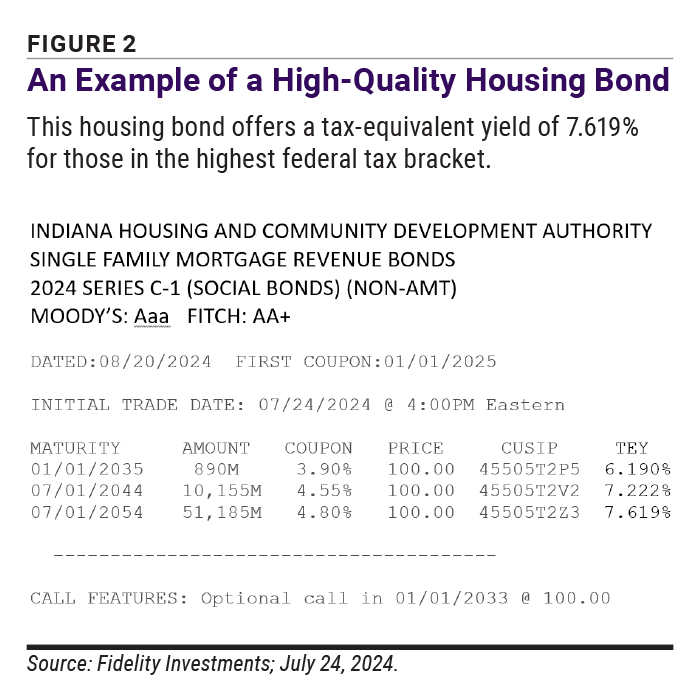
However, some high-quality bonds yield more than others based on their sector. Housing bonds are a very attractive choice right now as states try to increase the housing stock. For example, Figure 2 shows a recent new issue with a sample of maturities. Note the information provided: name of the issuer, the ratings from Moody’s and Fitch, the date of issue, when the first coupon will be paid, the initial trade date and the fixed call on January 1, 2033. Housing bonds are generally subject to extraordinary calls, in whole or in part, at any time. In describing the individual maturities, you can see in Figure 2 that you are provided with:
If you were to purchase the 2054 maturity with a 4.80% coupon, your tax-exempt yield equivalent in the highest tax bracket is 7.619%, with minimal risk.
The coupon is the fixed interest rate the bond is paying. If market fluctuations drive the bond’s price higher than the face value, we say that the bond is selling at a premium. The premium value declines over the life of the bond as it approaches its due date. This premium cannot be taken as a loss and is amortized over the life of the bond.
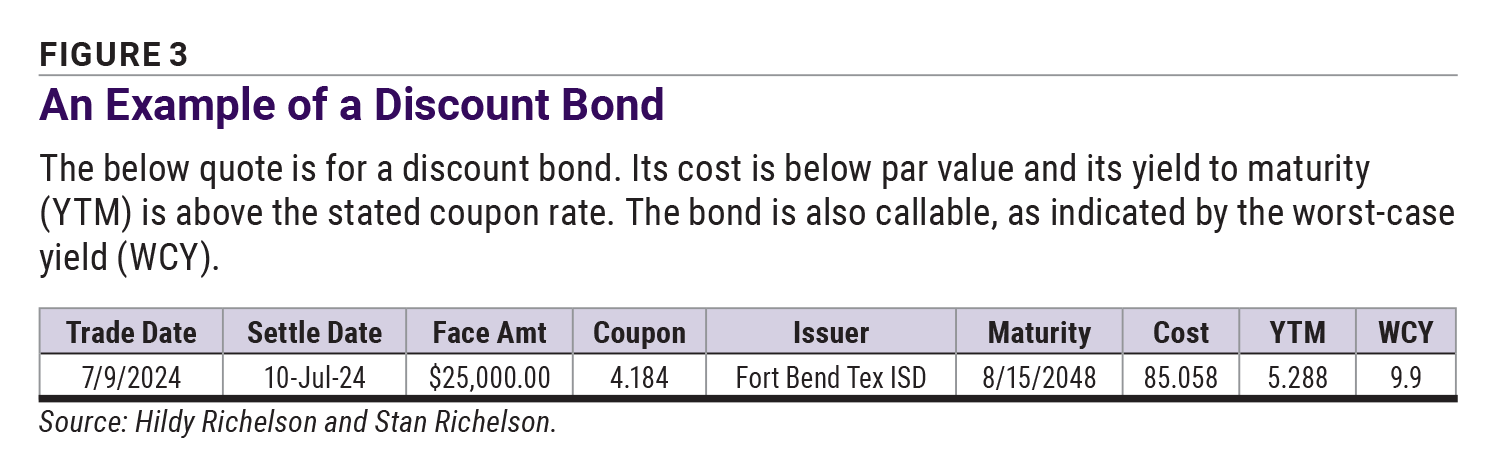
If interest rates rise, then the value of the bond may decline below its face value. If so, this bond is said to be selling at a discount. You can purchase discounted bonds in your retirement accounts and reap great potential rewards. Figure 3 shows a taxable bond issued by the Fort Bend, Texas, Independent School District that was selling at a cost of 85.058 or $850.58 per bond. It will come due at face value (100) in 2048. However, it has a call provision that enables the issuer to redeem the bonds in 2027 at 100. If the bond is redeemed at 100, then the yield would be 9.9% (worst-case yield). If the bond is not called, its yield to maturity would be 5.288%.
There are different, complex tax rules for discounted bonds held in taxable accounts. The bond buyer must proceed with caution.
Within the context of your objectives and your financial situation, individual high-quality bonds can play important roles:
The power of bond investing is revealed in the long-term perspective, not quarter by quarter. Compounding interest is like a rolling snowball—starts small, but continues to expand geometrically as it gathers more snow. Compounding is the buildup of interest being paid on interest, plus the interest paid on your reinvested principal. If you track the process, a marvel unfolds.
PRISM Wealth-Building Process


BARRY J from TX posted over 2 years ago:
Royce F from WA posted over 2 years ago:
ROBERT A from NC posted over 2 years ago:
JOHN L from NJ posted over 2 years ago:
DONALD G from TN posted over 2 years ago:
James F from USA posted over 1 year ago:
You need to log in as a registered AAII user before commenting.
Log InCreate an account