


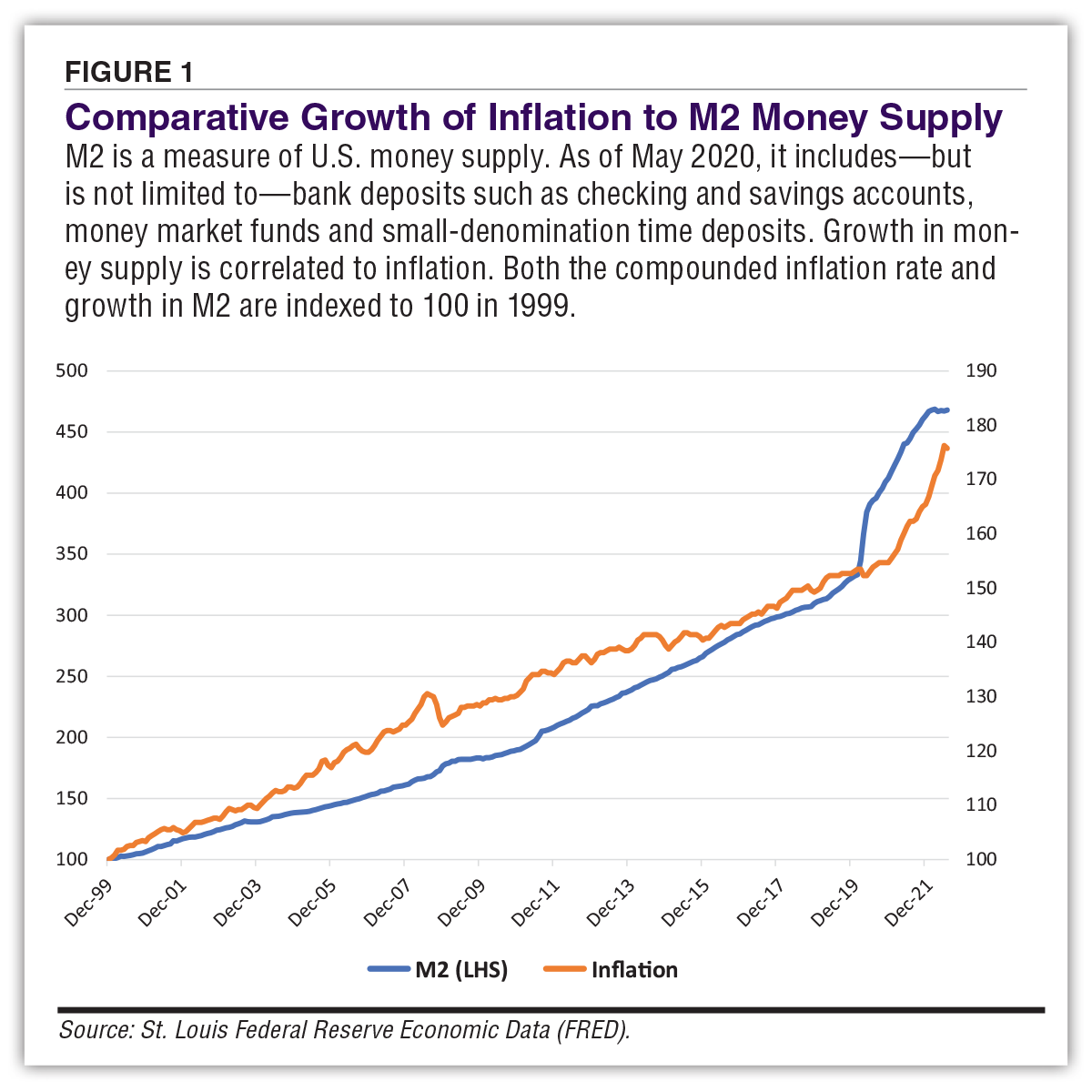
Recent years have been accompanied by significant inflation, associated by some with the impact of the pandemic on supply chains and by others (notably economists of the monetarist and Austrian schools) with the growth of the U.S. money supply. Figure 1 shows the comparative increases in inflation (as measured by the consumer price index, or CPI) and the M2 money supply (which, as of May 2020, includes—but is not limited to—bank deposits such as checking and savings accounts, money market funds and small-denomination time deposits). It appears from the figure that the two are positively correlated, leading us to conclude that continued growth in the money supply is likely to be accompanied by continued inflation.
Whatever the cause, inflation hurts savers and bond investors by destroying purchasing power. The Federal Reserve Bank of St. Louis reports that between 1913 and 2022, for instance, the U.S. dollar depreciated by a factor of slightly more than 33. In other words, an item that would have cost $1 in 1913 would, all else equal, cost $33 in 2022. For comparative purposes, the union rate for a plumber in New York City in 1913 was $0.69 per hour, which on an inflation-adjusted basis would be $20.77 in 2022. An internet search at the time of writing suggests that the current hourly wage rate for a plumber in New York is about $25. In general, it appears that wages tend to keep pace with or exceed the rate of inflation. For those living on fixed incomes, such as many retirees, though, the loss of purchasing power due to inflation can result in a significant decrease in their standard of living.
Those who remember the 1970s and 1980s will recall that inflation peaked at close to 15%. The Rule of 72 suggests that an annual inflation rate of 10% would cause prices to double, and the standard of living to decline by half, for those on fixed incomes, in about 7.2 years (72 ÷ 10). Similarly, a more modest inflation rate of 4% would cause prices to double in 18 years (72 ÷ 4), within the life expectancy of someone who retires at age 65. Even if the Federal Reserve, through its open market and other operations, is successful in its goal of maintaining an annual average inflation rate of 2%, we can expect prices to approximately double every 36 years (72 ÷ 2).
TIPS Versus Traditional Treasury Bonds
One type of instrument that offers some protection against inflation is Treasury inflation-protected securities (TIPS). Because their returns are linked to inflation, these instruments are sometimes referred to colloquially as “linkers.”
Coupons on TIPS are determined through an auction process when the instruments are issued. While investors in standard, or “nominal,” Treasury notes and bonds receive coupons that reflect nominal interest rates—incorporating a real rate of interest (to compensate investors for the use of their money over time) and a premium for anticipated inflation—coupons on TIPS reflect just the market’s real rate of interest. (Coupons on both nominal Treasuries and TIPS are fixed at issuance. However, changes in real yields can cause the yields on both to change. Changes in actual inflation can also cause yields on nominal Treasuries to change.)
Investors in nominal Treasuries face the risk that realized inflation will be greater than anticipated. This would cause the inflation premium to become insufficient so that the nominal interest rate, reflected in the coupon, will provide insufficient compensation for both time and actual inflation. TIPS investors, on the other hand, are protected against actual inflation because TIPS incorporate an adjustment to their principal based on the realized rate of inflation, as measured by the CPI, albeit reflected with a three-month lag.
Largely due to the Fed’s policy of keeping rates low, yields on TIPS of all maturities were negative as recently as March 2022. Although investors received inflation adjustments, they were not being compensated for lending money to the government.
How TIPS’ Principal Adjusts to Inflation
While the coupon rate on TIPS is fixed, the principal amount (par value, meaning the face value of the bond) is adjusted semiannually based on an inflation index, the non-seasonally adjusted consumer price index for all urban consumers (CPI-U). Inflation, as reflected by an increase in the index, results in a corresponding increase in the bond’s principal. Since interest is paid on the outstanding principal, inflation will also lead to an increase in the dollar coupon received by investors.
In the comparatively unlikely event of deflation, which would result in a decrease in the index, the principal and, consequently, the dollar coupon, of a TIPS will be proportionately reduced.
The effect of the principal adjustment is to protect against inflation. The effect is not perfect because, first, as noted earlier the inflation adjustment is based on a lagging CPI figure. Secondly, the inflation index used may not accurately reflect the inflation that a given investor experiences. The effect of these caveats is that in periods of high inflation, the real (inflation-adjusted) return that an investor earns may be lower than anticipated, or even negative.
For example, suppose that an investor purchases, at issuance, $100,000 worth of TIPS at par value with a stated coupon rate of 2.2%. Six months later, the annual inflation rate is reported as 3.5%, making the semiannual rate 1.75% (3.5% ÷ 2). The inflation-adjusted principal at the end of the first six-month period is set at $101,750 ($100,000 × 1.0175). The dollar coupon is calculated to be the 2.2% stated coupon, multiplied by one-half to reflect a six-month period (2.2% ÷ 2). This coupon is then multiplied by the adjusted principal. Therefore, the investor receives $101,750 × 1.1%, or $1,119.25 as shown in Table 1.
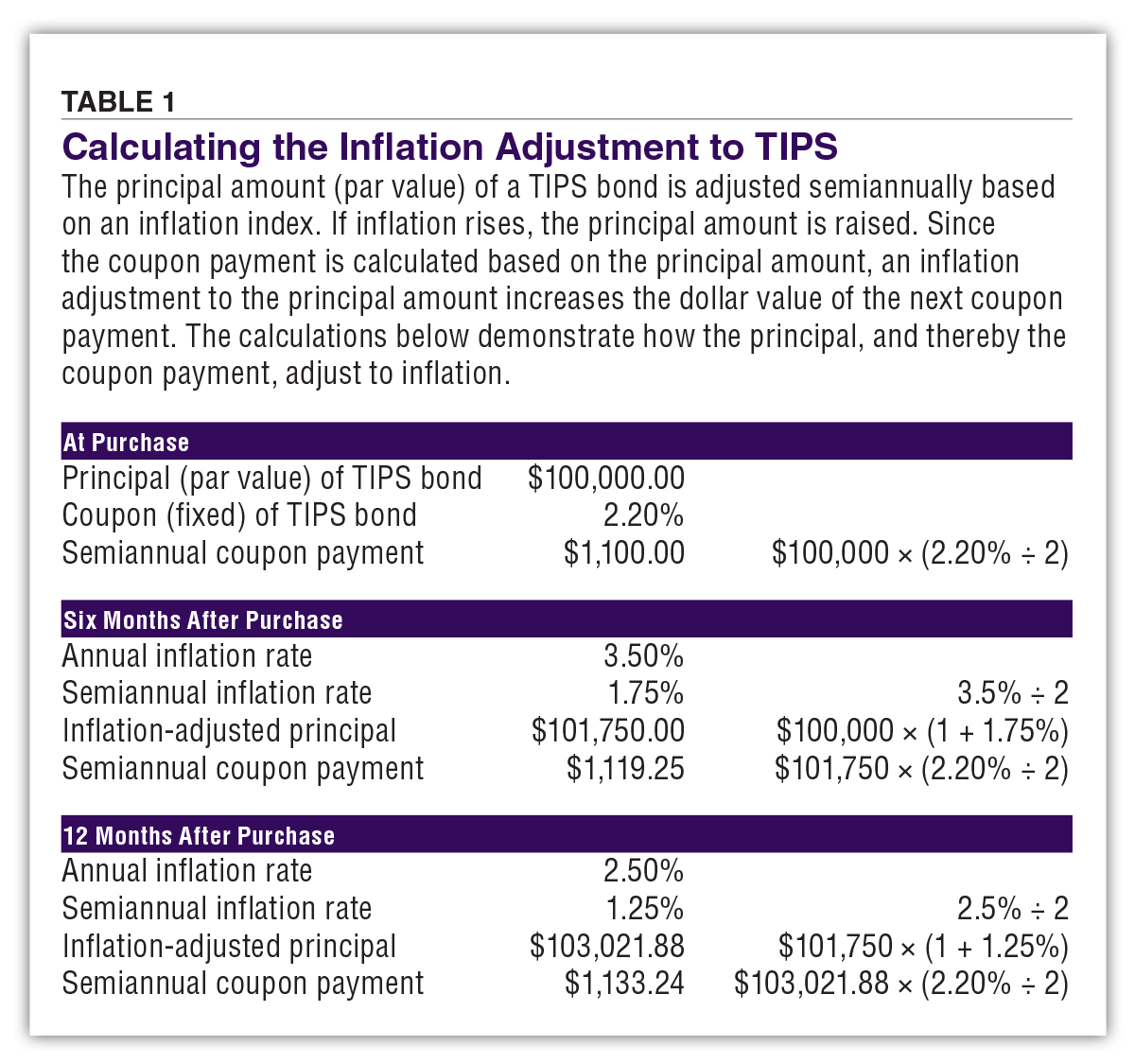
In a similar fashion, if the semiannual inflation rate for the second six months is 1.25%, then the adjusted principal at the start of the period ($101,750) will be increased by 1.25% to $103,021.88. The interest payment in the second period is calculated by multiplying $103,021.88 by half the coupon rate of 2.2%, or 1.1%. This results in an adjusted coupon of $1,133.24. The Treasury Department reports the principal adjustments made on TIPS. Details on those adjustments can be found at www.treasurydirect.gov/instit/annceresult/tipscpi/tipscpi.htm.
TIPS also provide some protection against deflation, a general decrease in prices (not to be confused with disinflation, which reflects reduced, but still positive, price growth). This is because although TIPS coupon payments are based on a principal balance that declines with deflation, the investor will receive the greater of the adjusted principal or the original principal at maturity. As we shall see later, though, regular Treasury securities tend to perform better when inflation is lower than expected.
Investors should note that, in addition to the coupon payments, principal increases that result from the inflation adjustment are taxed as income in the year in which they occur, even though the holder won’t realize the increase until the bond matures or is sold. Because of the tax treatment of this “phantom income,” investors owning TIPS are often recommended to hold them in a tax-advantaged account like a traditional IRA or Roth IRA. Note that reductions in principal due to deflation can generate tax benefits that can be used to offset other taxable income.
Interest Rate Risk for TIPS
Although TIPS offer investors some protection against inflation, holders ought to be aware that they still face interest rate risk. Due to their comparatively lower coupons, TIPS tend to have longer durations (greater price sensitivity to changes in interest rates) than regular Treasury bonds. If interest rates rise, bonds with fixed cash flows become less attractive, so that the prices of most bonds, including TIPS, will move inversely and investors may even experience negative returns.
Figure 2 shows that as interest rates rose in early 2022, for example, and prices on regular Treasury securities fell, as reflected in the price decline of the iShares 7-10 Year Treasury Bond ETF (IEF), so too did the price of TIPS. Prices of exchange-traded funds (ETFs) that owned them, such as the iShares TIPS Bond ETF (TIP), also fell.

Yields on TIPS typically move in the same direction as regular Treasuries but are driven by real rates (nominal rate minus the inflation premium) rather than the nominal rates that affect standard Treasuries.
If prevailing nominal rates rise due to an increase in inflation, the negative price pressure on TIPS will be moderated to some extent by the increased coupon payments that will result from the principal being adjusted. But if real interest rates increase, due to a Fed rate increase greater than general inflation expectations—perhaps driven by other monetary policy motivations—interest rate sensitivity will lead to a corresponding decrease in the price of TIPS. The comparatively limited supply of TIPS, though, tends to act as a brake on real yield increases. Buy-and-hold investors won’t recognize any price loss immediately but will suffer an opportunity cost over the remaining life of the bond by receiving a lower yield than purchasers of more recently issued securities.
Skeptical commentators might point out that although the Fed may wish to aggressively increase rates to curb inflation, doing so also increases the cost of servicing the national debt. A less aggressive stance that is more tolerant of inflation would make it easier to repay that debt in the future. Estimating future inflation accurately is, therefore, a difficult task.
How to Buy TIPS
Investors can gain exposure to TIPS indirectly by purchasing a mutual fund or ETF that includes them in its portfolio or directly from the Treasury Department (via TreasuryDirect.gov), a bank or a broker through an auction process. As part of the auction process, you can enter a noncompetitive bid or a competitive bid.
With a noncompetitive bid, you agree to accept the yield determined at auction (the “stop”). The advantage to taking this approach is that you are guaranteed to receive the full amount of TIPS you wish to purchase (aka subscribe for).
With a competitive bid, you specify the minimum yield that you are willing to accept. You will only receive securities if the stop equals or exceeds the yield you specify. However, if the stop equals your bid you may receive less than you bid for, and if the stop is lower than your bid you won’t receive any securities. (Yields and prices are inverted, so the lower the yield, the higher the price. The bond issuer—in this case, the federal government—wants to sell bonds for the lowest yield accepted by auction participants.)
TIPS will never have a coupon below 0.125%, so if the stop yield is below that, or is negative, then the TIPS will be sold at a premium, meaning for more than face value.
You can purchase TIPS in units of $100 with maturities of five, 10 and 30 years. Auctions are held throughout the year:
- Five-year TIPS: April, June, October and December
- 10-year TIPS: January, March, May, July, September and November
- 30-year TIPS: February and August
You can submit up to $10 million in non-competitive bids using the TreasuryDirect platform, or via a bank or broker. Competitive bids, for up to 35% of the initially offered amount, may only be placed via a bank or broker.
An ETF will offer more diversification than the typical investor can achieve buying individual TIPS. The cost will also be lower than going through a bank or broker. Prospective purchasers should be aware that the quoted yield on an ETF may be misleading as it may include the expected inflation adjustment, rather than merely reflecting the real yield on the underlying TIPS. As previously noted, the real yield may be negative.
The Breakeven Rate and TIPS
Market practitioners can make use of Fisher’s law to calculate the “breakeven rate,” which is the expected rate of inflation currently priced in the market. Fisher’s law states that the nominal yield equals the real yield plus the expected rate of inflation.
For example, on September 27, 2022, the yield on the 10-year Treasury note was 3.95% and the yield for a 10-year TIPS bond was 1.63%. The expected annual inflation rate over the next 10 years was therefore 2.32%
(3.95% – 1.63%). If realized inflation ends up being higher than the breakeven rate, then TIPS investors will outperform investors holding regular Treasuries. This is because regular Treasuries will become less attractive as their coupons lose purchasing power.
If inflation comes in lower than anticipated, then TIPS will likely underperform. Holders of regular Treasury securities will continue to earn the inflation premium that was too high, while the principal adjustment that TIPS investors receive will be based on the lower, actual inflation rate.
Figure 3 shows the 10-year breakeven inflation rate through July 2022, as reported by the Federal Reserve Bank of St. Louis.

TIPS Protect Against Unanticipated Inflation
Investors concerned about inflation can seek the comfort of TIPS. These do not provide complete protection against inflation, however, particularly when inflation increases rapidly. They also do not necessarily offer more effective protection than traditional, or nominal, Treasuries. If the realized inflation rate turns out to be lower than anticipated, nominal Treasury securities are likely to outperform TIPS.
Where TIPS can be useful is in protecting against unanticipated inflation. Investors should also remember that, despite the protection they afford against inflation, TIPS merely reduce, but do not eliminate, interest rate risk. Despite these caveats, TIPS can make sense in a diversified portfolio, particularly in tax-advantaged accounts.

Related

Related
Discussion
FREE REPORT

KENDRICK M from NC posted over 3 years ago:
MICHAEL D from CA posted over 3 years ago:
MICHAEL D from CA posted over 3 years ago:
MICHAEL D from CA posted over 3 years ago:
Philip D from CA posted over 3 years ago:
MICHAEL D from CA posted over 3 years ago:
Vinod N from MA posted over 3 years ago:
MICHAEL D from CA posted over 3 years ago:
MARVIN V from IN posted 10 months ago:
You need to log in as a registered AAII user before commenting.
Log InCreate an account