


Christine Benz leads a class in AAII's new Essential Investing Video Course. Go to https://www.aaii.com/ves for more information and to subscribe.
- Benefits of the bucket strategy in retirement
- Tips on the timing of Social Security benefits and the role of annuities in retirement
- How to set an appropriate withdrawal percentage
 Christine Benz is the director of personal finance and retirement planning at Morningstar Inc. Her new book is “How to Retire: 20 Lessons for a Happy, Successful, and Wealthy Retirement” (Harriman House, 2024). I spoke to Benz about the current thinking on withdrawal rates and allocating in retirement, including when to take Social Security and the role of annuities.
—Cynthia McLaughlin
You’ve written about the bucket strategy approach to allocation in the AAII Journal and talked to AAII members about it. With the bucket strategy, is there anything to think about in periods of high inflation versus low inflation, in different stock market cycles or interest rate regimes?
One thing I like about the bucket strategy is that it’s a well-diversified portfolio approach. It’s set up to address a lot of different risks.
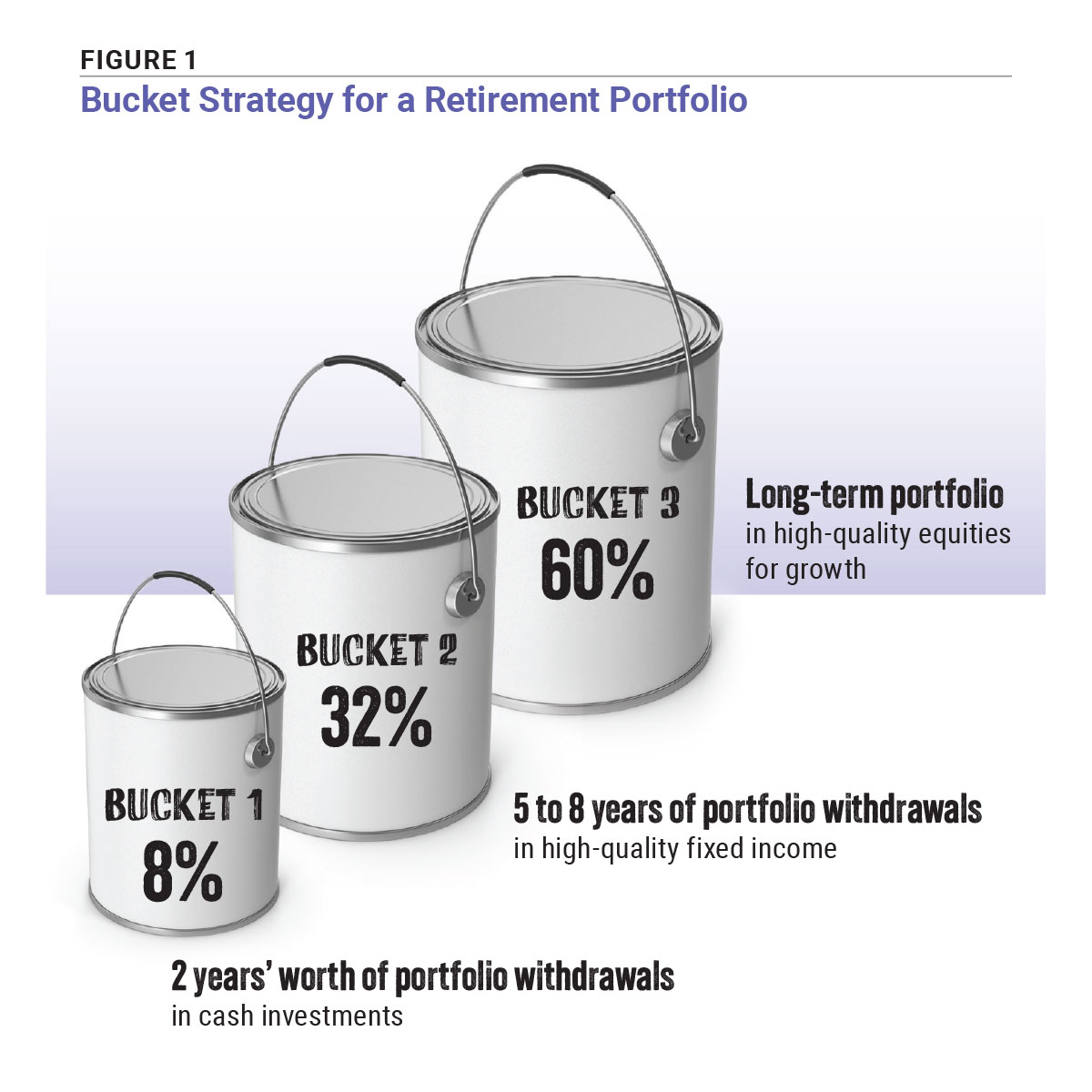
When I talk about a basic bucket structure, I’m thinking about, say, two years’ worth of portfolio withdrawals in true cash investments. There is an inflation risk, so you want to be careful not to overdo that bucket.
Stepping out on the risk spectrum with the second bucket, you’d think about a high-quality fixed-income portfolio with a combination of short- and intermediate-term bonds. I would definitely hold Treasury inflation-protected securities (TIPS) as a component of that portion of the portfolio. That’s equivalent to another five to eight years’ worth of portfolio withdrawals.
Bucket three is the growth engine of the portfolio. Inherently, it doesn’t have any direct inflation hedges. Bucket three would be an equity portfolio. Stocks have historically had returns that are higher than the inflation rate. That bucket is naturally inflation-protected over the long term (Figure 1).
If you have an annuity, Social Security and a pension, how do you decide what your allocation to cash and bonds should be?
The starting point is to look at what your anticipated portfolio spending will be given that those nonportfolio income sources will help meet your fixed spending. Look at what your variable, or discretionary, spending might be, and then structure that portfolio to support it.
I mentioned two years’ worth of cash investments, another five to eight years’ worth of fixed income, with the rest going into high-quality equities. What I like about that is that it’s eminently customizable.
You could have, for example, a tenured college professor who’s getting almost all her income met through her pension. In that lucky scenario, that person would really be sipping from the investment portfolio, so she could structure it much more aggressively.
If you have someone who is taking a more standard 4% initial withdrawal from the portfolio, that translates into two years’ worth of cash—an 8% cash allocation. If we have another eight years in high-quality short- and intermediate-term bonds, that’s 32% (eight times 4%). Those two buckets combined equal 40% allocated to cash and bonds, and then you have the rest in equities. It is effectively a 60% stocks/40% bonds portfolio. I think that’s an interesting thing.
When many retirees do this work, they come up with something that looks a lot like a 50% stocks/50% bonds or 60% stocks/40% bonds allocation. It’s the bucket strategy that takes them to a fairly conventional place in terms of the portfolio’s actual asset allocation.
The challenge today is that so many retirees have had such a good experience with equities for a couple of decades. Right now, it’s very difficult to suggest that they consider derisking their portfolios. I run into this all the time where I talk to investors who say, “I have maybe a little bit of cash and then a dividend-paying stock portfolio.” The derisking conversation is a hard one, but I do believe that there’s an advantage to having something besides equity assets in a portfolio. But certainly bonds haven’t made a great case: Over the past decade, returns have been very so-so. Plus, we had 2022, which jostled around bond prices. Bonds weren’t as balanced as anyone investing looked for them to be.
If somebody wants to claim Social Security as late as possible, what should they do with their portfolio to cover that gap? Conversely, what are your thoughts on claiming early and then reinvesting the money? Is it worth doing?
Let’s take claiming early first. The thing that people sometimes underrate is that the boost in Social Security you receive for delaying benefits is effectively a guaranteed return. Even if you do claim early and plan to invest the money, you will not be able to match that guaranteed return you can earn on delayed filing. That’s one reason to think twice about assuming you will be able to beat the boost in your eventual benefits that you get through delayed filing.
In terms of supporting delayed filing, I love that question because it points directly at sequence of returns risk. Sequence of returns risk is the chance of encountering a bad market environment—one that could put your plans at risk in your early years of retirement.
If you are planning to have higher withdrawals in the early years of retirement, I really think the bucket strategy can make sense in this context. You are plotting out your anticipated portfolio withdrawals and locking them down in cash and high-quality bonds, maybe even TIPS. In this strategy, you are matching expected cash flow needs from your portfolio, thinking about how they’ll be higher in the early years of retirement and determining where you will be able to go for those cash flows. In the bucket system that I often talk about, I earmark roughly 10 years’ worth of portfolio withdrawals in more liquid assets, a combination of cash and short- and intermediate-term, high-quality bonds. That strategy is a good starting point.
There are other things people can think about where they’re using a short-term annuity to bridge that gap. It’s another strategy worth considering.
The idea is that if your portfolio withdrawals are going to be a little bit higher in those early years of retirement, you’re not risking having to tap equities if they happen to be undergoing a downturn at the time you need your money.
Annuities can be confusing, and I think they have a bad rap. There are a lot of bad products out there, but also some good annuity products too. How do pre-retirees and retirees sort through this?
There’s a lack of good information on many annuity types. As a starting point, one thing I recommend is that people go through Wade Pfau’s Retirement Income Style Awareness questionnaire. It helps you address whether you’re a good candidate for guaranteed income.
Due to your own tendencies or types of income that you’ll be bringing into retirement, you may not be a great fit for an annuity. Maybe you’re covered by a pension. In that case, an annuity wouldn’t be a great idea.
In terms of doing your due diligence, if you’re working with an adviser and looking at an annuity purchase, I would say that, ideally, the person would be objective. The adviser wouldn’t necessarily get paid on the sale of that annuity. In reality, that’s not often the case. The commission is often inextricably linked to the advice you’re getting. So, do your due diligence. Ask all the questions.
I’ve been kind of shocked, frankly, in speaking with older adults. They’ve shown me their portfolios and I’ve looked down and said, “Oh, this is an annuity, right? You know, this is an annuity.” And they’re not even aware that they have an annuity. I think there’s a real disconnect sometimes with people not fully understanding the product they’re purchasing. Exhaust your questions.
My personal bias is toward annuity products that are a little bit simpler. The nice thing about those products is that there’s a lot of transparency. They tend to not be super costly, but it’s easy to see, in terms of your payout, how that product compares with other similar products. My bias is toward those simple immediate income annuities, or perhaps a deferred income annuity.
It’s definitely appropriate to do all your due diligence. It’s also appropriate to think about the inflation component. That is a big knock on the very basic annuities I was just talking about. You cannot buy an annuity with an inflation adjustment that is tied to the consumer price index (CPI). So really understand the implications of that, especially if we are in a somewhat higher inflation environment.
Also understand the importance of the financial wherewithal of the insurer, because you may have the contract for many years. You will want to make sure that you are with a topflight insurance company.
It is easy to understand how people get annuities in their portfolio though they’re not quite sure what they are.
Well, exactly—like the dinners at Morton’s The Steakhouse that are often couched as retirement tax planning or something like that. But often there is an annuity sales pitch embedded in that free dinner that you’re about to sit down for.
There is a school of thought about using annuities and other fixed-income products to immunize projected expenses. What are your thoughts?
I think it’s a really interesting strategy.
One thing I would like people to do is to look at their fixed household expenses and identify the things that are more or less immovable in their budgets. That might be your tax bills, insurance costs, food costs, utility costs, etc. If you still have a mortgage, that would be in the mix. Tally up all the things you need to keep your household running, setting aside things that are in the category of nice to have, like planned vacations. Look at those fixed expenses.
Then look at your nonportfolio sources of cash flow. For many of us, that’ll be Social Security. Do those two things line up? Does Social Security cover those basic household expenses? If it doesn’t, that can be a perfectly appropriate place to look to an annuity to meet that shortfall.
It helps you right-size the annuity. It also helps you obtain a lot of peace of mind with the long-term portion of your portfolio. So, if you know that those fixed household expenses are effectively covered with paychecks that you get through Social Security and perhaps an annuity, it can give you a lot of peace of mind with the fluctuations that will inevitably occur with your investment portfolio. It can also get you more comfortable with taking variable withdrawals from that investment portfolio.
Research that our team at Morningstar, as well as others, have worked on points to the value of being flexible with portfolio withdrawals. Flexible withdrawals benefit your portfolio over the whole of your retirement life cycle.
Seeing if you can’t match your fixed household expenses with nonportfolio income sources up front allows you to be more flexible with your portfolio withdrawals.
A question we get a lot is whether there is a “best” annual withdrawal percentage. There is the 4% rule. There is the strategy of using required minimum distributions (RMDs) to determine withdrawal rates. Do you think there is a magic number that works best?
The 4% guideline is a fine starting point. For people who are five years from retirement, it’s a good starting salvo when you’re trying to figure out whether you have enough. Take 4% of your balance and see if, when combined with Social Security, it’s an amount you could live on.
Every year, we look at safe withdrawal rates based on forward-looking market return expectations that we get from our team at Morningstar Investment Management LLC (Table 1). Our team tends to be a little bit conservative in terms of return expectations. So last year, 4.0% was the number that we suggested people embarking on retirement could use. The numbers were 3.3% in 2021 and 3.8% in 2022. Our takeaway was that 3.3% was a good number in 2021 because starting conditions were just so poor in terms of yields being low on fixed income and cash investments. We also saw the beginnings of higher inflation during that period and equity valuations were looking expensive.

I do think that a lot of research from our team and others points to the value of being flexible. Revisit how your portfolio has done annually. Take less in poor years. This will mean that you can very likely take more in a good year, like 2023. I like the idea of taking a step back every year and revisiting your withdrawal rate. You can also take more as you age, which is the logic at play with the RMD system, where people take larger shares of their portfolios as their life expectancy declines and they advance in age.
Bearing that in mind, I hate to hear from a retiree who says, “Oh, I just take 3% of whatever my portfolio balance is every year.” I think to myself, well, that might be fine. Maybe that’s enough, but you’re probably shortchanging yourself. You’re also probably shortchanging your opportunity for some lifetime giving. I think sometimes people view themselves as savers or investors, so when they hear that they should be able to spend more in retirement, they think that we’re just talking about frivolity. We’re not saying you should buy a new car every year, go out to dinner every night or do things that aren’t meaningful to you. Rather, you should look at opportunities for lifetime giving.
Mike Piper, my friend who is in charge of the Oblivious Investor website as well as the Open Social Security tool, has talked about the value of lifetime giving—meaning giving to your kids when they’re younger. When they’re in their 20s, 30s and 40s, those gifts will probably be more impactful to them than if they were to receive money from you later in life when they’re in their 50s and 60s. Looking at those opportunities to help kids pay off their student loans or make a down payment on their first home, or whatever it might be, has benefits that can accrue to people who pursue lifetime giving. It also translates into a higher withdrawal rate.
If you could give your 20- or 30-year-old self advice about preparing for life 40 years later, what would it be?
The main thing I would tell myself is just how quickly it goes. You still feel young inside, but the time goes so quickly.
When I think about the things that have led to financial success for my husband and me, a lot of it has been incredibly mundane. It is staying employed, working hard, setting a decent savings rate, investing regularly and taking ample risk in our portfolio. The amazing thing is that those mundane strategies have really worked out for us. If I were to talk to my 20- or 30-year-old self, I would say just stick with those mundane activities of saving, regularly investing in the stock market and not doing anything at all when the market turns down. Everything will be just fine if she does that.
The conversation continues in AAII Retirement Investing, where Benz and McLaughlin discuss strategies for transitioning into retirement.

Related

Related

Portfolio Strategies
For Bucket Portfolios, the Devil Is in the Details
Discussion
FREE REPORT

Get your free copy of our special
report analyzing the tech stocks
most likely to outperform the
market.
RANDALL T from CA posted over 2 years ago:
SCOTT T from CO posted over 2 years ago:
JOHN L from NJ posted over 2 years ago:
JAMES I from UT posted over 2 years ago:
ROBERT A from NC posted over 2 years ago:
Mahlon M from WA posted over 2 years ago:
TIMOTHY A from PA posted almost 2 years ago:
BARRY J from TX posted almost 2 years ago:
BARRY J from TX posted almost 2 years ago:
RONALD K from MO posted almost 2 years ago:
JEAN H from IL posted almost 2 years ago:
JEAN H from IL posted almost 2 years ago:
R R from NY posted almost 2 years ago:
Paul K from MD posted almost 2 years ago:
BARRY J from TX posted almost 2 years ago:
CRAIG B from WI posted 8 months ago:
You need to log in as a registered AAII user before commenting.
Log InCreate an account