


Charles Rotblut leads a class in AAII's new Essential Investing Video Course. Go to https://www.aaii.com/ves for more information and to subscribe.
Interest rates on savings accounts and certificates of deposit (CDs) peaked ahead of last month’s 0.50% (50 basis-point) interest rate cut but remained high.
At the start of September, the national average interest rate on savings accounts was 0.53%—a post-pandemic high. The average interest rate on a one-year CD was 2.06%, down from the July 30 peak of 2.15%. The average five-year CD yielded 1.46%, versus 1.50% in July.
These interest rates were recorded before the Federal Reserve cut its target rate for federal funds by 50 basis points (0.50%). It was the first interest rate cut to be made by the Fed since March 2020.
“Yields on cash investments like savings accounts, money markets and CDs will come down as interest rates come down, just as they went up when interest rates were rising,” said Bankrate.com’s chief financial analyst Greg McBride, CFA. “If you’ve been eyeing a CD, now is the time to lock that in—you won’t do better by waiting.”
These two charts show the trends in interest rates since 2021. Both are updates to charts we published in the December 2022 AAII Journal (“Savings Account Yields Are the Highest Since 2008”).
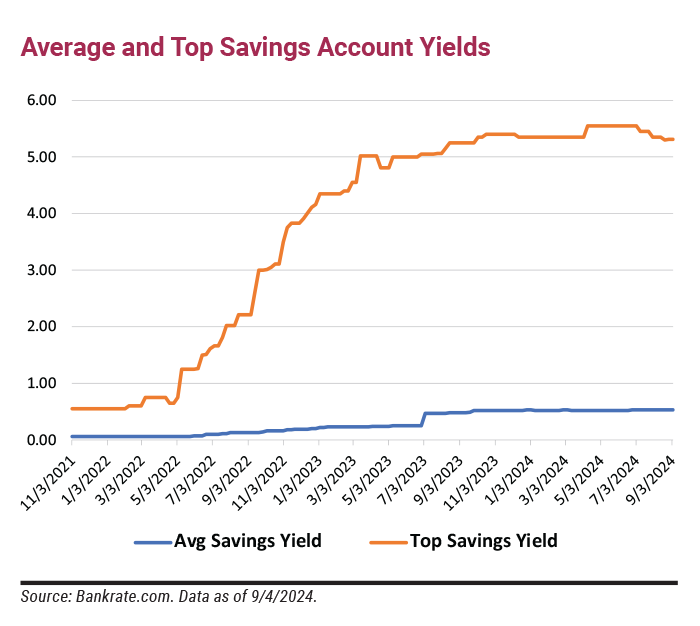
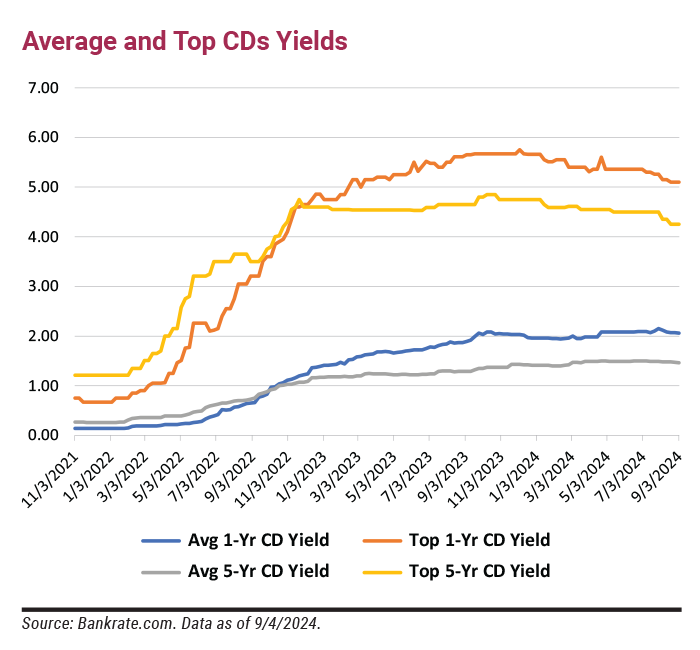
As was the case two years ago, it pays to shop around—and often to bank online. The highest savings account yield was five percentage points above the national average at the start of September. For one-year CDs, the spread between the highest and average yields was 3.60 percentage points. The spread between the highest and average yields for five-year CDs was 3.35 percentage points. Even if you don’t lock in the very highest interest rate, the reward for shopping around can still be significant.
Always verify that any bank you use is insured by the Federal Deposit Insurance Corp. (FDIC) and any credit union you use is insured by the U.S. National Credit Union Administration (NCUA).

Related

Editor's Note
Shop for Yields, but Be Careful About Where You Bank
Related

PRISM Wealth-Building Process
Guidelines for Selecting Bonds and Cash-Like Instruments
Discussion
FREE REPORT

Get your free copy of our special
report analyzing the tech stocks
most likely to outperform the
market.
BARRY J from TX posted almost 2 years ago:
You need to log in as a registered AAII user before commenting.
Log InCreate an account