


Related
Financial Statements
Ideally, a gold allocation should change based on where gold equities are in the valuation cycle.

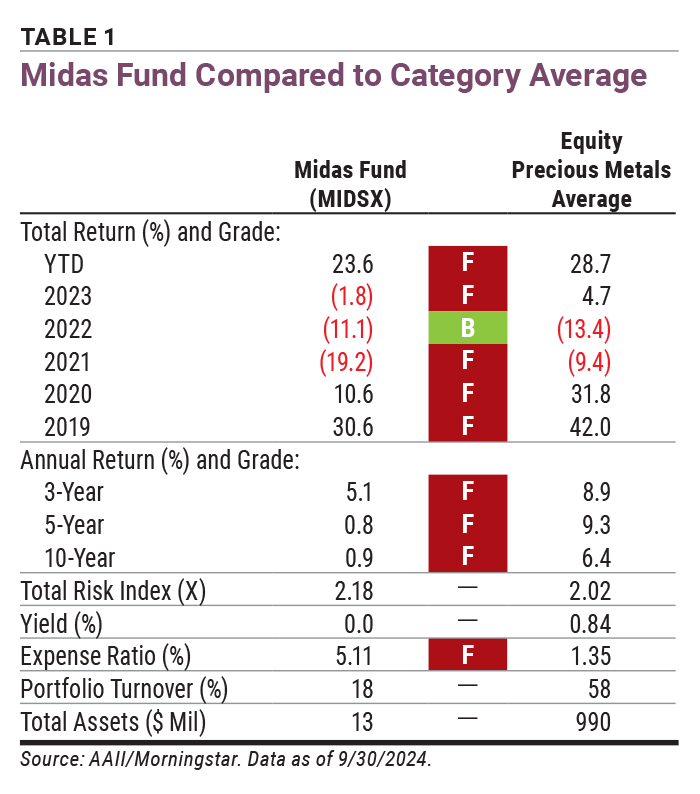
Thomas Winmill is portfolio manager of Midas Fund  (MIDSX), which focuses on investments in gold miners, gold and other precious metals. I spoke to Winmill in early October about what investors should consider when thinking about adding an allocation to gold-related assets to their portfolios.
—Cynthia McLaughlin
What is the thesis for including an allocation to gold in a portfolio?
There’s a traditional theory that gold is a safe haven—an alternate asset class that moves in sometimes contrary directions to equity markets. In short-term periods, say three to six months after an interest rate cut, broad equity markets typically go down and the price of gold goes up. So, there is some reason on a short-term basis, after you see a 50-basis-point cut by the Federal Reserve, to allocate to gold.
Medium term, because gold is not someone’s liability and it has 4,000 years acting as a store of value, it can be a good insurance policy in a portfolio if everything else is going down during those scary moments of a market crash. Because there’s no return on equity (ROE) in gold bullion, however, over centuries it has underperformed almost every asset class. So, there is a timing element to holding gold.
What’s probably not as well recognized, though, is that the equities of gold mining companies offer operating leverage and potential for a return on investment in almost any gold price environment. In the particular environment we’re in, we are seeing very stretched valuations for general equities and historic bargain basement valuations for precious-metal-related equity investments.
What should individual investors keep in mind when using gold or gold mining companies in their portfolio as a diversification strategy? Would the considerations be different for somebody who is retired versus a younger saver?
A younger individual typically invests for capital appreciation and has a longer time horizon. In that situation, the market for equities, including gold mining equities, offers a “weighing machine” and that’s an opportunity to take an investment position in a quality mining company with a longer-term view.
In the short term, the market for gold investing is a notoriously fickle “voting machine” and many unpredictable psychological, nonfinancial, factors affect prices, such as violence in the Middle East or something of that nature. In my experience, having managed Midas Fund for over 20 years, I have not seen any successful investor exploiting short-term psychological factors. So, the younger you are and the longer your investment horizon, you can increase your allocation to quality gold mining companies that have histories of producing returns for their investors and look for the benefit of the proverbial “weighing machine.”
For older investors, gold can be a nice source of income because there are some gold mining companies that have good dividends and are committed to a sustainable dividend policy. Gold mining, however, is a very speculative activity, and gold equities and gold bullion can be very volatile. So, older investors or those seeking more stability in their asset base and fixed income, should have a smaller percentage of their overall assets in precious metals and precious metals equities.
Ideally, your gold allocation should change based on where gold equities are in the valuation cycle. When investors get too excited “voting” for gold, they unfortunately often overweight it at the wrong time. Considering that current valuations—using measures such as price to net asset value, free cash flow yield, value of reserve ounces per share, etc.—are relatively low compared to the past, this might be a good time to overweight gold equities in a portfolio.
Midas Fund holds both gold mining companies and the SPDR Gold Trust, which holds gold bars. What are the goals of having exposure to both the mining companies and gold itself? Is there an advantage of one over the other?
From a portfolio management standpoint, you see what’s called beta, where one asset class tends to perform in relative percentage terms to another asset class. If the gold price goes up $1, the beta to the gold price movement in a diversified portfolio of gold stocks would normally be two to three. So you could expect gold equities to go up 2% or 3% if the gold price goes up 1%, due to operating leverage.
The gold and silver exchange-traded funds (ETFs) in Midas Fund form a precious metal core that normally doesn’t go down as much if equity prices decline or go up as much if those prices rise. The ETF gold and silver ounces complement the ounces of the fund’s portfolio companies that hold unmined gold reserve ounces in the ground.
Remember, gold and silver mining companies have their inventories composed of ounces of metal in ore contained in the ground. That is where we are looking for our biggest precious metals exposure.
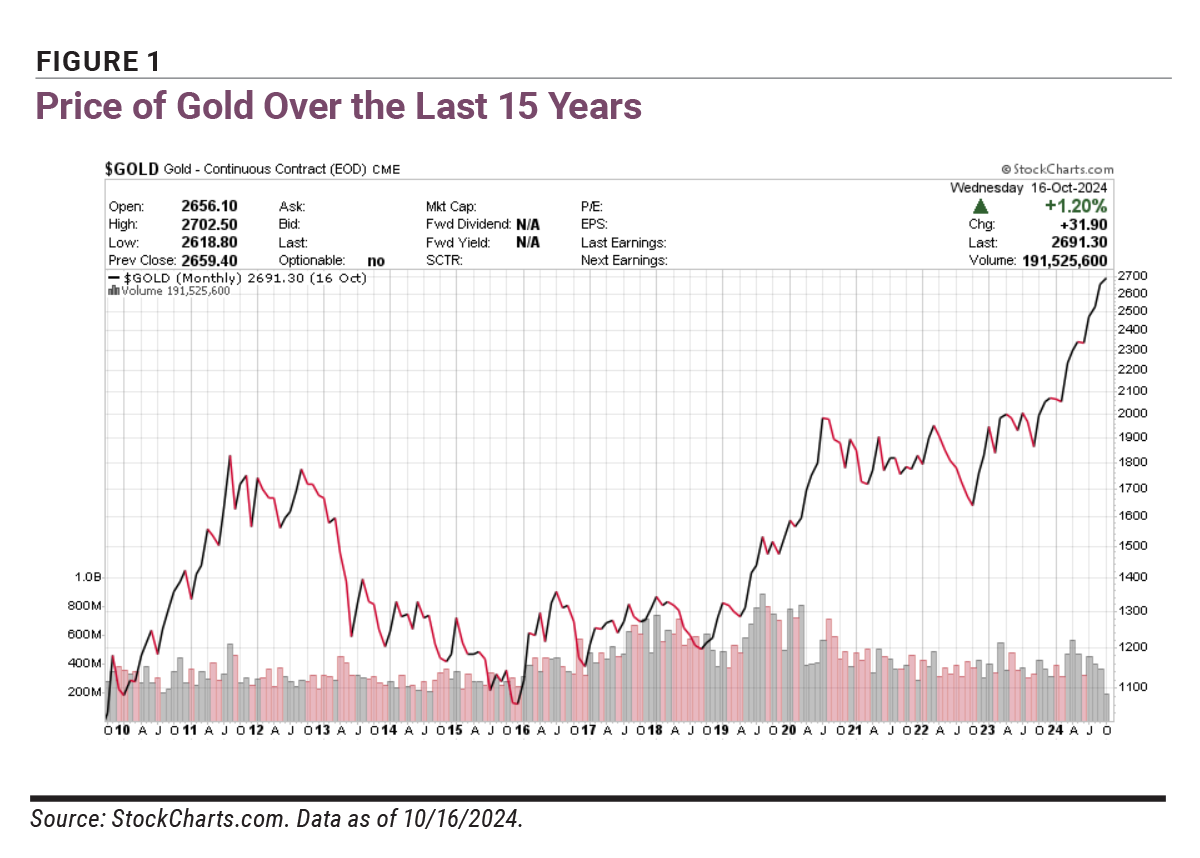
Gold went up early during the coronavirus pandemic and then fluctuated as inflation increased in 2021 and again in 2022. What drives the price of gold, and are those reasons different today than they were previously?
There are a lot of theories. We’ve talked about the history of gold and its relative performance to other asset classes. Yet, the essential role of gold has not changed. The concept of gold as a store of value and an alternative asset class is still widely accepted.
Since the outbreak of the Russia-Ukraine war, we’ve seen an acceleration of the trend of foreign central bank reserves becoming less and less composed of U.S. dollars. The percentage of foreign central bank reserves composed of U.S. dollars was around mid-70% years ago. It’s around 50% today. What that suggests to us is that foreign central banks are saying, “Wait, look at what happened to Russia in 2022. They got on the wrong side of the U.S. Treasury, and all their assets are frozen.”
In fact, since 2022, China has undertaken a massive divestment of its U.S. dollar-denominated reserves in the form of U.S. Treasury bonds, etc. At the same time, statistics show a massive increase in central bank buying of gold. If you own gold in a vault or produce it within your borders—and China is one of the largest producers of gold—the U.S. Treasury cannot affect your net worth or your ability to have liquidity. Gold is widely accepted and a lot more valuable pound for pound than oil. You’re seeing the central banks of Russia, China and other countries around the world that are not on great terms with the U.S. buying gold. And since 2022 to now, we’ve seen a big change in the gold price.
I would argue that there may be two other factors leading to the recent escalation of gold prices, related to the fact that the Federal Reserve and U.S. Treasury have embarked on very unconventional central bank policies. First, for a long time past, these policies have resulted in burgeoning fiscal deficits and debt and an apparently senseless monetary policy of near zero interest rates. Second, these policies have caused a lack of confidence in the future wisdom of the Fed. The theories that I’m hearing and reading are that, over the years, due to these policies there’s been a reduction of return on investment of federal spending and a reduction of net savings across the country.
When you have essentially a zero return on investment of federal spending and a negative national savings rate, you have a real problem. That’s when the country can have a downward spiral because it can’t grow its way out of its massive debt situation. I think both factors are contributing to a perception that the debasement of the U.S. dollar is imminent and that gold may offer a safe haven from that debasement.
How would you suggest an investor determine whether to increase or decrease exposure when investing in gold or gold mining companies?
Investing in gold mining is not that different from any kind of investment activity. The biggest risk in investing in any sector is a lack of knowledge. To reduce your risk, increase your knowledge about what you own. If you know what you own and you have a base valuation for it, volatility does not become a problem. You must understand exactly what you own, and if you don’t understand exactly what you own, be super careful.
If you’re investing on macroeconomic themes, be aware that macroeconomic investing is very rarely successful. There are many factors; we have talked about many major ones already. There are probably 100 other minor ones we could have covered. The less you know, the more you have to diversify, and if you super diversify, you’re going to end up getting a market-based return that almost defeats the purpose of an individual trying to pick out stocks or adjust sector allocations.
A foundational approach to investing—and this is true for our Midas Fund and our other funds that invest in a broader spectrum of securities—is, in our view, free cash generation. If you invest $1 into a business, you presumably have an expectation of receiving more than $1 back. That extra amount you expect back over the dollar you put in is best measured by free cash flow. That’s true for Microsoft Corp. (MSFT), Barrick Gold Corp. (GOLD) or any company. For someone looking to invest in a mining company, they need to focus on its ability to generate free cash flow.
I’d be very careful about trying to project free cash flow for a company that has never produced any— it’s best to adopt a “show me” attitude. Also be very careful about any company’s ability to continue to produce free cash flow in the future unless it has adequate gold reserves in the ground.
For example, a company with an amazing amount of historical free cash flow may chug along for another year or two, and then, oops, it’s out of economic ounces to mine. It looks cheap today but isn’t. Maybe it has a 20% free cash flow yield for two years, and then it stops mining and it’s game over. You’ve really lost 60% of your money after taking out 20% for two years in a row.
So, look at a company’s historical ability to generate free cash flow, and then look at how many ounces of reserves—not speculative or inferred, but provable economic reserves in the ground—it has in front of it. If it’s a 10% free cash flow yield that has 10 years of reserves, you’ll get your money back after 10 years. That is a poor investment. If you discount those future cash flows, your investment of $100 today would be worth only $80 or whatever your discount rate is. Look for free cash flow and look at the number of years that this company is likely to be able to continue mining and earning that free cash flow.
Besides free cash flow, what key financial metrics do you look at when you’re evaluating gold mining companies and thinking about including them in Midas Fund?
You want to see companies that are improving operations or bringing additional ounces online, where the free cash flow yield is expected to increase. We look for growing production and lower all-in sustaining cost of those ounces. We also consider reserves, resources, debt levels, share dilution, price to net asset value, value of reserve ounces per share and similar measures.
However, one nonfinancial thing to bear in mind, particularly in this environment, is political risk.
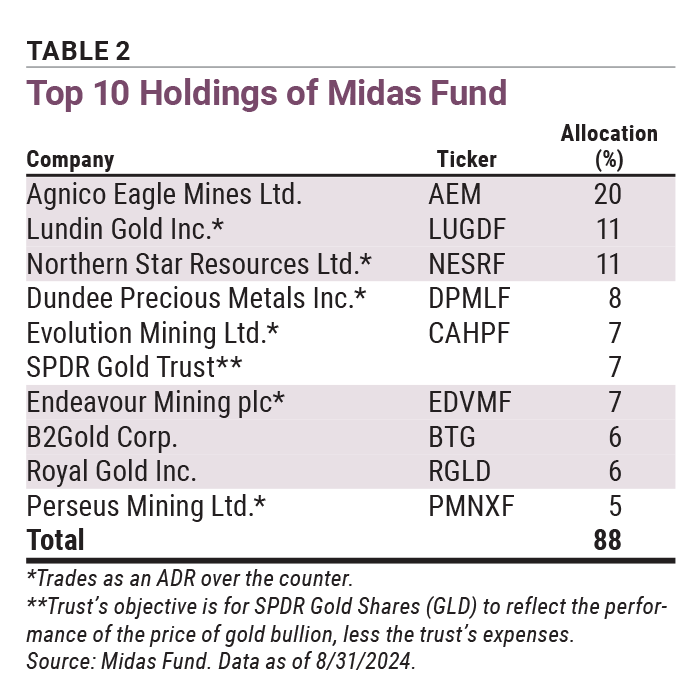
Currently, our biggest holding in Midas Fund is Agnico Eagle Mines Ltd. (AEM). Agnico Eagle is focused on having mines in countries that have a stable mining code and good social license to continue to mine, including North America, Finland and Australia. For instance, Canada is probably the most favorable jurisdiction in the world to start a mine. There’s an established mining code and the permitting process is well understood. Capital that goes in is fairly secure.
In contrast, Mali in West Africa used to be a very nice country for gold mining. Not anymore. Those in charge in Mali have decided they need more money, and a number of companies whose assets or mines are mostly in Mali have been getting skinned. The prospects for those companies that were quite attractive four or five years ago are almost hopeless today.
In 2024, there are over 60 federal elections being held around the world. There’s a lot of change going on all over the world. A mine takes a long time to work out—perhaps a minimum of 10 years of mining to capture hoped-for economic returns. Some fabulous South African mines have been going for 100 years. You want to put a limited amount of capital in and get a lot of capital out. A stable political regime is essential to permit that process to happen.
Look for free cash flow, a lot of ounces in reserves and a stable political jurisdiction.
With many gold mining companies operating globally, are there any currency or country risks you haven’t mentioned that investors should consider?
Well, the geopolitical situation is very important. We talked about the way a local government can change the tax code. It can also change the ownership of the local mining company. It can require preferred dividends. It can simply nationalize. All of these things have happened in the past, and they’ll probably continue to happen in the future.
Currency control is something that happened a lot more in the old days. Due to apartheid, it was very difficult to repatriate investment dollars into South Africa because of the international boycott against that country. There are similar situations in countries such as Zimbabwe, which has an elaborate currency control today. The current president—Emmerson Mnangagwa, whose nickname is The Croc or The Crocodile—has a very difficult regime for permits. And South American countries are famously implementing currency controls in and currency controls out.
I think there’s going to be more currency controls going on in the future. South Africa essentially puts out currency controls. That’s probably the reason why crypto is so important for most folks with assets in that country at the moment, so investors should be careful with that. Additionally, China has its own controls under which large movements of capital have to be permitted. So that is definitely a concern.
And, of course, there’s just violence. One of the companies that we own shares of purchased a very large deposit in Sudan just before the civil war broke out. So that’s a problem. And the company is looking at Senegal, looking at Cote d’Ivoire, but they also have problems. I would stay away from Burkina Faso—extremists in the northeast are essentially making mining areas uninhabitable and very difficult for the safety of mining personnel.
You can just go down the list of countries that you would not want to put capital into, where you would not want to visit and you probably wouldn’t even want to drink the water.
With the increasing popularity of cryptocurrencies, has the perception of gold being a safe haven changed? Does it make sense to hold both gold and crypto in your portfolio if you’re looking for this type of exposure?
The advent of crypto also has origins from the time when there were perceptions that the Fed was acting in unconventional and questionable ways—i.e., fiscal bail-outs and monetary zero-interest-rate policies after the 2008 financial crisis. Importantly, however, I am not sure that the market for crypto is going to be embraced by the major central banks. El Salvador accepts crypto as legal tender, but I don’t know if that’s going to be a trend. In the U.S., we’ve seen the U.S. Securities and Exchange Commission (SEC) essentially go after crypto brokers and various crypto offerings. I think many governments around the world are going to continue cracking down on crypto.
I don’t see that happening with gold because so much of central bank assets are in gold.
For investors who want to own physical gold, what considerations should they take into account and how should they proceed?
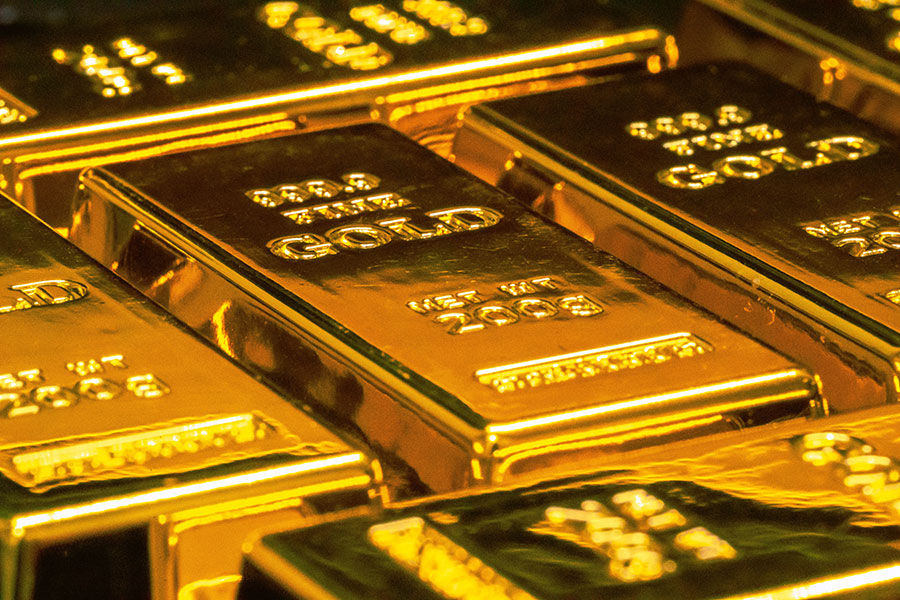
In considering whether to own physical gold, make sure to understand that the price you might see on the screen—such as a futures price or the London fixed price—is probably not the price you’re going to get when you buy or sell a one-ounce bar, for example. Screen prices are typically for much bigger orders, say 100 ounces or more. The bullion dealer engaging with a retail investor is going to take a much bigger spread. If the London price is $2,600 per ounce, it may be offered retail to you at $2,700 per ounce. If you want to sell it, it might be $2,500 per ounce.
Also, don’t forget that there is storage and insurance that needs to be considered when you’re talking about your total return. It’s like owning a car.
The last thing I would say to investors is to consider the opportunity cost. If instead of buying one ounce for $2,600 you put that in a money market fund, you get income and you would not be subject to spreads. I would buy physical gold just for fun; I would not do it as part of a long-term investment plan.
Is there anything I didn’t cover that you’d like to add?
I would add that it’s interesting that the gold price is up 35% so far in the 12 months [as of early October]. The S&P 500 index is up 27%, but valuations of S&P 500 companies are stretched. Valuations for the gold miners are really quite attractive. I would try to stick with good free-cash-flow-producing gold mining companies that have plenty of ounces in their reserve statement and mines in stable countries.
Financial Statements

Portfolio Strategies
Investor Professor

JOHN L from NJ posted almost 2 years ago:
ROBERT A from NC posted almost 2 years ago:
DANIEL B from MN posted almost 2 years ago:
DANIEL B from MN posted almost 2 years ago:
BARRY J from TX posted almost 2 years ago:
John T from USA posted almost 2 years ago:
CRAIG B from WI posted almost 2 years ago:
WILLIAM B from PA posted 11 months ago:
You need to log in as a registered AAII user before commenting.
Log InCreate an account