

Related

Portfolio Strategies
The two primary rules for reducing investing-related taxes are transacting less and holding less tax-friendly investments in tax-preferred accounts.

Charles Rotblut leads a class in AAII's new Essential Investing Video Course. Go to https://www.aaii.com/ves for more information and to subscribe.
Understanding the tax rules regarding capital gains, dividends, distributions and interest income can help increase your aftertax returns. Reducing turnover and making smart decisions about the types of accounts certain investments are held in—a concept known as asset location—will allow you to hold on to more of your investment gains and income.
Navigating the tax rules starts with understanding how they apply to the four primary ways investors realize profits from their portfolios.
Capital gains are realized when you sell an investment at a higher price than what you acquired it at.
Short-term capital gains occur when an investment is sold within one year of purchasing it. They are taxed at ordinary (marginal) income rates for investments.
Investments held for longer than one year in a taxable account qualify for long-term capital gains rates. These rates are below the ordinary income rates.
For 2024, long-term capital gains rates are 0% for married couples filing joint returns with taxable income of $94,050 or less and single filers with taxable income of $47,025 or less. Married joint filers with income of $94,051 to $583,750 ($47,026 to $518,900 for singles) will pay a 15% tax rate. A 20% tax rate applies to incomes above $583,750 and $518,900, respectively.
These thresholds are inflation-adjusted. In 2025, there will be no long-term capital gains taxes owed on taxable income up to $96,700/$48,350 for married and single filers, respectively; 15% tax rate up to $600,050/$533,400 for married/single; and 20% for those with taxable income above those levels.
AAII’s My Portfolio allows you to track the capital gains and losses on your stocks, exchange-traded funds (ETFs) and mutual funds. Simply add your holdings, their purchase date(s) and the number of shares you own.
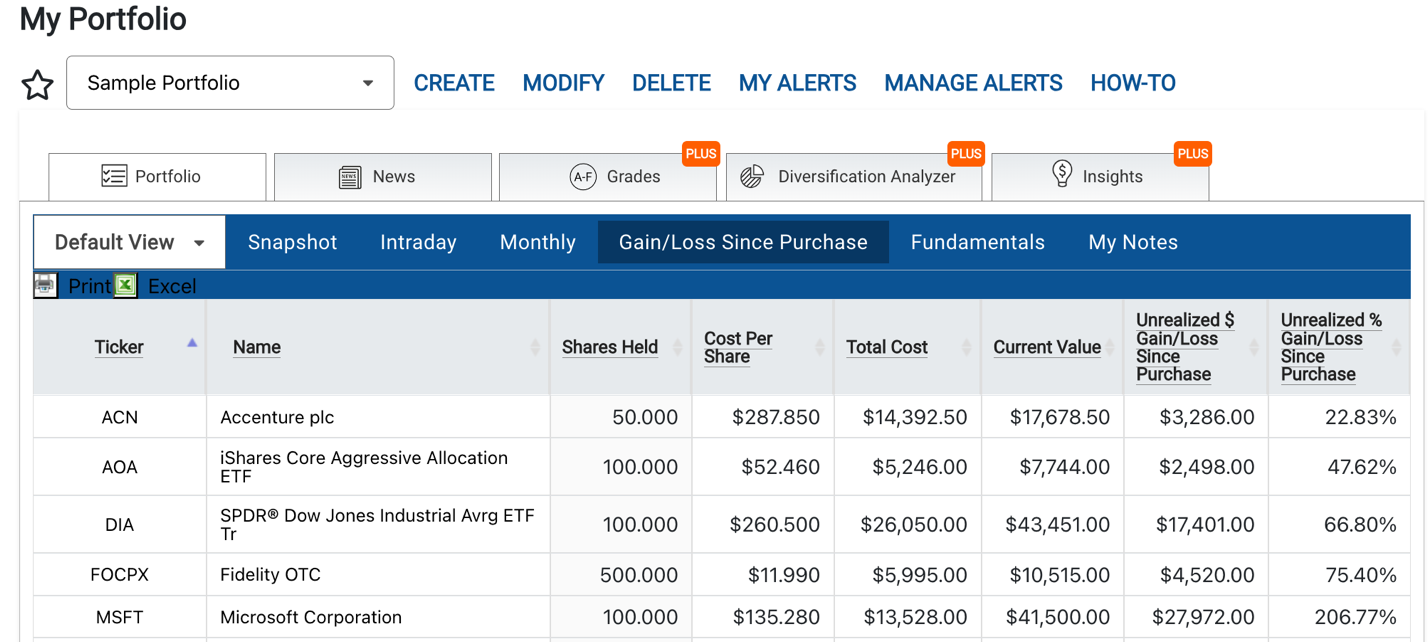
The main tab of My Portfolio is labeled “Portfolio.” In this tab’s menu is an option to see Gain/Loss Since Purchase (Figure 1). Clicking on it will show your current unrealized profits or losses. More than one lot can be added to My Portfolio if you purchased shares of the investment on different dates. To see the purchase dates or to add new lots, simply click on Modify. The default Modify view will show you the oldest purchase date and the average cost of your position. Clicking on the edit button will allow you to see additional lots.
Figure 1. Gain/Loss Tracking in AAII’s My Portfolio
My Portfolio helps AAII members to track gains and losses for stocks, mutual funds and exchange-traded funds (ETFs).
Source: AAII and QuoteMedia. Data as of 11/15/2024.
Note that the net capital gains from selling collectibles (such as coins or art) are taxed at a maximum 28% rate.
Capital gains taxes can be minimized by limiting turnover in taxable accounts, holding investments for over one year in taxable accounts, and/or using tax-advantaged accounts—such as individual retirement accounts (IRAs)—for strategies or funds with higher levels of turnover.
Dividends are categorized as either qualified or nonqualified.
Qualified dividends are taxed at the same favorable rates as long-term capital gains rates if holding period requirements are met. A stock must be owned for at least 61 consecutive days during a 121-day period beginning 60 days before the ex-dividend date. Preferred stocks must be held for 91 days during the 181-day period that began 90 days before the ex-dividend date. Failure to meet these holding periods will result in the dividend being taxed at the higher ordinary income rates.
Nonqualified dividends are taxed as ordinary income. Most companies pay qualified dividends; contact the company’s investor relations department if you are unsure.
Distributions are other payments of income to shareholders. Real estate investment trusts (REITs) make distributions that are taxable as ordinary income rates. Master limited partnerships (MLPs) often include a return of capital in their distributions. Whenever capital is returned, the payment decreases your cost basis in the investment. The return of capital is not taxable as long as your cost basis remains above $0, though your future taxable gains will be larger.
Mutual funds, ETFs and closed-end funds may distribute capital gains, qualified dividends, nonqualified dividends, return of capital and/or interest income. Taxable distributions can occur even when a fund’s calendar-year returns are negative.
The tax-cost ratio indicates how tax-efficient or inefficient a fund has been. This ratio measures how much a fund’s annualized return is reduced by the taxes paid on distributions, assuming the maximum marginal tax rate. The lower the ratio, the more tax-efficient the fund.
The tax-cost ratio for a specific ETF or mutual fund can be viewed on AAII’s Evaluator pages. To access them, just type the fund’s name or ticker symbol into the search box located at the top of most pages on AAII.com. The ratio is also included in AAII’s Mutual Fund and ETF Guides. Furthermore, A+ Investor and AAII Platinum subscribers can use the Mutual Fund and ETF Screeners to filter for ETFs and mutual funds with low tax-cost ratios.
Interest income is typically realized from bonds, money market funds and interest-bearing accounts. Interest income can be either taxable or tax-exempt.
Interest received from corporate bonds and most interest-bearing accounts is taxable at ordinary income rates. Interest (coupon) payments from Treasury bonds are generally taxable at the federal level at ordinary income rates but exempt from state taxes.
Municipal bond interest is exempt from federal taxes. It is also exempt from state taxes depending on the locale of the issuer and the taxpayer.
A simple rule to understand is that when holding periods for assets (including stocks, bonds and funds) are not met, any gains realized will be taxed at the ordinary marginal tax rates. The same rule applies to dividends when the 60-day or 90-day holding periods are not met.
Long-term capital gains and qualified dividends are taxed under the more favorable capital gains rates (which can be as low as 0%). Municipal bond interest is also exempt from federal and state taxes (depending on locale). For this reason, realizing long-term gains and receiving qualified dividend income and municipal bond interest in taxable accounts is preferred. All other taxable income is better realized in tax-preferred accounts like IRAs and Roth IRAs. (Those in the higher marginal brackets may find it advantageous to hold dividend stocks in tax-preferred accounts.)
The 3.8% net investment income (NII) tax applies to interest, dividends, capital gains, rental and royalty income, and nonqualified annuities, among other investment-related income realized in taxable accounts.
The NII tax is levied on joint filers with modified adjusted gross income (MAGI) above $250,000 and single filers with MAGI above $200,000. Distributions from tax-deferred accounts like traditional IRAs are included in the calculation of MAGI.
Up to 85% of Social Security benefits may be taxed if your combined income—MAGI plus half of your Social Security benefits—exceeds certain thresholds. One-half of municipal bond interest realized in taxable accounts is included in the calculation of combined income.
Investment income, including tax-exempt bond interest, is also factored into Medicare’s income-related monthly adjustment amount (IRMAA). Higher investment income in one calendar year can lead to higher Medicare Parts B and D premiums two years later.
Taxable distributions from IRAs and other tax-preferred accounts also increase your current combined income as well as raise your Medicare premiums two years out.
The two primary rules for reducing investing-related taxes are transacting less and holding less tax-friendly investments in tax-preferred accounts (IRAs, Roth IRAs, etc.).
Other options include using capital losses to offset capital gains, donating appreciated assets from taxable accounts to charity and making Roth IRA conversions.
Portfolio Strategies

Financial Planning

Tax Strategies

JOHN L from NJ posted almost 2 years ago:
ROBERT A from NC posted almost 2 years ago:
BARRY J from TX posted almost 2 years ago:
THOMAS S from OR posted almost 2 years ago:
ROBERT A from NC posted almost 2 years ago:
You need to log in as a registered AAII user before commenting.
Log InCreate an account