

Related

Financial Planning
While smart asset location can reduce your tax exposure in retirement, be sure not to let the tax tail wag the portfolio dog.

Charles Rotblut leads a class in AAII's new Essential Investing Video Course. Go to https://www.aaii.com/ves for more information and to subscribe.
Asset location is one of the primary tools that retirees—as well as those saving for or approaching retirement—have for managing their tax exposure. Asset location is the tax treatment of the account an investment is placed in.
Asset location takes on additional importance once an individual investor retires, claims Social Security or files for Medicare—whichever comes first. Strategic asset location can reduce:
In this article, I explain the primary ways retirees can be taxed on their income, discuss the tax treatment of different account types and provide strategies for reducing your tax exposure.
Most people are familiar with taxable income. Taxable income is the amount of income the Internal Revenue Service (IRS) uses to determine how much federal tax you owe.
Three other types of income take on significance for retirees. They are adjusted gross income (AGI), provisional income and modified adjusted gross income (MAGI). Understanding their differences is key to making strategic use of asset location.
AGI is calculated on IRS Form 1040 just before the standard deduction or itemized deductions are claimed. AGI includes—but is not limited to—wages, taxable interest, nonqualified dividends, pension income, certain types of annuity income, taxable individual retirement account (IRA) and 401(k) distributions. It serves as the basis for determining not only taxable income but also provisional income and Medicare MAGI.
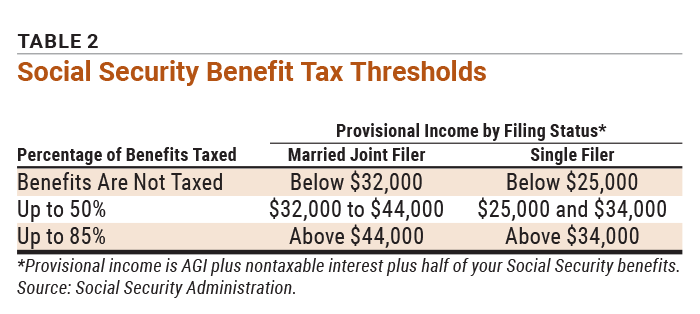
Provisional income (also known as combined income) determines the percentage of your Social Security benefits that will be taxed. It starts with AGI, removes taxable Social Security benefits and adds back nontaxable interest received in a taxable account, such as coupon payments from municipal bonds, plus half of your Social Security benefits received.
Married joint filers with provisional income of at least $32,000 ($25,000 for single filers) pay income taxes on up to 50% of their benefits. Married joint filers with provisional income of more than $44,000 ($34,000 for single filers) pay income taxes on up to 85% of their benefits.
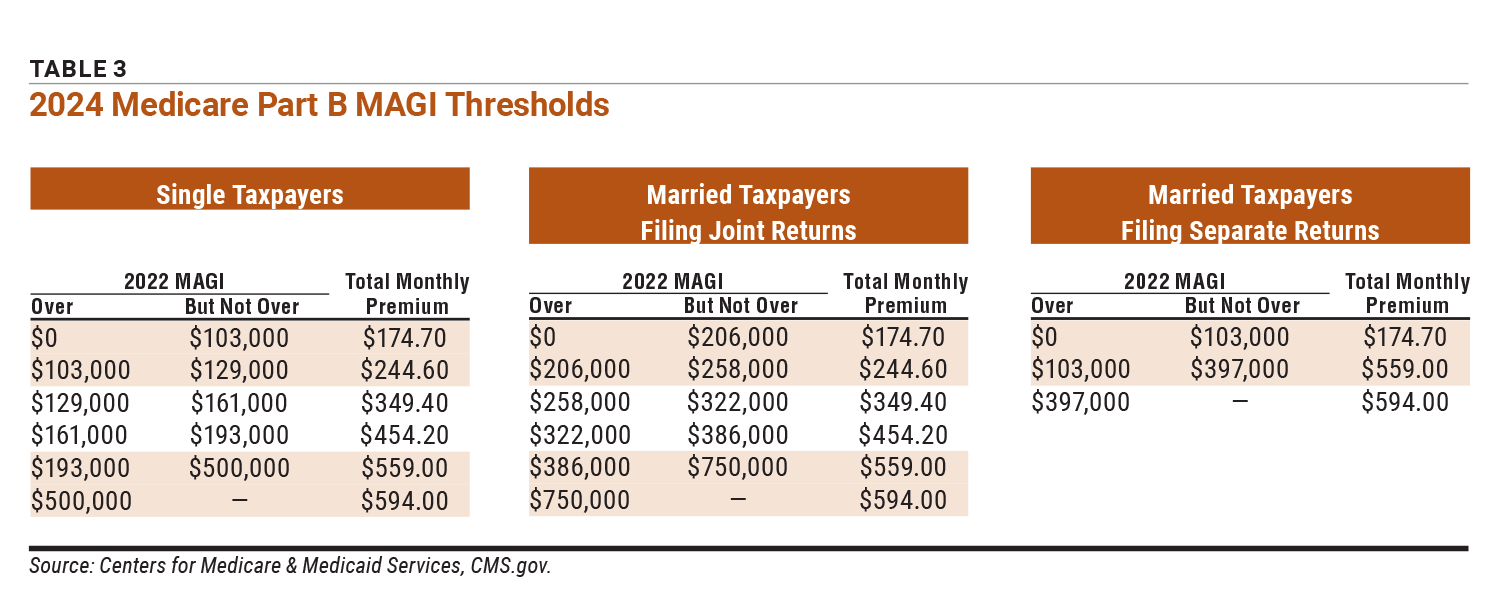
The MAGI discussed in this article determines the Medicare Part B and Part D premiums you will be charged two years from now. It is AGI plus tax-exempt interest. It is a number to watch closely because even a $1 bump over the limit can result in paying more than $1,000 per year in excess Part B premiums. Since it is impossible to know what Medicare premiums will be two years in the future, use the most current premiums available to determine the limit.
As you can see from the previous section, asset location matters. Even tax-friendly investments can become turncoats if held in the wrong type of account. Table 1 summarizes the impact of asset location for different types of accounts, as explained below.
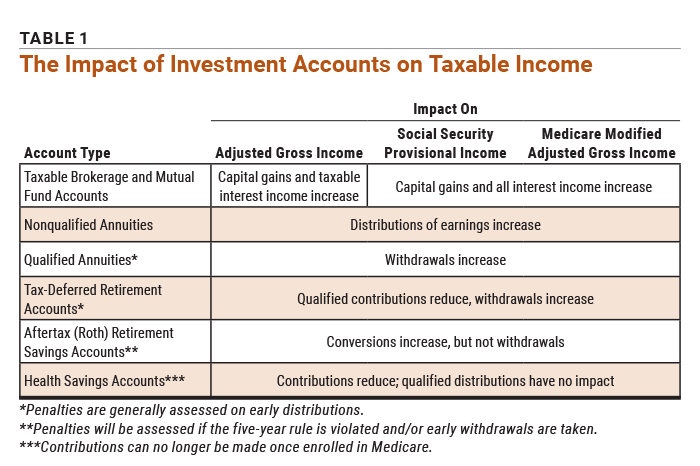
Taxable accounts are the least friendly when it comes to asset location. All capital gains and dividends are taxed. So are distributions from mutual funds, exchange-traded funds (ETFs) and closed-end funds (CEFs). Interest earned on cash savings, corporate bonds and Treasury bonds are taxable at the federal level.
Long-term capital gains realized in taxable accounts are added into AGI. This occurs even though such gains are taxed at the 0%, 15% and 20% reduced tax rates. Long-term capital gains are also subject to the net investment income (NII) tax, which is discussed in the Net Investment Income Tax section of this article.
Interest earned on municipal bonds is generally not taxed but counts toward both provisional income and MAGI.
The tax characteristics of annuities can be tricky but generally depend on whether the annuity is qualified or nonqualified.
Nonqualified annuity contracts are the most common type. They are purchased with aftertax dollars. Since the principal used to purchase the annuity has already been taxed, future distributions of the principal are tax-free. Distributions of the principal also do not impact provisional income or MAGI.
Distributions of earnings from nonqualified annuity contracts are taxable. These distributions add to AGI and therefore increase both provisional income and MAGI. As such, they can increase how much of your Social Security benefits are taxed and what you will pay in Medicare premiums two years from now.
Qualified annuities are purchased with pretax dollars and are held in a tax-deferred account like a traditional IRA or a 401(k) or 403(b) account. Qualified annuities have required minimum distributions (RMDs) starting at age 73 (rising to 75 in 2033). RMDs are included in AGI and therefore increase your provisional income and MAGI. (Nonqualified annuities are not subject to the RMD rules.)
Traditional IRAs or qualified employer-sponsored plan accounts such as 401(k)s, 403(b)s or 457(b)s are generally exempt from taxes. Capital gains, interest and fund distributions received within such accounts are tax-free, making these accounts attractive from an asset location perspective.
Contributions are generally tax deductible. As such, they reduce AGI for the tax year the contribution is attributed to.
Distributions from traditional IRAs, 401(k) plan accounts and other qualified retirement accounts are treated as taxable income. Distributions from these tax-deferred accounts increase AGI, provisional income and MAGI. These distributions are generally subject to an additional 10% penalty if taken before age 59½.
Like their tax-deferred counterparts, Roth IRAs, Roth 401(k)s and Roth 403(b)s are tax-friendly. Capital gains, interest and fund distributions received within such accounts are tax-free.
The key difference is that Roth accounts are funded with aftertax dollars. Contributions to Roth accounts do not alter your provisional income, AGI or MAGI.
Distributions from Roth accounts are tax-free. These distributions do not add to provisional income, AGI or MAGI as long as the five-year rule is met and the owner is at least 59½ years old. This makes Roth accounts even more attractive from an asset location perspective. The five-year rule basically holds that the Roth IRA must be five years old before taking distributions. If either rule is broken, a 10% penalty is generally applied to earnings.
Health savings accounts (HSAs) are the most attractive from a tax-planning standpoint. Contributions are tax deductible (therefore reducing AGI in the year they are made). Capital gains, dividends, interest and fund distributions realized within the account are not taxed. Finally, distributions are tax-free and do not count toward AGI as long as they are spent on qualified medical expenses.
There are limitations to these accounts. Individuals must be enrolled in a high-deductible health care plan (HDHP) and not be enrolled in Medicare to contribute. A 10% penalty applies to excess contributions, which can happen if a person is not enrolled in a qualified HDHP for the full calendar year. An additional 20% tax is levied on distributions that are not used for qualified medical expenses by those who are under the age of 65 and not disabled.
Medical expenses paid by an HSA distribution are not eligible to be counted as a deductible expense.
The primary purposes of strategically using asset location are to reduce taxable income and avoid the “tax torpedo.” The tax torpedo is the additional amount in taxes and/or Medicare premiums you will pay by having one extra dollar of annual income. It can be an extra dollar of provisional income, AGI or MAGI.
A key to navigating around the tax torpedo is understanding where the various income thresholds lie.
Once provisional income exceeds $32,000 for married joint filers ($25,000 for individuals), up to 50% of Social Security benefits will be taxed (Table 2). The percentage of benefits taxed rises to a maximum of 85% once provisional income exceeds $44,000 ($34,000 for single filers).
As noted previously, Medicare Part B and Part D premiums are based on MAGI from two years prior. MAGI earned in 2024 will determine your 2026 premiums. The MAGI thresholds are adjusted annually. The Centers for Medicare and Medicaid Services (CMS) announce the updated thresholds in early November and they are included in our annual tax guide.
Table 3 shows the 2024 thresholds for Medicare Part B. The first threshold is crossed when married joint filers’ MAGI exceeds $206,000 and single filers’ MAGI exceeds $103,000.
Also known as tax brackets, these are the most recognized tax rates. Marginal tax rates are the amount you owe on each dollar of taxable income. Taxable income is AGI less either the standard deduction or any itemized deductions. The tax on each dollar over the next marginal tax threshold is charged at the higher rate.
Realized capital gains and ordinary dividend income (dividends that do not qualify for the reduced tax rates) for assets located in taxable accounts count toward your AGI. Therefore, they both can alter how much of your Social Security benefits are taxed (via provisional income) and how much you will pay in Medicare premiums two years from now (via MAGI).
Short-term capital gains and ordinary dividends are taxed at your marginal tax rates. Long-term capital gains and qualified dividends are taxed at the reduced 0%, 15% and 20% rates. All are subject to the NII tax.
Interest earned from savings accounts, money market accounts, certificates of deposit (CDs) and taxable bonds located in taxable accounts is taxed at the marginal tax rate. It also increases AGI.
Interest earned from Treasury bonds is taxable at the federal level (and increases AGI) but not at the state level. Municipal bond interest is not taxable at the federal level but does increase both provisional income and MAGI.
The 3.8% NII tax is levied on taxable interest, dividends, nonqualified annuities, rents and royalties, capital gains and passive income from partnerships for assets held in taxable accounts. It can also apply to the sale of a primary residence if income is above the threshold and proceeds from the sale exceed the home sale exclusion of $500,000 for married joint filers and $250,000 for single filers.
The NII tax applies to married people filing jointly with MAGI above $250,000—$200,000 for single people—for both the 2023 and 2024 tax years. The MAGI is different here than what is used to determine Medicare premiums. The IRS defines MAGI for purposes of the NII tax, as AGI “for regular income tax purposes increased by the foreign earned income exclusion (but also adjusted for certain deductions related to the foreign earned income).” MAGI in this case will generally be the same as AGI for the majority of taxpayers who have not excluded any foreign earned income.
There are two types of investment accounts you can withdraw from without increasing your provisional income, AGI and MAGI: Roth accounts and HSAs.
These include Roth IRAs, Roth Simplified Employee Pension (SEP) IRAs, Roth 401(k) accounts, Roth 403(b) accounts and Roth 457(b) accounts. Qualified distributions from these accounts are excluded from your provisional income, AGI and MAGI.
Qualified distributions are those taken after the five-year period—beginning with the first tax year a contribution to a Roth for your benefit was made—and after you reach age 59½. Distributions are also treated as being qualified if you are disabled, if the distributions are made to a beneficiary following your death or if you meet the first home purchase exemption.
The income earned in the Roth account on distributions taken in violation of the five-year rule is taxed. If the withdrawals are taken by a Roth account owner who is under the age of 59½, a 10% penalty will apply to the amount converted to a Roth account.
HSAs share characteristics with both traditional and Roth retirement accounts. Contributions reduce AGI. (Contributions made by an employer are excluded from an employee’s income for tax purposes.) Amounts saved in an HSA grow tax-free.
Distributions from HSAs are tax-free as long as they are used to pay for qualified medical expenses. They are also tax-free if used to pay for long-term care insurance premiums (up to age-related limits), Medicare (but not Medicare supplemental policies), Consolidated Omnibus Budget Reconciliation Act (COBRA) coverage and related continuation coverage and health care coverage while receiving unemployment insurance. HSA dollars cannot otherwise be used for insurance premiums.
Distributions not used for qualified medical expenses are taxable and will be levied an additional 20% tax. This penalty is waived for those age 65 or older or disabled.
There are caveats. The contribution limit for HSAs is lower than it is for IRAs. The 2024 (and 2025) limits are $4,150 ($4,300) for individuals with self-only coverage and $8,300 ($8,550) for individuals with family coverage. The contribution limit falls to zero the first month a person enrolls in Medicare. Any excess contributions are subject to a 6% excise tax.
While we have provided you with several account options, there are two general asset location rules that will help you choose the right type of accounts for you. They are:
These are good for locating tax-friendly investments like index mutual funds and ETFs as well as municipal bonds. They also work well for holding master limited partnerships (MLPs). Just keep in mind that interest earned on municipal bonds will increase your provisional income and Medicare MAGI.
It can make sense to locate dividend-paying stocks in a taxable account because qualified dividends are eligible for the reduced tax rate. The same applies to long-term stock holdings. Just beware that dividend income and capital gains income can trigger the NII tax.
These accounts are good for holding less tax-friendly investments since capital gains and interest income are not taxed. Such investments include real estate investment trusts (REITs) and corporate bonds as well as mutual funds and ETFs with higher tax-cost ratios. You may also wish to locate investments used in higher turnover strategies in these types of accounts.
They are not desirable for municipal bonds because you lose the advantage of having the bond interest excluded from federal and potential state taxes.
From an asset location standpoint, Roth accounts share the same characteristics as traditional IRAs and 401(k) plan accounts. Neither capital gains nor interest income are taxable. This makes these accounts also appealing from an asset location perspective for holding REITs and corporate bonds as well as mutual funds and ETFs with higher tax-cost ratios.
Qualified annuities are suitable for a Roth IRA. When purchased within a Roth IRA, distributions are not taxed and therefore do not contribute to provisional income, AGI or MAGI. An exception exists if distributions are taken too early; in such cases, earnings are treated as taxable income.
Roth accounts are also not desirable for municipal bonds.
Like traditional and Roth IRAs, no capital gains or income realized on investments located in HSAs are taxed. This makes them suitable for less tax-friendly investments.
Depending on which investment company you have your HSA with, your investment options may be limited to their menu of offerings. Self-directed HSAs provide you with a range of options similar to what you would find in a traditional brokerage account.
Beyond asset location, here are some guidelines for managing your tax exposure in retirement. Properly timed and scaled Roth conversions can help you avoid the tax torpedo. Conversions are taxable in the year they happen, so you want to make sure you spread them out to avoid pushing your taxable income and provisional income, as well as your Medicare MAGI, above the next thresholds.
If you own traditional, taxable and Roth IRA accounts, do the math on planned withdrawals and any intended rollovers to avoid being bumped into higher tax thresholds. Make Roth conversions prior to reaching the RMD starting at age 73 (75 in 2023). After 73 (75), limit withdrawals from IRAs, 401(k) accounts, etc., to just the RMD and then withdraw the remaining amounts from taxable and Roth accounts. (See “A Case Study: How to Reduce Marginal Tax Rates in Retirement” in the November 2023 AAII Journal for more information.)
Use your IRAs to donate to charity. Qualified charitable distributions (QCDs) reduce your AGI dollar for dollar. Traditional charitable donations are not deductible unless you itemize. Even then, they are deducted after provisional income, AGI and Medicare MAGI are calculated.
Hold only tax-friendly investments in taxable accounts. In addition, avoid doing any short-term trading in these accounts.
FIGURE 1
Adjusted gross income (AGI) serves as the underlying basis for various income-related thresholds, including the percentage of your Social Security benefits that are taxed, the Medicare premiums you will pay and whether the net investment income (NII) tax applies.
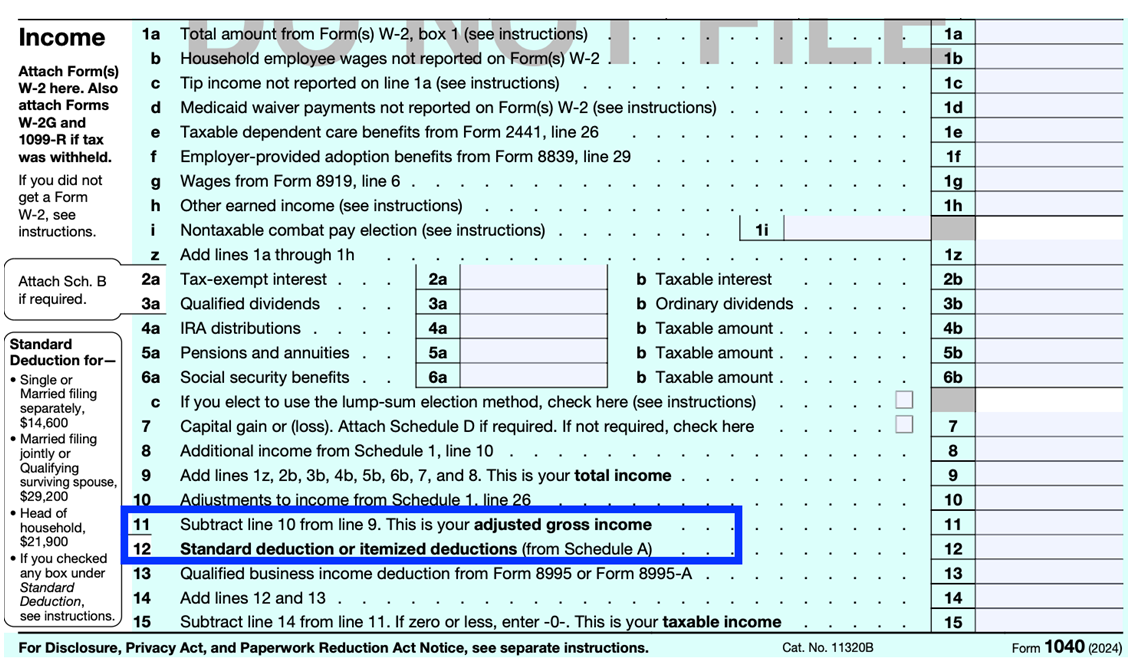
Source: Draft version of the 2024 Form 1040, Internal Revenue Service.
While smart asset location can reduce your tax exposure, do not let the tax tail wag the portfolio dog. Make the best investment decisions for your portfolio and then decide the appropriate account to carry out those actions.
Also, plan ahead whenever possible. This is particularly the case when it comes to Roth conversions and taking withdrawals from different types of accounts. If you are unsure about the tax consequences of your plans, consult a tax professional or financial planner versed in tax-friendly strategies.
Financial Planning

Feature


ROBERT A from NC posted over 2 years ago:
CRAIG B from WI posted over 2 years ago:
KEVIN V from NC posted over 2 years ago:
JAMES M from WA posted over 2 years ago:
F P from MA posted over 2 years ago:
DAVE G from TX posted over 2 years ago:
DAVE G from TX posted over 2 years ago:
DAVE G from TX posted over 2 years ago:
DAVE G from TX posted over 2 years ago:
DAVE G from TX posted over 2 years ago:
Richard M from NJ posted over 2 years ago:
BARRY J from TX posted over 2 years ago:
DAVID P from TX posted over 2 years ago:
FRANKLIN M from GA posted over 2 years ago:
You need to log in as a registered AAII user before commenting.
Log InCreate an account