

Related

Financial Planning
Combining an optimal Social Security claiming strategy with a multiphase withdrawal strategy that exploits the rising and falling pattern of marginal tax rates can add substantial value to a retirement portfolio.

In our last AAII Journal article (“The Importance of Considering Marginal Taxes When Taking Withdrawals,” September 2023), we discussed how ordinary income—including that from tax-deferred account withdrawals, such as a 401(k)—combined with Social Security benefits and Medicare income-related monthly adjustment amounts (IRMAAs) can increase marginal tax rates well above the taxpayer’s tax bracket. The marginal tax rate is the tax rate on a dollar of ordinary income adjusted for the taxation of Social Security benefits and Medicare thresholds.
This article builds on the prior article with a case study that illustrates several points. First, households should consider marginal tax rates—and not tax brackets—when withdrawing funds in retirement. Second, coordinating a smart Social Security claiming strategy with a multiphase withdrawal strategy that exploits the rising and falling pattern of marginal tax rates in retirement will usually add substantial value to the retired household’s accounts. The increase is in comparison to a household that follows either the conventional wisdom or proportional withdrawal strategies. The additional value is usually substantially larger if someone follows the conventional wisdom or a proportional withdrawal strategy and begins Social Security benefits at retirement. The conventional wisdom strategy withdraws all funds from the taxable accounts first, then withdraws all funds from the tax-deferred accounts and lastly withdraws all funds from the Roth account. The proportional withdrawal strategy is what we believe many readers of Fidelity’s and Charles Schwab’s discussion of their proportional withdrawal strategies would do. It involves taking proportionate withdrawals from all accounts each year. Compared to the conventional wisdom withdrawal strategy, this would move some tax-deferred account withdrawals to fill low tax brackets in early retirement years.
Our case study involves Betty, a single individual who was born December 2, 1960. She has a full retirement age of 67 years. Her primary insurance amount (PIA)—the amount she would receive monthly by claiming Social Security benefits at her full retirement age—is $2,400. She has a financial portfolio worth $750,000, consisting of $650,000 in a tax-deferred account and $100,000 in a taxable account with a cost basis of $85,000. She will spend $4,825 in real (inflation-adjusted) terms per month (beyond Medicare premiums) beginning in January 2024, which is when this analysis begins. Betty’s life expectancy is 90 years.
We assume inflation is 2.5% per year, which will affect tax brackets, standard deductions, the Medicare standard premium and threshold levels for the modified adjusted gross income used to determine Medicare premiums (which we call MAGImed). She maintains a 60% bond/40% stock portfolio with stocks allocated first to the taxable account and then, when one is present, to the Roth account. Bond annual returns are 3% per year, while stock returns are 7.2% per year (1.7% dividend income and 5.5% capital appreciation).
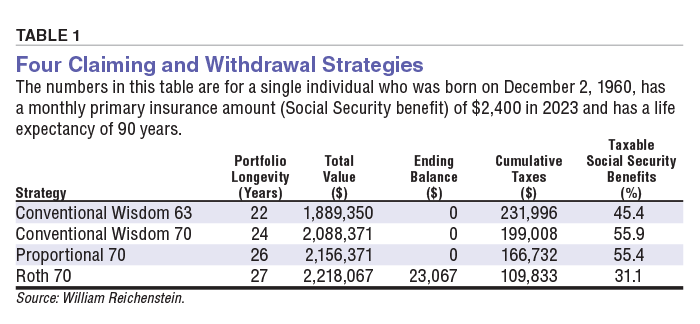
Table 1 presents the results from four combinations of 1) Social Security claiming strategies and 2) withdrawal strategies. Notice that Betty’s optimal strategy in retirement requires coordinating her Social Security claiming strategy and her withdrawal strategy. She pays no Medicare IRMAAs in any year in any of these strategies.
In the conventional wisdom 63 strategy, she claims Social Security benefits at her retirement at age 63 in December 2023. The first payment is received in January 2024. In this strategy, she withdraws all funds to meet her spending needs from her taxable account until it is exhausted. She then withdraws funds from her tax-deferred account until it is exhausted. Her portfolio meets her spending needs for 22 years, but it fails to meet her spending needs in her last five years.
In the conventional wisdom 70 strategy, she claims Social Security benefits at age 70 and withdraws funds using the conventional wisdom withdrawal strategy. This strategy meets her spending needs for 24 years, but it fails to meet her spending needs in her last three years. Thus, the optimal Social Security claiming strategy added two years of longevity and $199,021 in total value compared to the conventional wisdom 63 strategy. The total value is an aftertax amount that consists of the sum of spending (beyond Medicare premiums) plus the ending balance, which, when positive, is the remaining aftertax funds inherited by heirs. (Inherited tax-deferred account balances are reduced by 20% to reflect an estimate of lost balances due to taxes.)
In the proportional 70 strategy, she claims Social Security benefits at age 70 and withdraws funds from her portfolio following the proportional withdrawal strategy. In this strategy, she withdraws funds proportionately from her taxable account and tax-deferred account each year, subject to the requirement that her tax-deferred account withdrawal is at least as large as her required minimum distribution (RMD), when it applies. Her portfolio lasts 26 years, but it fails to meet her spending needs in her last year.
In the Roth 70 strategy, she claims her Social Security benefits at age 70 and follows a three-phase withdrawal strategy that is described in the next section. Her portfolio lasts her 27-year life-span in retirement and her heirs inherit $23,067 of aftertax funds. Compared to the results from the conventional wisdom 70 strategy, this optimal withdrawal strategy adds three years of longevity and $129,696 in total value.
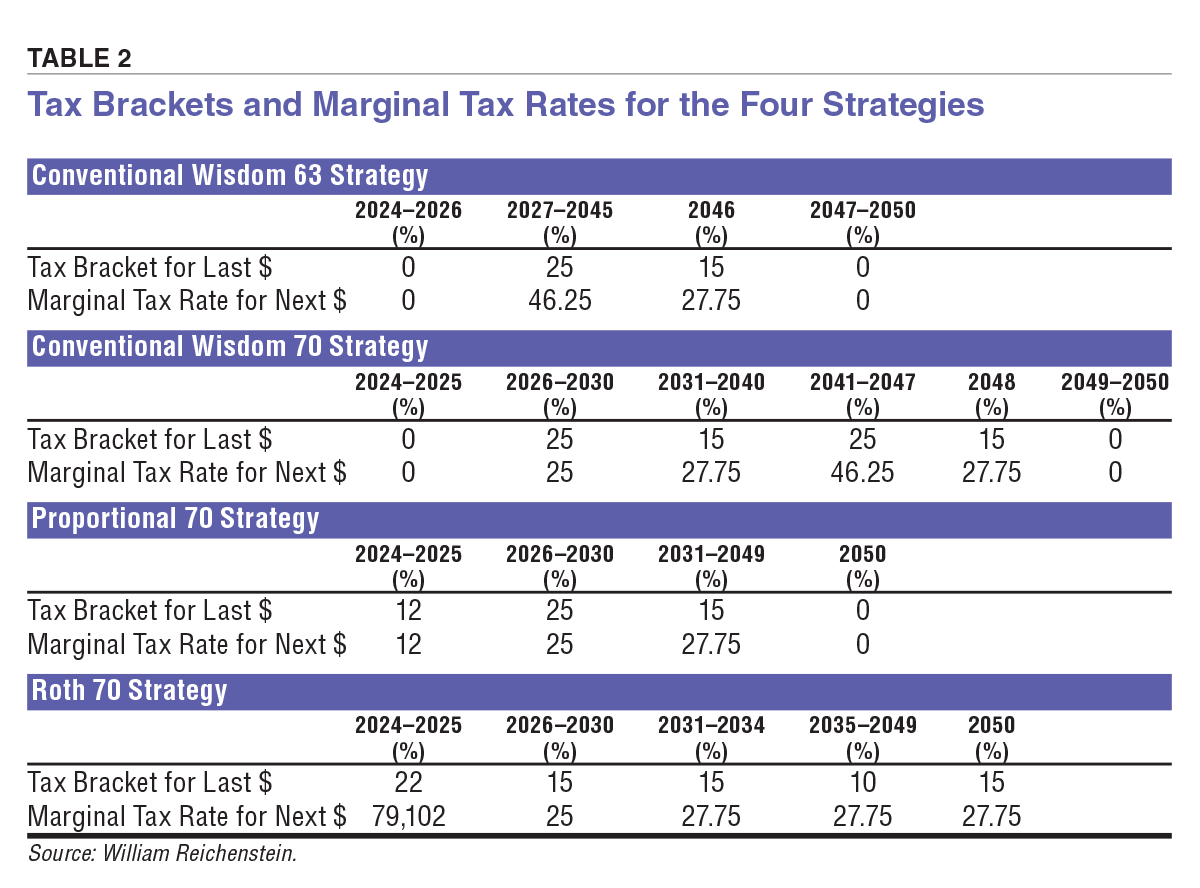
To understand why the Roth 70 strategy is able to add so much value, let’s examine the tax bracket on the last dollar of income and the marginal tax rate if one more dollar would be withdrawn from her tax-deferred account in each retirement year from these four strategies (Table 2).
In the conventional wisdom 63 strategy, Betty will be in the 0% tax bracket between 2024 and 2026, when funds are withdrawn from her taxable account. Since her adjusted gross income (AGI) will be less than her standard deduction in these years, the marginal tax rate if she withdrew $1 from her tax-deferred account would be 0%. Her taxable account will be exhausted late in 2026.
In 2027 through 2045, when all withdrawals come from her tax-deferred account, Betty will be in the 25% tax bracket, but her marginal tax rate on the next dollar withdrawn from her tax-deferred account would be 46.25% (25% tax bracket × 1.85) due to the taxation of her Social Security benefits. As explained in our September 2023 article, this dollar withdrawn from her tax-deferred account would cause another $0.85 of Social Security benefits to be taxed. So, her taxable income would rise by $1.85. Her portfolio will be exhausted in 2046 and will fail to meet her spending needs in her last five years.
In 2046, Betty will be in the 15% tax bracket, but would have a marginal tax rate of 27.75% (15% bracket × 1.85). In 2047 through 2050, her only income will be her Social Security benefits. So, she will be in the 0% tax bracket and would have a marginal tax rate of 0%.
In the conventional wisdom 70 strategy, Betty will be in the 0% tax bracket in 2024 and 2025 and her marginal tax rate on the next dollar of income would be 0%. Her taxable account will be exhausted late in 2025. In 2026 through 2030, she will be in the lower end of the 25% tax bracket and, because she has not yet begun her Social Security benefits, her marginal tax rate would also be 25%.
Betty’s Social Security benefits begin in 2031. The combination of Social Security benefits and tax-deferred account withdrawals will place her in the high end of the 15% tax bracket in 2031 through 2040 and in the low end of the 25% bracket in 2041 through 2047. However, due to the taxation of Social Security benefits, the marginal tax rates on the next dollar withdrawn from her tax-deferred rates in these years would be 27.75% (15% bracket × 1.85, reflecting the taxation of Social Security benefits) in 2031 through 2040. Her marginal tax rate would rise further to 46.25% (25% × 1.85) in 2041 through 2047.
Betty’s portfolio will be exhausted after withdrawing her remaining tax-deferred account funds in 2048. In 2048, her tax bracket on the last dollar of income will be 15%, while her marginal tax rate would be 27.75%. In 2049 and 2050, her Social Security benefits will be her only income. So, her tax bracket and marginal tax rate would be 0% in these years.
In the proportional 70 strategy, Betty will withdraw funds proportionately from her taxable account and tax-deferred account each year with the qualification that her tax-deferred account withdrawal must be at least as large as her RMD. She will be at the high end of the 12% tax bracket in 2024 and 2025 and at the low end of the 25% bracket in 2026 through 2030 as shown in Table 2. Betty’s marginal tax rates on the next dollar of income would be the same in these years because she will not have yet begun taking Social Security benefits.
Her Social Security benefits will begin in 2031. So, in 2031 through 2049, Betty’s tax bracket will be 15%, but the marginal tax rate on the next dollar of income will be 27.75% (15% × 1.85). Her portfolio will be exhausted in 2050. So, her tax bracket and marginal tax rate would be 0% in her last year.
The Roth 70 strategy combines the optimal Social Security claiming strategy with a multiphase withdrawal strategy that is identified by the Retiree Inc. Income Solver software.
In phase one, during 2024 and 2025, Betty withdraws funds from her taxable account to meet her spending needs. She will then make Roth IRA conversions whose total dollar value will keep her taxable income below the first Medicare AGI threshold level. The last dollar withdrawn from her tax-deferred account and converted to her Roth account is taxed at the 22% bracket. If she were to convert another dollar to the Roth and will be on Medicare Part B two years hence, then this withdrawal from the tax-deferred account would cause her to pay the first Medicare IRMAA. Thus, she would pay a marginal tax rate of 79,102%, which would be primarily caused by the Medicare IRMAA of $790.80.
In phase two, from 2026 through 2030, Betty will withdraw funds from her tax-deferred account to fill the 15% tax bracket. She will then make tax-free withdrawals from her Roth account to meet the rest of her spending needs. Her last dollar of taxable income will be subject to the 15% tax bracket. If she were to withdraw another dollar from her tax-deferred account, it would be subject to the 25% tax bracket. Since her Social Security benefits have yet to begin, the marginal tax rate on the next dollar of income in these years would also be 25%.
Betty’s Social Security benefits will begin in 2031. In 2031 through 2034, the combination of Social Security benefits and tax-deferred account withdrawals will meet her spending. In these years, her tax bracket will be 15%, but her marginal tax rate on the next dollar of tax-deferred account withdrawals would be 27.75% [15% bracket × 1.85].
In phase three, from 2035 to 2049, Betty will make tax-deferred account withdrawals to fill the 10% bracket. She will then make tax-free Roth account withdrawals to meet the rest of her spending needs. Her tax bracket on the last dollar of income will be 10%, but the marginal tax rate on the next dollar of income would be 27.75% [15% bracket × 1.85]. Betty’s Roth account will be exhausted in 2050. So, she will have to withdraw additional funds from her tax-deferred account to meet her spending needs. She will be in the 15% tax bracket and have a 27.75% marginal tax rate in the last year.
The value added from the Roth 70 strategy is attributable to two factors. First, in this strategy, Betty will make substantial Roth conversions in 2024 and 2025 totaling $179,190. These converted dollars will be subject to tax brackets of 0%, 10%, 12% and 22%. Since her Social Security benefits have not yet begun, these were also her marginal tax rates.
These early-year Roth conversions will provide the tax-free Roth funds that will allow her to avoid 1) additional tax-deferred withdrawals in 2026 through 2030—the first of which would have been taxed at marginal tax rates of 25%, and 2) additional tax-deferred account withdrawals in 2031 through 2050. The first of these withdrawals would have been taxed at a marginal tax rate of 27.75%. Moreover, in many of these years, some of the additional tax-deferred account withdrawals to meet her spending needs would have been subject to the 25% tax bracket and taxed at marginal tax rates of 46.25% (25% × 1.85). Thus, the Roth conversions in 2024 and 2025 that will be made at marginal tax rates of 0% to 22% will allow Betty to avoid additional tax-deferred account withdrawals in her remaining years that would have been taxed at marginal tax rates of 25% to 46.25%.
Second, in this Roth 70 strategy, the tax-free Roth account withdrawals in 2031 through 2050 will not affect her provisional income and, thus, not increase the taxable portion of her Social Security benefits. Thus, the taxable portion of her Social Security benefits is only 31.1% in this Roth 70 strategy. In contrast, it is much higher in the other strategies, especially in the other strategies where she delays her Social Security benefits until age 70.
Separately, we believe many readers of Fidelity’s and Schwab’s proportional withdrawal strategy material would claim Social Security benefits at retirement and follow their proportional withdrawal strategy. If Betty followed this proportional 63 strategy, her portfolio would have failed to meet her spending needs for her last four years and produced a total value that is $295,200 less than the Roth 70 strategy. Thus, it is important to coordinate both the Social Security claiming strategy and the withdrawal strategy.
The case we presented is for a single retired household with moderate wealth. As previously explained, there are many factors to consider when determining the optimal strategy for coordinating Betty’s Social Security claiming strategy with her withdrawal strategy in retirement. Now, let us consider how the lessons of the importance of coordinating these two strategies would apply to a retired household with higher wealth and/or that is a married couple.
First, single retirees who have a slightly higher level of wealth need to consider how their coordinated Social Security claiming strategy and withdrawal strategy would affect their lifetime Medicare premiums. The possibility of having to pay IRMAAs in one or more retirement years adds another layer of complexity.
There are additional considerations for a married couple. For simplicity, assume the husband dies first and leaves his retirement accounts to his wife, who is two years younger than him. If she has reached her RMD age, then her RMDs will be modestly lower than their RMDs would have been if both partners were still alive. The interest, dividends and capital gains from their joint taxable account will be the same. Furthermore, the surviving spouse usually inherits any pension income their deceased spouse may have had. Finally, the surviving spouse usually inherits the larger of the married couple’s Social Security benefits, which is often the lion’s share of their joint benefits when both partners were alive.
Thus, the survivor’s AGI and MAGImed will likely only be modestly lower than they would have been if both partners were still alive. Since the tops of the first five tax brackets are twice as high for married couples as they are for singles, the survivor will likely be in a higher tax bracket than they would have been in as a married couple. Furthermore, since the first four MAGImed income threshold levels are twice as high for married couples as for singles, a surviving spouse with a higher level of financial assets may pay multiple IRMAAs every year beginning three calendar years after the death of the first spouse. In fact, the surviving spouse could pay more in Medicare premiums for each of these years than the couple would have paid if both partners were still alive.
The lesson is that retired married households usually have more to gain than retired single households by making Roth conversions while both partners are still alive. Yes, these factors add several additional layers of complexity to the analytic framework, but the logic behind this statement is not difficult to understand. Thus, to reduce the couples’ joint lifetime income taxes and their joint lifetime Medicare premiums, married households should consider making Roth conversions while both spouses are still alive.
As noted in our September 2023 article, the conventional wisdom of first withdrawing all funds from a taxable account, then all funds from a tax-deferred account until exhausted and finally from a Roth account until exhausted is seldom a tax-efficient withdrawal strategy. Fidelity and Schwab recommend proportional withdrawal strategies in retirement that are generally much more tax efficient than the conventional wisdom withdrawal strategy.
Coordinating a smart Social Security claiming strategy and a multiphase tax-efficient withdrawal strategy will usually add substantially more value to retirees’ accounts than the combination of 1) claiming Social Security benefits at the beginning of retirement and 2) using a proportional withdrawal strategy. Furthermore, as demonstrated in Betty’s case study, even if a household combined the optimal Social Security claiming strategy with a proportional withdrawal strategy, substantial additional value can be added by combining the optimal Social Security claiming strategy with a multiphase withdrawal strategy that exploits the rising and falling pattern of marginal tax rates attributable to the taxation of Social Security benefits and Medicare IRMAAs.
Financial Planning

Financial Planning
Financial Planning

BERNARD V from NC posted over 2 years ago:
MICHAEL S from WA posted over 2 years ago:
DAVE G from TX posted over 2 years ago:
Don P from USA posted over 2 years ago:
JOHN L from NJ posted over 2 years ago:
ROBERT A from NC posted over 2 years ago:
ROBERT A from NC posted over 2 years ago:
ROBERT A from NC posted over 2 years ago:
ROBERT A from NC posted over 2 years ago:
ROBERT A from NC posted over 2 years ago:
VICTOR S from NC posted over 2 years ago:
STUART L from MI posted over 2 years ago:
CHARLES R from IL posted over 2 years ago:
Richard P from IL posted over 2 years ago:
DAVE G from TX posted over 2 years ago:
JOE W from WA posted over 2 years ago:
DAVE G from TX posted over 2 years ago:
JOSEPH K from TX posted over 2 years ago:
MICHAEL C from MI posted over 2 years ago:
MARK R from WI posted over 2 years ago:
DAVE G from TX posted over 2 years ago:
DAVE G from TX posted over 2 years ago:
DAVE G from TX posted over 2 years ago:
MARK R from WI posted over 2 years ago:
DAVE G from TX posted over 2 years ago:
You need to log in as a registered AAII user before commenting.
Log InCreate an account