


Related

Portfolio Strategies
Strategic tax planning alongside delayed Social Security claiming can increase portfolio longevity and legacy in retirement.

This example from the second edition of my book, “Retirement Planning Guidebook: Navigating the Important Decisions for Retirement Success” (Retirement Researcher Media, 2023), shows how strategic tax planning alongside delayed Social Security claiming can increase portfolio longevity and legacy in retirement. Specifically, we examine the case for a 62-year-old couple that has just retired in 2023. They have $2.5 million of investment assets, divided between $500,000 in a taxable account, $1.7 million in a traditional tax-deferred individual retirement account (IRA), and $300,000 in a tax-exempt Roth IRA. The cost basis for their taxable assets is also $500,000.
Their goal is to spend $120,864 per year in retirement, net of any federal income taxes until age 85, and then $95,245 per year afterward. They live in a state that does not tax income. For Social Security, I simplified to make them a one-earner couple. The primary insurance amount is $30,000 per year for the worker. The couple will get $32,250 if they both claim at age 62 and $52,200 if they claim at age 70. For their retirement finances, the priority is to build a financial plan that will cover their spending goals through age 95. When meeting spending goals, a secondary priority is to maximize the aftertax surplus of wealth for their beneficiaries at age 95. For this case study, all strategies succeed in meeting the spending goal so that we can focus on which strategy provides the largest legacy.
The couple must pay federal income taxes—an additional expense that will be estimated beyond their spending goals. I calculate taxes on the portfolio distributions, including interest from the taxable account, the ordinary income generated from IRA distributions, the precise amount of taxes due on Social Security benefits, any Medicare premium surcharges if modified adjusted gross income (AGI) exceeds the relevant thresholds and any potential net investment income surtaxes due. These taxes are calculated based on the tax law in 2023, including the shift to higher tax rates in 2026 that is part of the sunsetting provisions in current law. Tax brackets increase with inflation, though the thresholds for determining taxes on Social Security and the net investment income tax are not adjusted for inflation. Our couple uses the standard deduction instead of itemizing.
This example does not incorporate asset location issues and long-term capital gains management, as I follow the funded ratio assumption that all funds are invested in bonds to see if the financial plan can work without taking market risk. This simplifies real (inflation-adjusted) investment returns to be 1.75% with inflation of 2.5% for an overall 4.29% return. Investments are held in bonds and provide 4.29% taxable interest payments annually without potential for capital gains or losses. While investment returns are simplified, the full tax code has been built into the example.
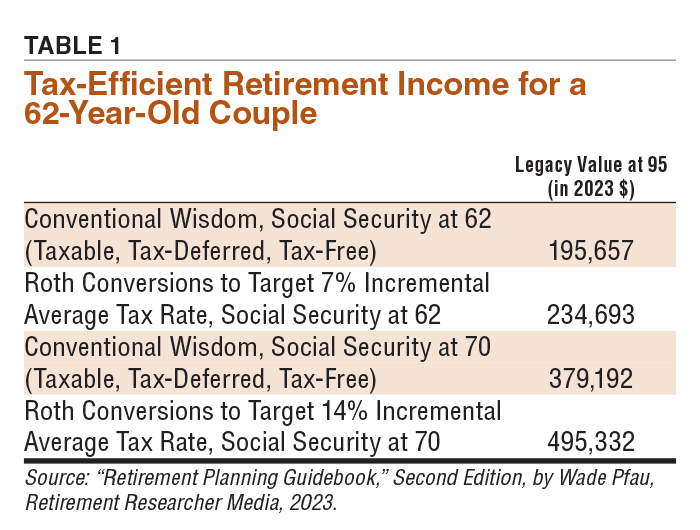
Table 1 summarizes the overall results for this case study. It shows four different strategies, all of which support the spending goal through age 95. The difference is the aftertax legacy value of investment assets at the planning age. To determine the aftertax legacy value, taxable assets receive a step-up in basis at death, providing their full value for heirs. Tax-deferred assets maintain their embedded income tax liability after death. I assume that adult children will be beneficiaries, and the SECURE Act would require them to spend down the account within a 10-year window when they may still be in their peak earning years and face higher tax rates. To reflect this, I assume that remaining tax-deferred assets will be taxed at a 25% rate to reduce their legacy value to heirs. Tax-exempt Roth assets also face the same distribution requirements, but they will not be taxable to heirs, so their full value passes as legacy. Note that this goal of maximizing aftertax legacy values is not necessarily the same as minimizing taxes, as more wealth can lead to more taxes while also providing greater aftertax wealth.
The first strategy (Conventional Wisdom, Social Security at 62) is to claim Social Security at age 62 and to follow the conventional wisdom for spending down assets: Take any required minimum distributions (RMDs), then spend the taxable portfolio, then the tax-deferred portfolio and then the tax-exempt portfolio. If RMDs and Social Security add up to more than the spending need, the excess is invested in the taxable account. This strategy supports $195,657 of legacy in today’s dollars.
The second strategy (Roth Conversions to Target 7% Incremental Average Tax) continues with claiming Social Security at 62, but it uses a more tax-efficient drawdown strategy that supports $234,693 of legacy. The answer for creating tax-efficiency beyond the conventional approach generally involves spending from a blend of taxable and tax-deferred assets to meet expenses and to potentially make Roth conversions to generate more taxable income beyond what is needed to cover current spending, while taxable assets remain. Once taxable assets are depleted, the retiree then shifts to spending a blend of tax-deferred and tax-exempt assets to control the amount of taxable income and taxes, which might also include Roth conversions, in a manner that allows for the greatest aftertax spending and legacy potential for investment assets.
The next set of strategies also shows the value of delaying Social Security. First, the couple claims Social Security at 70 and uses the conventional wisdom spend-down strategy (Conventional Wisdom, Social Security at 70). This increases the legacy for the investment assets to $379,192. The final strategy uses age 70 claiming along with Roth conversions (Roth Conversions to Target 14% Incremental Average Tax, Social Security at 70), which increases the legacy supported by investments to $495,332. As delaying Social Security adds value to the plan, I proceed with this tax planning discussion by detailing the differences between the conventional wisdom strategy and a more tax-efficient strategy when both use age 70 for Social Security claiming. As can be seen, the topics described in this article can add significantly to the performance of a retirement plan.
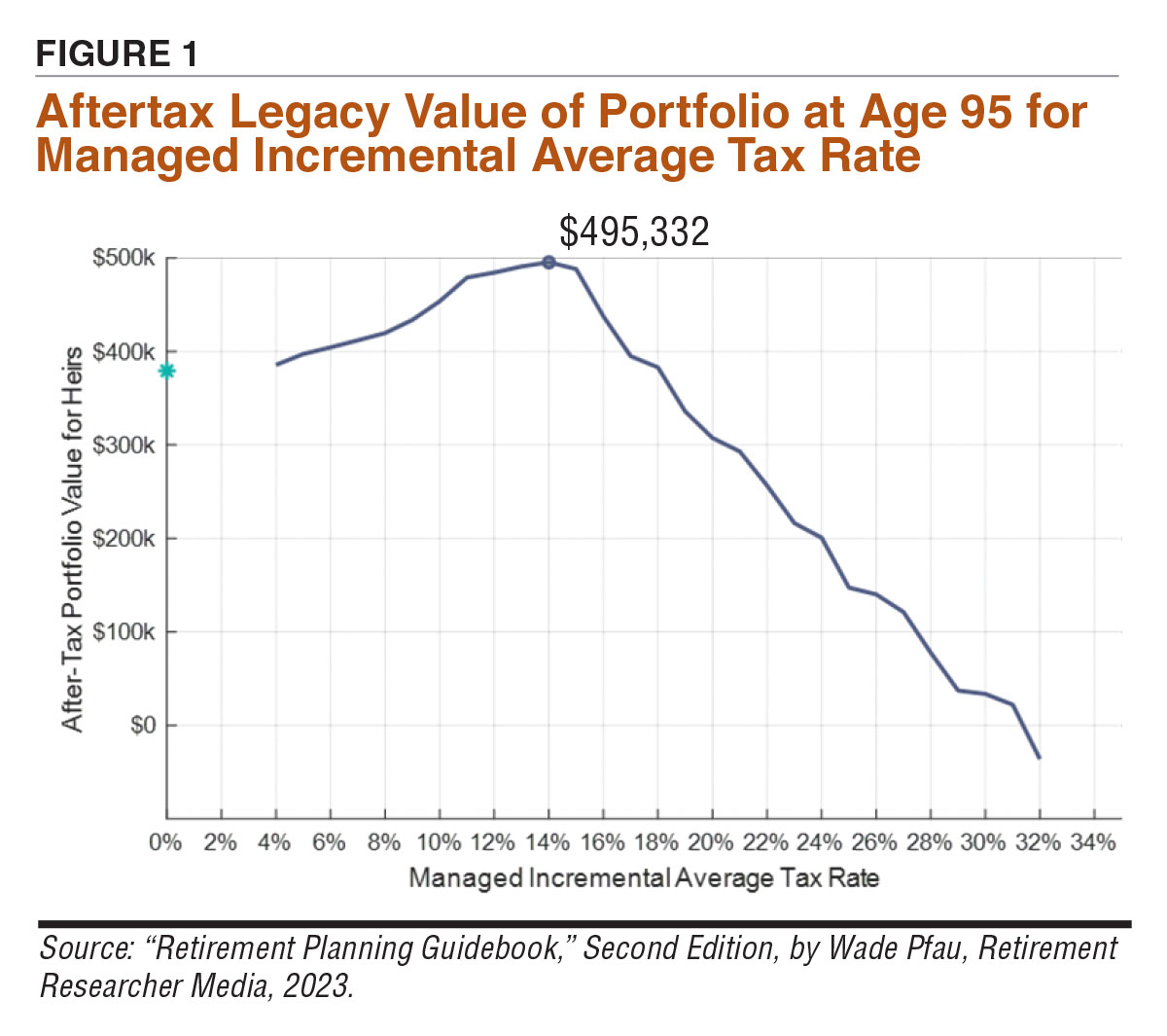
Figure 1 shows the analysis when managing different incremental average tax rates paid on additional IRA disbursals used for spending or Roth conversions. Legacy peaks at an incremental average tax rate target of 14%, though legacy values are quite close for a range of tax targets from about 10% to 16%. With the 14% target, the legacy in today’s dollars is $495,332. The conventional wisdom tax strategy supported $379,192 of the legacy. These are the two strategies we investigate further.
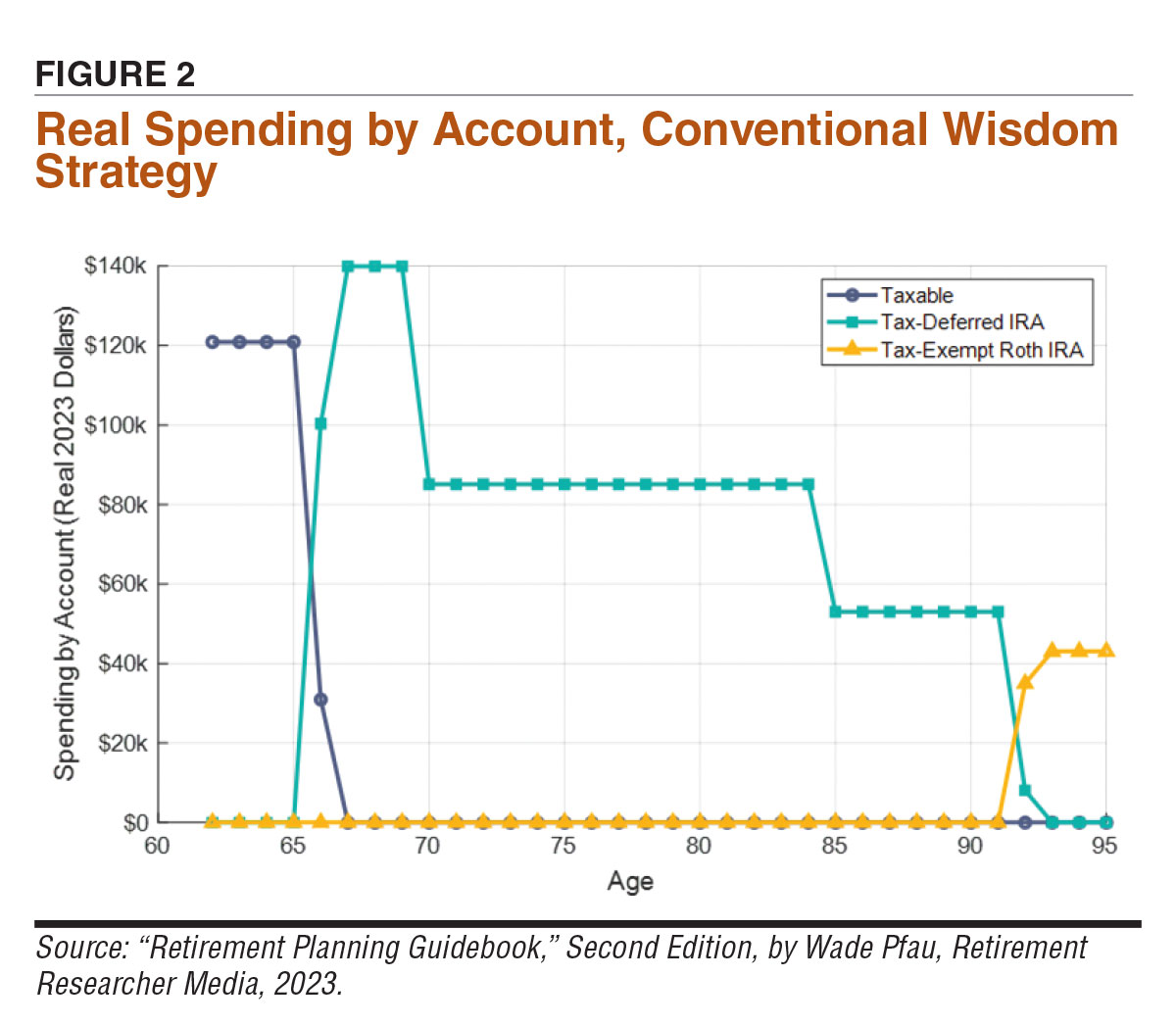
In Figure 2, we start by showing the spending by account type over retirement in real dollars for the “conventional wisdom, Social Security at 70” strategy. Taxable assets are spent first. There is enough to cover the first four years of spending and part of the fifth year (age 66). Then, we shift to the tax-deferred account. Spending increases at first to account for the higher taxes with these distributions. It falls at age 70 as Social Security begins and falls at age 85 with the reduction of the spending goal. The tax-deferred account depletes at age 92, and then the tax-exempt Roth account covers the remainder of spending. These distributions are also a bit smaller, as taxes decrease when spending is sourced to the Roth account.
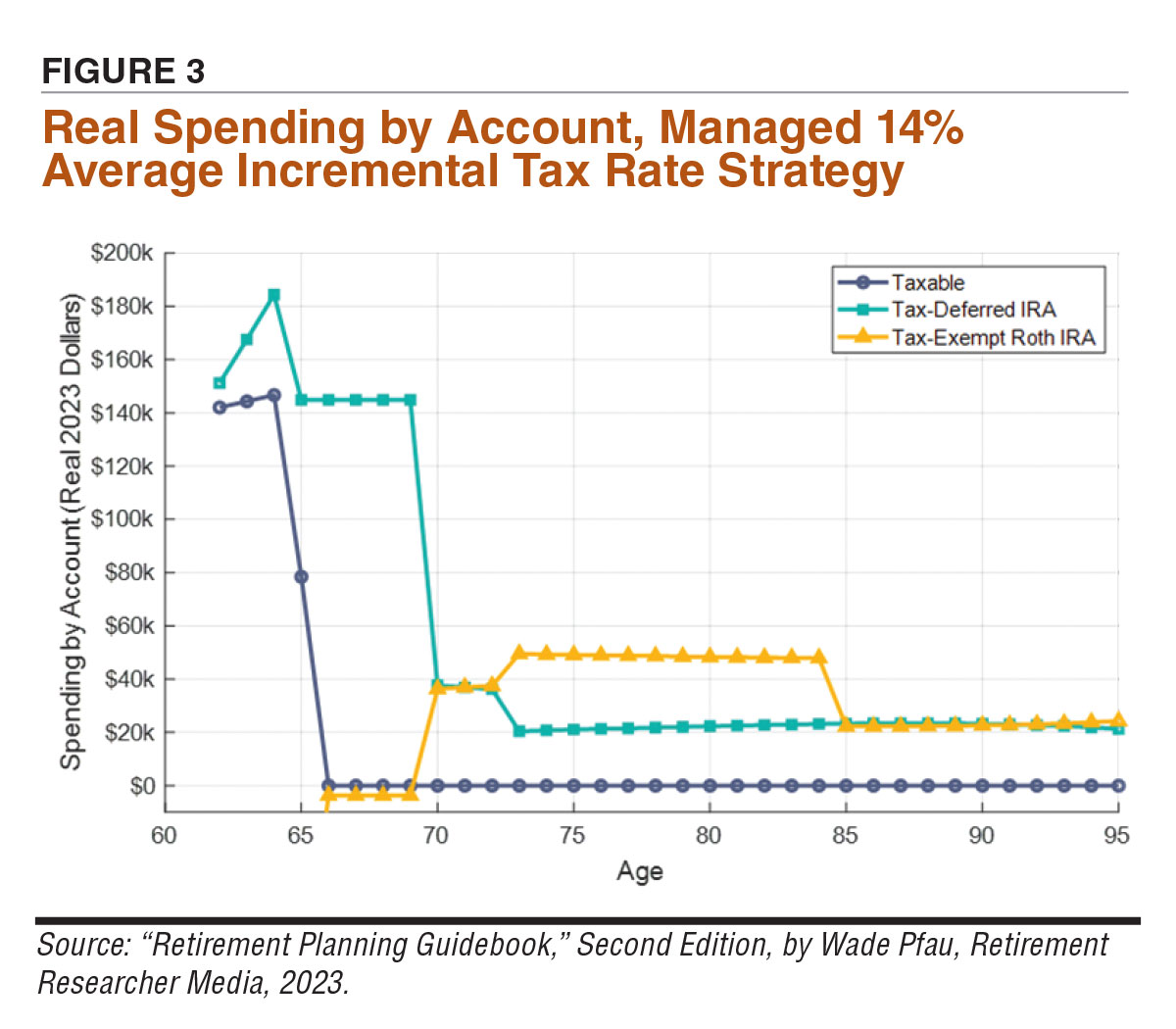
Next, Figure 3 shows spending by account type for the more tax-efficient strategy (Roth Conversions to Target 14% Incremental Average Tax Rate). Tax-deferred account distributions remain high through age 69. This is primarily driven through Roth conversions and covering spending needs. The Roth IRA distributions are negative in these years as inflows arrive from the conversions. I do not show those negative values to make the lines easier to see, but the amount of Roth conversions and the negative values reflect the inflows to the tax-exempt account. With Roth conversions, taxes will be higher, and this also leads to greater distributions from the taxable account to cover spending needs and taxes. The taxable account now depletes at age 65.
At age 65, retirement spending needs are sourced to the tax-deferred account, pushing the starting point for considering conversions to higher tax brackets. This makes it harder to engage in Roth conversions while keeping the incremental average tax rate on the additional distributions below 14%, so Roth conversions decline dramatically. Social Security begins at age 70, further reducing tax-deferred distributions and leading to tax-exempt distributions from the Roth to help manage taxes.
At age 73, the distributions enter a phase in which RMDs are taken from the tax-deferred account, raising the initial base of taxable income. There is no longer an opportunity to manage further distributions at a level below the tax target. The remainder of the spending goal is covered through distributions from the tax-exempt account. This continues for the remainder of retirement, with a drop in the spending goal at age 85. At age 95, there are still assets in the tax-deferred (legacy value is $131,433) and tax-exempt (legacy value is $363,899) accounts.
One may wonder why the tax-deferred distribution is higher at ages 70 to 72, compared to age 73 and later. This is a quirk of the incremental average tax rate methodology, as in the years before RMDs begin there is a longer runway for generating taxable income with a smaller tax impact to keep the incremental average tax rate lower for longer, allowing for greater total taxable income. Once RMDs begin, the starting point for incremental disbursals is higher, which causes the 14% average tax rate threshold to be reached more quickly. As will be seen later, this couple is impacted by the tax torpedo, and they cannot generate more taxable income beyond their RMDs without immediately exceeding their target rate.
There are no Roth conversions with the conventional strategy. But Roth conversions play an important role with the more tax-efficient strategy, especially in the first four years when spending needs and taxes are covered by the taxable account. A small amount of Roth conversions continue until Social Security begins at age 70, and then these opportunities end as the Social Security tax torpedo will come into play.
For Roth conversions, the early retirement years consist of spending down taxable assets like in the conventional strategy, but also generating more taxable income by converting assets from the tax-deferred account into the Roth account while the extra taxes can be paid at a low enough average rate. The first three years of retirement witness Roth conversions of more than $150,000 per year, which can be done while keeping the average incremental tax rate below 14% as income pushes through the 0%, 10%, 12% and 22% tax brackets. In the first year, the Roth conversion is $151,220. This amount was determined because it generates $21,171 in tax, compared to $0 tax before Roth conversions begin. This is precisely an incremental average tax rate of 14% ($21,171 ÷ $151,220).
The taxes considered in this case study include the impact of ordinary income marginal tax rates, the impact on taxable Social Security, the impact on Medicare premiums in two years (estimated as a part of current-year taxes to determine the average tax rate), the impact of shifting preferential income into higher tax brackets and the impact of additional net investment income and Medicare surtaxes. The targeted incremental average tax rate providing the best financial outcome can then be determined.
To find a method that can be reasonably explained, the incremental average tax rate works well. This is a measure of the total change in taxes due as a percentage of the additional IRA disbursal or Roth conversion amount. It goes beyond the marginal tax increase of the last dollar of the conversion to look at the entire tax impact of the conversion. It is easier to compute because there are fewer potential target tax rates to test than with other approaches that aim to manage levels of adjusted gross income (AGI). It also naturally allows the income thresholds to adjust based on the tax situation in a straightforward manner to pick up nonlinearities in the tax code that impact taxes each year. The optimal strategy does not have to be described as multiphased with different income thresholds targeted at different points in retirement. Finally, it will be easier to use average tax rates in real-world applications as individuals can more easily target when the additional tax on a Roth conversion remains below the targeted incremental average rate threshold.
But this method is not perfect. First, for any individual case, there is still a need for some sort of software or projection to decide which incremental average tax rate should be targeted. Second, there could be more efficient methods than what I describe. The average incremental tax rate performs well in comparison to more sophisticated approaches, but I do not claim that it is the best. Tax-efficient distribution strategies are an area of active research and different software programs are being developed for both financial advisers and individual consumers.
For the conventional strategy, AGI is low during the first four years, as the only taxable income source is interest earned on the taxable assets. AGI increases dramatically from ages 66 to 91, as distributions from the tax-deferred account (treated as ordinary income) become the primary spending source. Social Security also helps to meet spending needs after age 70. Late in retirement, spending is covered through the tax-exempt account, and the only source of AGI is the taxable portion of Social Security.
Meanwhile, the more tax-efficient strategy keeps AGI higher by using Roth conversions until age 70 when Social Security benefits begin. At this point, the tax situation has been dramatically improved, and AGI remains lower for the remainder of retirement. Taxable income sources include smaller tax-deferred account distributions and a smaller percentage of taxable Social Security benefits. Since the tax-deferred account does not deplete, AGI is higher after age 92 since these assets are still available to support a portion of retirement spending.
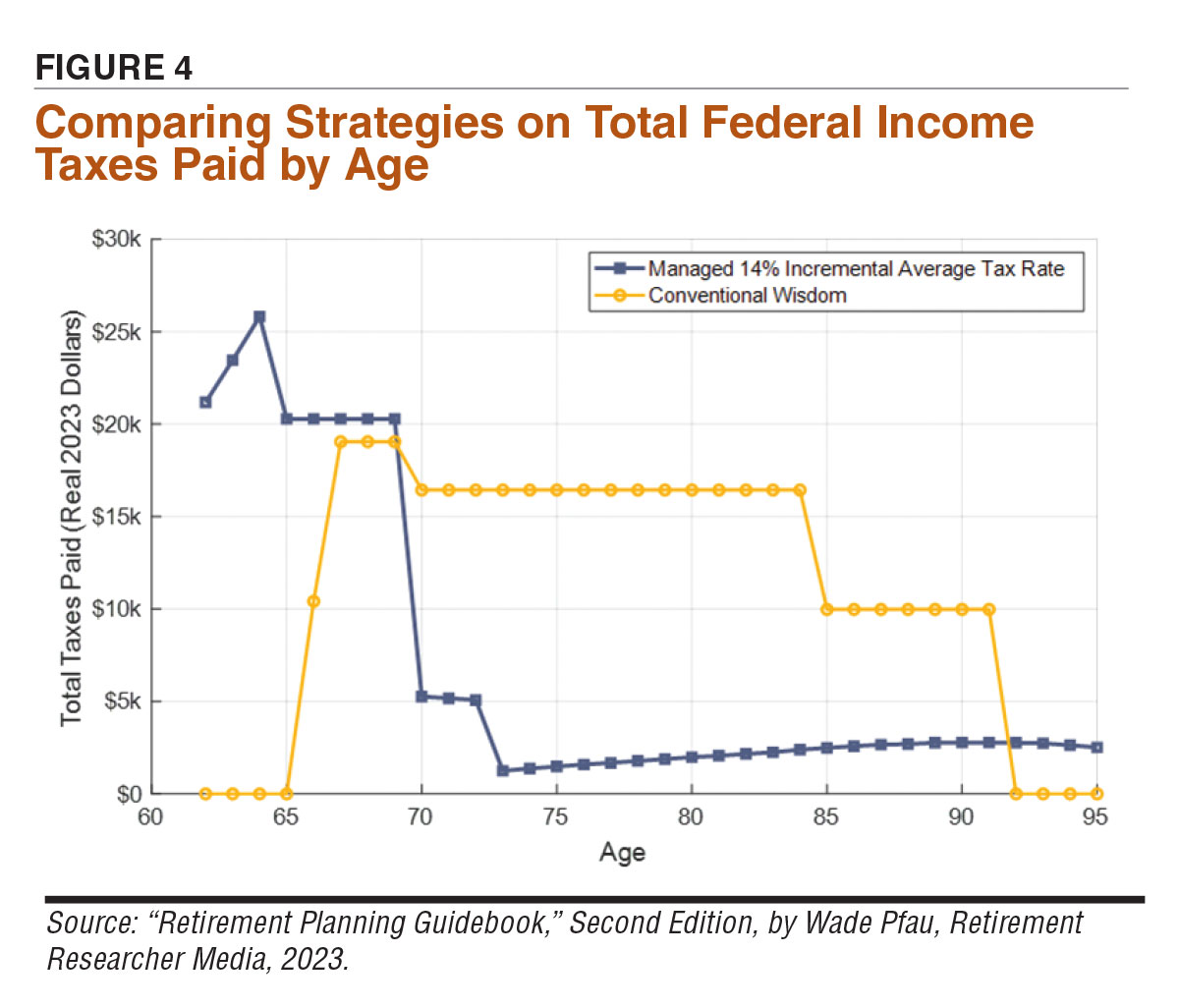
Figure 4 shows the total federal income taxes paid for each retirement year. The conventional wisdom method keeps taxes at $0 for the first four years as the taxable account generates less interest than the amount of the standard deduction. Tax capacity is wasted, as income could still be generated at a 0% marginal tax rate. Taxes then increase once the taxable account depletes, and the Social Security benefit taxation and IRA distributions keep the tax bill consistently higher until the tax-deferred account depletes.
Taxes decrease at age 85 as the spending goal drops, and taxes fall to $0 at age 92 when the tax-deferred account depletes and retirement spending shifts to the tax-exempt account that does not impact AGI. At this point, the only taxable income is the taxable portion of Social Security, and this is less than the standard deduction.
Meanwhile, the tax-efficient strategy leads to a higher tax bill through age 69. Once Social Security and RMDs begin, the total taxes due are kept low for the remainder of the retirement horizon. Taxes have been front-loaded with this retirement strategy.
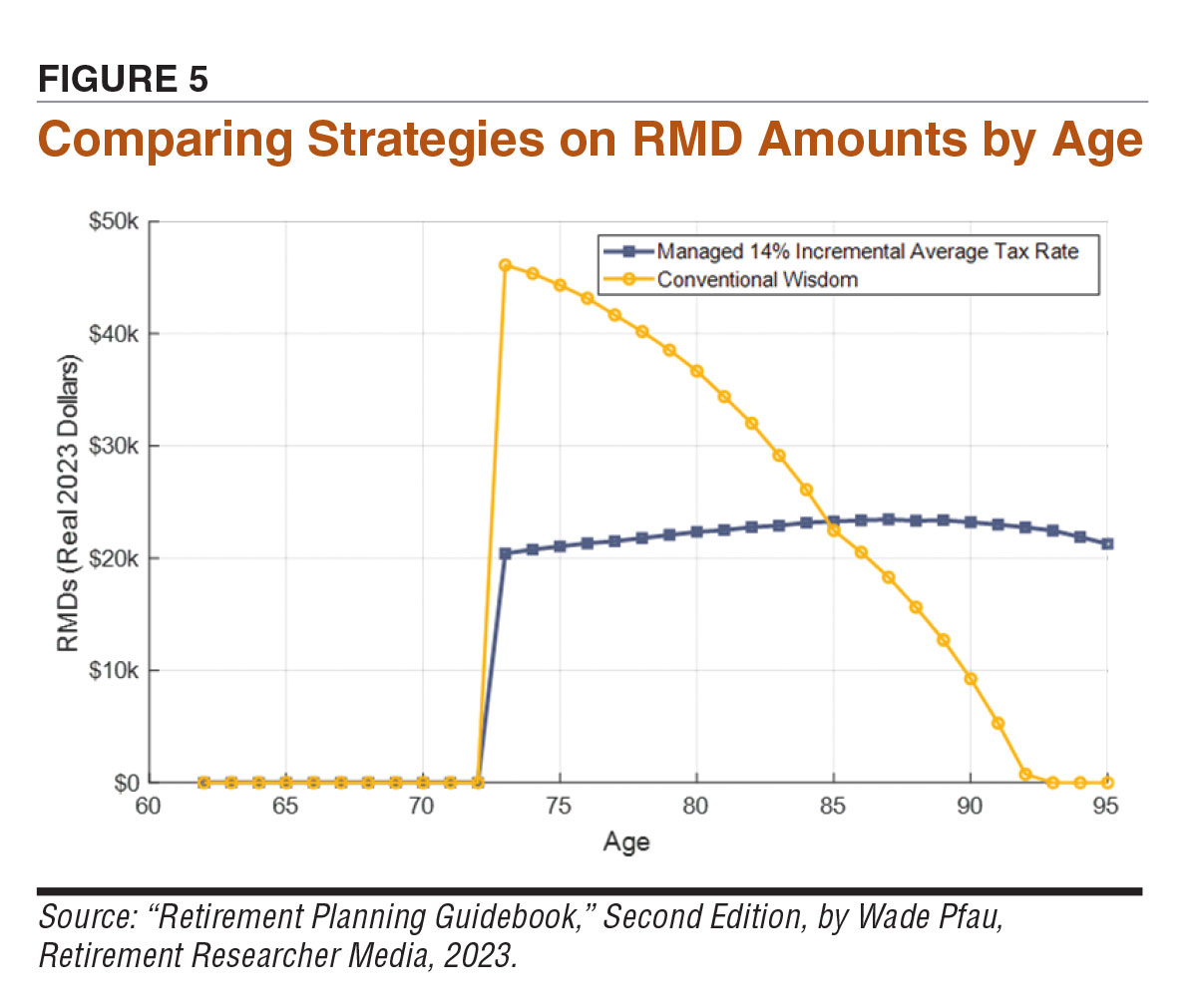
Figure 5 shows the amount of RMDs by age for the two strategies. As of 2023, RMDs begin at age 73. With the conventional wisdom, the tax-deferred account balance is much larger at this point, and it is spent more quickly, leading to higher RMDs through age 84, and then lower until the tax-deferred account depletes at age 92. With the tax-efficient strategy, the efforts to engage in Roth conversions have led to a lower and more consistent amount of RMDs throughout retirement. Part of what drives the 14% average tax rate to support the best outcomes is how it leads to RMDs that remain below the standard deduction, which also helps to reduce taxes on the Social Security benefit.
In this case study, the upfront taxes help to dramatically reduce the taxable amount of Social Security benefits received by the household. The conventional wisdom strategy leads to 85% of the Social Security benefits being taxed for most of the retirement horizon.
For the $52,200 of annual benefits received, 85% taxation means that $44,370 of these benefits are added to AGI. Only with the depletion of the tax-deferred account at age 92 does this percentage drop. At this point, because the thresholds for determining the taxable portion of Social Security do not adjust for inflation, even half of the Social Security benefit is large enough to ensure that a portion (around 15%) is taxable. The capacity to pay taxes at a 0% tax rate is again being wasted by not having enough taxable income to cover the standard deduction.
With the more tax-efficient approach, the taxable portion is about 54% at ages 70 to 72, and then it decreases to 30%. The taxable percentage then slowly increases as the formulas for determining Social Security benefit taxation are not indexed to inflation. This lower Social Security contribution to AGI along with less RMDs drives the tax savings.
Figure 6 shows the marginal tax rate paid on an additional dollar of income for the federal income tax brackets without including any additional nonlinearities like the Social Security tax torpedo. The conventional wisdom strategy does not take advantage of the lower tax rates available through 2026. It then settles into the 25% marginal tax bracket until age 85 when the reduction to the spending goal helps to support a reduced level of taxable income. The couple stays in the 15% tax bracket until the tax-deferred account depletes, at which point the tax rate falls to 0%.
Meanwhile, with Roth conversions, the marginal tax rate for the more efficient strategy is 22% through 2025 and then 25% until age 69. After this point, the marginal tax rate does not exceed 15% again and is even able to stay at the 10% level for ages 73 to 82.
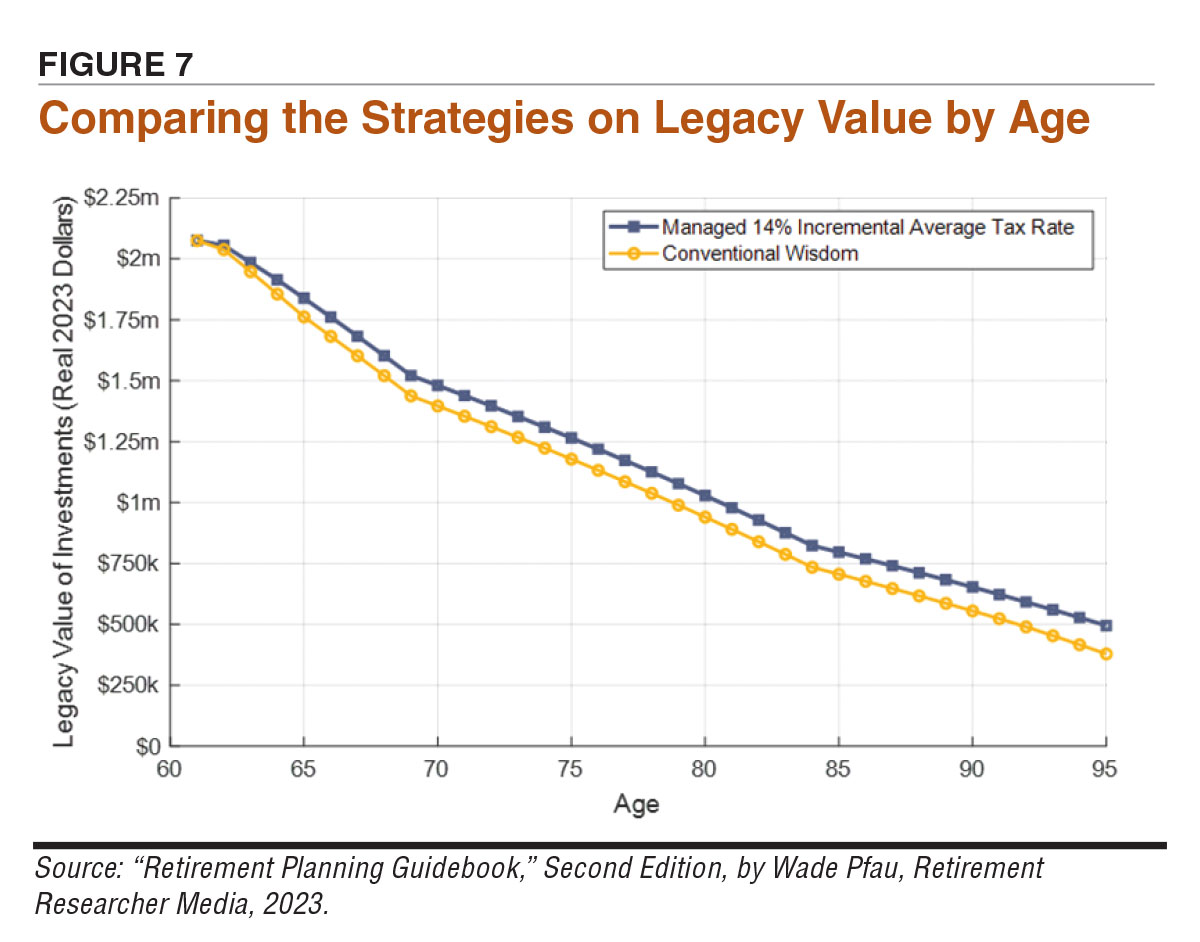
Finally, Figure 7 compares the legacy value of investment assets over time. This sums the remaining taxable assets, 75% of the remaining IRA (to account for the embedded income tax liability) and the remaining Roth assets. We know from before that the legacy is higher for the more efficient strategy at age 95. It turns out that the legacy is higher at all ages. This is a result of the assumption that any IRA assets left as an inheritance will go to adult children facing a 10-year window to take distributions and who will face a 25% marginal tax rate. Because the retired couple can immediately start to use Roth conversions and pay taxes at 22%, they are immediately improving the legacy value by a small amount that continues to grow throughout the entire retirement horizon.
Though retirees may be wary about unnecessarily generating more taxable income in the early retirement years, this is another example about how short-term sacrifice with retirement income planning can lead to long-term efficiencies.
The conventional spending strategy creates inefficiencies by wasting the ability to generate taxable income without paying tax and by unnecessarily generating too much taxable income in the middle retirement years. Though the couple could avoid paying taxes during the first four years of retirement, they are heading toward a bigger tax bill later.
The same problem also happens late in retirement as the tax-deferred account is spent too aggressively. Shifting income from the high-tax middle years of retirement to earlier and later years when lower marginal tax rates apply would have helped their financial situation in a meaningful way.
The incremental average tax rate strategy better smooths taxes and manages non-linearities to keep their overall taxes lower. Real value can be obtained by combining a delay in Social Security with an aggressive Roth conversion strategy in the early retirement years.
Portfolio Strategies

PRISM Wealth-Building Process

Portfolio Strategies

Hugh P from WA posted over 3 years ago:
WILLIAM W from CA posted over 3 years ago:
RICHARD S from HI posted over 3 years ago:
WAYNE W from WI posted over 3 years ago:
P B from FL posted over 3 years ago:
DONALD M from WA posted over 3 years ago:
DAVE G from TX posted over 3 years ago:
J M from NJ posted over 3 years ago:
ANTHONY A from NC posted over 3 years ago:
JOHN S from MA posted over 3 years ago:
LYNNE A from CT posted over 3 years ago:
BRIAN H from TX posted over 3 years ago:
BRIAN H from TX posted over 3 years ago:
ROBERT A from NC posted over 3 years ago:
JORDON W from CA posted over 3 years ago:
John H from FL posted over 3 years ago:
STEVEN H from CA posted over 3 years ago:
STEVEN H from CA posted over 3 years ago:
STEPHEN S from MD posted over 3 years ago:
Don P from USA posted over 3 years ago:
KEVIN V from NC posted over 3 years ago:
JAMES M from MT posted over 3 years ago:
THOMAS S from MN posted over 3 years ago:
David B from CA posted over 3 years ago:
EDWARD M from PA posted over 2 years ago:
You need to log in as a registered AAII user before commenting.
Log InCreate an account