

Related

Portfolio Strategies
William Bengen’s floor and ceiling rule is one approach that is simple and works fairly well.
by Charles Rotblut, Wade Pfau | May 2022

Charles Rotblut leads a class in AAII's new Essential Investing Video Course. Go to https://www.aaii.com/ves for more information and to subscribe.
Wade Pfau is a widely followed retirement researcher and a professor and program director at The American College of Financial Services in King of Prussia, Pennsylvania. He is also principal and director for McLean Asset Management and RISA LLC. In this second of a two-part interview, we discuss spending strategies for retirees as well as buffer assets. See the March 2022 AAII Journal for the first part of our conversation (“A New Perspective on Withdrawal and Allocation Strategies for Retirees”).
—Charles Rotblut, CFA
A challenge retirees face is determining how much they can safely spend in retirement. One solution I’ve seen, and I know you’ve written about, is using a flexible approach for determining how much can be spent. We at AAII have looked at Vanguard’s floor and ceiling approach (“A More Dynamic Approach to Retirement Spending,” April 2014 AAII Journal). Is there an approach you favor?
The 4% rule has a lot of assumptions built into it, and a lot of things speak toward using a withdrawal rate of less than 4% [see Table 1 for sustainable spending rates based on your planning horizon]. But if you have some flexibility to cut spending a little bit, it helps to manage sequence of returns risk in such a way that you can use a much higher initial withdrawal rate. I’ve looked at a number of the different variable spending strategies that are out there, including that Vanguard one.
TABLE 1. Sustainable Spending Rates
Vanguard’s approach is really complicated. It’s probably one of my least favorite of the variable spending strategies.
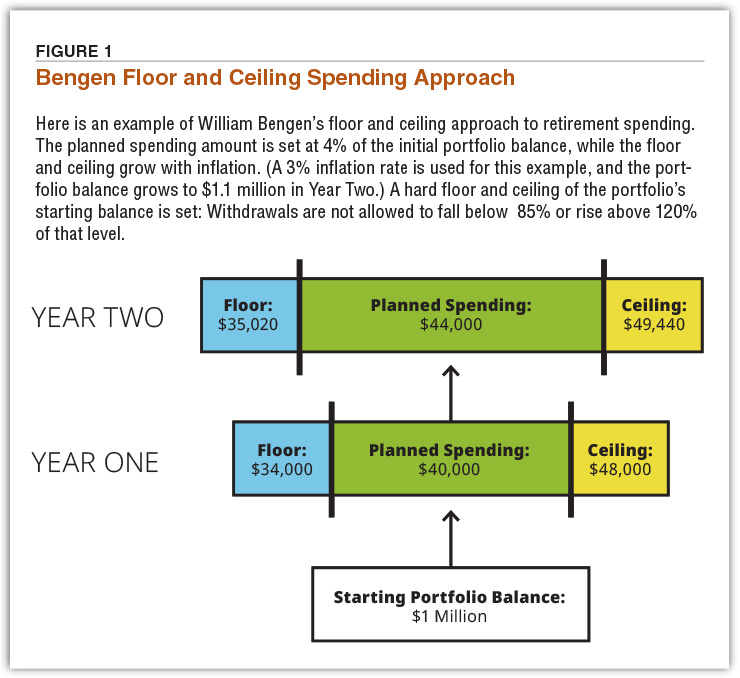
One I thought was pretty simple and also works pretty well was offered by William Bengen (the creator of the 4% rule). It’s also called a floor and ceiling rule, but it uses dollar floors and dollar ceilings, unlike Vanguard’s percentage change floors and percentage change ceilings.
With the original Bengen approach, 4% is an initial spending rate. Subsequently, you don’t care what the withdrawal rate is anymore. You just keep spending the same amount adjusted for inflation.
The exact opposite of that would be a constant percentage strategy. If I decided to just withdraw 4% every year of the remaining portfolio balance, I’m keeping track of the withdrawal rate, but I’m not really paying attention to what the spending is. I just take 4% of whatever’s left. If the portfolio goes down, I spend less. If the portfolio increases in value, I spend more.
The Bengen floor and ceiling rule applies a constant percentage, but then it has a dollar ceiling and a dollar floor. If markets are going up, spending rises until it reaches a ceiling, and then the increases stop. I don’t spend more beyond the dollar ceiling that could be growing with inflation. Conversely, if my portfolio is losing value, I spend the constant percentage of what’s left until I hit the floor spending level, and then I don’t continue to cut below that. It builds in some flexibility to make cuts to spending until you get down to that floor. [Figure 1 illustrates the approach.]
That can allow you to use a higher initial spending rate in such a way that the floor may not be all that much lower than if you just had a 4% real (inflation-adjusted) constant spending amount style strategy with no flexibility. Having some flexibility is helping to manage the sequence of returns risk.
If you’re looking at a 30-year retirement, is 4% a ballpark metric?
Yes, ballpark. With the Bengen rule, there’s still a little bit of downside risk because whenever you apply any sort of dollar floor, there’s the sequence risk of incurring a bad period of returns. There’s also the possibility of running out of money.
A pure constant percentage spending strategy with no floor or ceiling doesn’t even have sequence risk because you can never run out of money. It’s just that, as the portfolio loses value, you continue to cut your spending more and more to perhaps uncomfortable levels. But you can have a big increase in the withdrawal rate that way.
With the Bengen-style approach, it depends on what floor you pick, but you might be looking at being able to increase the initial withdrawal rate by 15% or 20% compared to what it would have been with just Bengen’s original 4% withdrawal rule.
Just to be clear, 15% to 20% of 4%.
Yes, of 4%. If you believe 4% was right before, you’d be getting up to 4.6% to 4.8% in terms of withdrawal rates.
It is still a sizable difference. What about required minimum distributions (RMDs)? How does a retiree incorporate a flexible spending approach with RMDs? Would it be spending X% amount of the RMD in retirement and putting the rest into a savings account?
Well, you can use the RMDs as a spending rule. It’s really getting to be related to academically optimal spend-down strategies. In a pure academic spend-down strategy, you have some sort of floor—perhaps Social Security or Social Security combined with an additional annuity. The RMDs cover your discretionary spending.
RMDs are conservative spending rates, but they have the academic characteristics that you’re looking for—that is, as you get older, your spending rate increases because you have a shorter remaining life expectancy. You’re spending a percentage of the portfolio balance and if you have a volatile investment portfolio, you’re allowing for volatile spending.
The RMDs are just telling you to spend an increasing percentage of what’s left each year as you age, and that’s a pretty efficient way to approach retirement distributions. You can probably be more aggressive than the RMDs because they are designed to be conservative. Nonetheless, I think that’s a perfectly acceptable way to approach a retirement spending strategy as well. You wouldn’t necessarily have to bank some of the RMDs just because they are already such conservative rates. They are a guideline of how much you can effectively spend in a sustainable manner as you go through retirement.
If somebody has a Roth IRA, they could just find the RMD factor and then do the math themselves.
Yes, or look at the RMD factor for their taxable brokerage accounts as well. It’s just applying that RMD rate to all of your investment assets.
I’d like to discuss the concept of buffer assets since they can help support spending during periods when the market is down. Could you explain what they are?
Yes. There are four basic ways to manage sequence of returns risk, and buffer assets are the fourth way. It’s an important category. What makes buffer assets distinct from something like a bucketing approach is that you really don’t think of the buffer asset as part of your investment portfolio. They can be cash that you’ve pulled out of the portfolio and just set aside, a reverse mortgage line of credit or policy loans from a whole life insurance policy.
A buffer asset is something on the sidelines that is not correlated with your portfolio and that provides a temporary spending resource after a market downturn or after something you’ve defined has happened. You’ll use that temporary spending resource to help relieve pressure on your investment portfolio so that you’re not spending from your portfolio when it’s in trouble. Then you’re going to give your portfolio a window of opportunity to recover so that you’re not touching it when it’s in danger. This helps to get it back on the right track again, so that it’s going to be more sustainable for you over the longer term.
You must have some sort of rule in mind for when you will spend from the buffer assets. The markets are down so I’m going to leave my portfolio alone. I’m not going to withdraw the amount needed for my spending for the year. I’m going to source that spending to this buffer asset outside the investment portfolio.
Do you have a rule as far as when people should tap the buffer assets? Is there a certain guideline you can suggest?
There are a lot of rules in practice. Some are along the lines of if the market was down last year, spend from the buffer asset this year. If the market was up last year, spend from the portfolio this year. Some rules look at a capital needs analysis of how much money you would need to have every year in retirement to make your plan work. If you have more than that, spend from the portfolio. And if you have less than that, spend from the buffer asset.
I never published this, but I was just curious for some other research that I was doing: I tested 16 different strategies, and I found one that works just as well as anything that’s more complicated. It’s also super easy to use in practice.
Just look at the value of the portfolio at the start of retirement. When you began your retirement, what was the combined value of your investment assets? Don’t worry about adjusting it for inflation. Just note what the value is in nominal terms.
In years where your investments are higher than that number, spend from the investments. In years where your remaining portfolio balance has fallen below that threshold, spend from the buffer asset.
That seems to work just as well as any of the more complicated rules you can come up with. It’s an approach I used in the third edition of my reverse mortgage book (“Reverse Mortgages: How to Use Reverse Mortgages to Secure Your Retirement,” Retirement Researcher Media, 2022). I’m just using that rule instead of some of the other more complicated rules suggested in past research articles. I think it can work really well, and it’s easy.
That is interesting. Our founder James Cloonan wrote a book a few years ago (“Investing at Level3,” AAII 2016) where he used the S&P 500 index as the benchmark. If the index is more than 5% below its high for the year, cash buffer assets are tapped for withdrawals. But your suggested approach is even simpler.
Yes. You don’t have to worry about keeping track of the index’s highs. If you’re comfortable making a spreadsheet, some of these other buffer asset rules can be easy to implement. But this is a really simple rule where you don’t need a spreadsheet to track anything. Just remember how much you had at the start of retirement.
In terms of replenishing that buffer asset, is there a certain guideline or rule?
In practice, right now I’m more focused on [examining] the reverse mortgage as a buffer asset and not so much on the cash buffers. So, maybe you would want to replenish your cash buffers more frequently.
I’m finding you don’t even need to replenish the reverse mortgage buffer. I’m testing that, but I’m not really finding that voluntarily paying back the loan can help all that much. Rather, just don’t worry about replenishing it.
Now the reverse mortgage, it is different from cash because you have a growing line of credit whereas if you spend down a cash buffer, it’s empty at that point. So, it is a different scenario, but just in a general sense, I don’t think that replenishing the buffer asset is necessarily as important as one might think.
Even in the context of cash, if you had a three-year cash bucket, that’s helping to get you through a sequence of returns risk event. And then you may not really need it anymore after that point. So again, it’s not obvious that you must replenish it, other than behaviorally you might like having that buffer. The buffer did its job by providing that three-year buffer for you, and that should be sufficient to get you through your retirement.
If your portfolio grows enough, then you’ll be in good shape. Obviously, one downside of making sure you get to a last day with money in the bank is realizing that you could have spent much more.
The sequence of returns risk is such a fascinating phenomenon that small changes can have such huge impacts. And one of them is that by skipping a distribution from your portfolio because you’re sourcing it from the buffer asset can result in you having $1 million at the end of retirement—hopefully just like you did when you started retirement.
The synergy is where small changes to what you’re doing with your portfolio can have such huge long-term impacts on the sustainability of your portfolio. So, once you’ve used a buffer asset, you may not really need to use it a second time. Maybe just let it ride. You can still run out of money, but you’re going to be in a much better position relative to where you were before that it may not even be worth replenishing the buffer.
We think you’d like this related webinar! Individual Investor Show: What to Do After the Retirement Party Ends
Portfolio Strategies

Retired Investor

Portfolio Strategies

JOHN L from NJ posted over 4 years ago:
ROBERT A from NC posted over 4 years ago:
G THOMAS W from TX posted over 4 years ago:
MAREK P from TX posted over 4 years ago:
JOHN B from PA posted over 4 years ago:
You need to log in as a registered AAII user before commenting.
Log InCreate an account