

Related

Portfolio Strategies
Even those certain they will not outlive their money can incorporate aspects of the wealth-building process in their personal PRISM plan.
by Charles Rotblut | May 2022

Charles Rotblut leads a class in AAII's new Essential Investing Video Course. Go to https://www.aaii.com/ves for more information and to subscribe.
Several AAII members have asked how specific issues related to retirement can be worked into the PRISM Wealth-Building Process.
Before I address retirement-related issues, I want to take a step back and discuss PRISM from a higher level. PRISM provides a framework for aligning your investment decisions with your goals. We purposely designed it to be broadly adaptable to a variety of situations as opposed to being narrowly focused and suiting the specific needs of a small proportion of investors. Within the PRISM framework, there is much room to incorporate the rules, preferences and guidelines you want to follow for your own situation.
With this in mind, let’s look at how to incorporate issues related to retirement into the PRISM process.

The first step of the PRISM process is P, Prioritizing Your Goals. For any retiree, goal number one is having enough cash flow to last throughout retirement. Depending on one’s wealth and non-portfolio sources of income (e.g., Social Security, pensions, annuities, etc.), this first goal may already be fulfilled.
Retirees who can reasonably expect not to outlive their wealth can turn their attention to secondary goals. In the PRISM Academy on the AAII Community, we’ve seen AAII members discuss helping out family members financially, traveling and buying a vacation home as goals. You may wish to make a donation to a charity or congregation. Or you may have different goals.
In the PRISM process, a retiree would focus first on funding retirement by completing steps R, Recognizing Risk Tolerance and Allocation; I, Identifying Management Preferences; and S, Selecting and Managing Investments, and then do the same for the secondary goals. Even if you are certain that you will not outlive your money, there are still aspects of the wealth-building process you should incorporate into your personal PRISM plan.
There is also an estate planning benefit to prioritizing your goals and working through Steps R, I and S for each goal. It will provide needed clarity for heirs regarding your wishes, how you invest and what sources of income you rely on. The Prioritizing Your Goals worksheet can also be used to start a conversation with your heirs about what your final wishes are.
We designed the PRISM Risk Assessment worksheet to specifically consider how reliant an investor is on portfolio withdrawals to fund a given goal. This obviously is very relevant to retirees.
There are two questions on the worksheet that are particularly relevant. The first, included in the “Financial and Psychological Risk” section, asks how much of your spending needs are covered by non-portfolio income. The second, included in the “Timing of Goal” section, asks “relative to your wealth, how large of a withdrawal will your goal require over a period of five years or less?”
The more a retiree’s spending needs are covered by Social Security, pension and even annuity payments, the more volatility in portfolio returns they can tolerate from a financial standpoint. Not having to sell stocks during a market downturn significantly increases the odds of not outliving your money by giving your portfolio time to recover.
The size of withdrawals relative to savings also matters significantly. Retirees who can adhere to more moderate withdrawal rates have a much higher likelihood of achieving retirement success than those who don’t. Simple rules of thumb are an inflation-adjusted 4% of the initial portfolio balance and using required minimum distributions (RMDs) as a guide. Having sources of guaranteed income like Social Security or pensions allows you to take smaller withdrawals (or spend less of your RMDs), thereby increasing your ability to tolerate bouts of downward market volatility in retirement.
When thinking about how much will be needed from the portfolio, it’s helpful to consider how your spending may change throughout retirement. Spending can be higher during the first phase of retirement, decline in the middle part and then rise in the latter part due to health issues, required assistance with daily activities and, potentially, memory care.
Higher expenditures later in life may or may not be partially offset by changes in non-portfolio income. A surviving spouse will tend to receive lower Social Security income because only one person will collect benefits going forward. A life insurance policy may provide added wealth in such situations.
If a higher level of care is needed, long-term care insurance and/or the Veteran Administration’s Aid and Attendance may cover some of the additional expenditures. A reverse mortgage can also be tapped (though consideration should be given to heirs who wish to keep the house in the family). All three increase the financial ability to tolerate risk and can allow for a higher allocation to more volatile assets like equities to be maintained. Offsetting this potential are medical expenditures, higher residential costs (e.g., an assisted living community), home improvements if opting to age in place and caregiving help. Such expenditures can increase the size of portfolio withdrawals.
When assessing tolerance for risk, we suggest considering what stage of retirement you are in and what levers can be pulled to fund it. I’ll reiterate what I’ve already said: The higher the proportion of expenditures that can be covered from non-portfolio sources of income, the greater your ability to tolerate volatility in the value of your portfolio.
In the PRISM process, goals and tolerance for risk drive the allocation decision. The basic rules of allocation call for diversifying among equities, bonds and so-called safe assets (cash, money market accounts, Treasury bills, etc.). Simply allocate the appropriate portfolio weight to each asset class. The AAII aggressive allocation model, for instance, calls for a nearly full allocation to a diversified portfolio of stocks. The moderate allocation model calls for a 60% allocation to stocks, a 30% allocation to intermediate-term bonds and a 10% allocation to short-term bonds or other safe assets.
Periodically, I’ve been asked how to incorporate Social Security benefits into determining one’s overall allocation. The PRISM Wealth-Building Process treats Social Security and pensions as non-portfolio sources of income. They increase an investor’s tolerance for risk.
My suggestion to those who wish to include Social Security in their portfolio allocation is to treat those benefits as buffer assets. Social Security benefits provide cash flow that can be relied on when market downturns occur. In this context, Social Security and pensions sit outside the traditional stock/bond allocation calculations. For those wishing to assign a dollar amount, the present value of expected future benefits can be used.
—Charles Rotblut, CFA
For investors who do not need any withdrawals, this type of percentage allocation works very well. Retirees—and anyone else who plans to make withdrawals—may need to make some modifications.
Buffer assets are very helpful in retirement. A buffer asset is a source of cash flow you can tap to avoid selling investments during a market downturn. In “Investing at Level3” (AAII, 2016), AAII founder James Cloonan recommended having two to four years of planned expenditures in safe assets. They are tapped when the stock market falls in value. Cloonan suggested tapping buffer assets when the stock market ends the year more than 5% below its previous high.
In “Strategies for Determining How Much You Can Spend in Retirement,” which appears in this issue, retirement expert Wade Pfau suggests having a bucket with three years’ worth of planned withdrawals. The cash bucket is tapped during years when the current value of the portfolio is below what it was at the start of retirement.
The buffer asset does not have to be cash. As Pfau explains, buffer assets can be a reverse mortgage line of credit or policy loans from a whole life insurance policy.
At the bottom of our Recognizing Your Allocation worksheet, we have added a section for buffer assets. You can use this to list any buffer assets you may have along with the rules you will use for tapping and replenishing them.
Step I of the PRISM Wealth-Building Process, Identify Investment Management Preferences, asks you to consider how involved you want to be in the selection of the individual investments you hold in your portfolio. This can range from selecting all the securities held to handpicking some stocks and using mutual funds and/or exchange-traded funds (ETFs) for other securities to fully relying on a human or robo-adviser.
As part of this step, we also ask you to consider what constraints you might have. A retiree who stays on their former employer’s 401(k) plan will be constrained to the investment options offered by that plan. Similarly, 529 college savings plans and health savings accounts may be limited in terms of the number of investments available.
A bigger issue facing retirees is the possibility of cognitive decline, including Alzheimer’s disease. Among the first signs of cognitive impairment—even mild levels of it—are the problems with managing one’s finances. Given this threat, it is prudent to include in your PRISM process a plan for transferring control of your portfolio.
The flexibility of PRISM allows you to make the choices that are best for you. Transitioning from handpicked individual securities to broad-based mutual funds or ETFs is one option. Another is to gradually give a trusted family member oversight and, if needed, power of attorney to overtake the management of finances. A financial adviser can be employed with a plan to have them take over portfolio management responsibilities when needed to.
None of these options are mutually exclusive. They can be combined. The key is to make these decisions and put the wheels in motion prior to the effects of cognitive decline occurring. Be sure to have discussions with trusted contacts and set them up with all of your financial institutions as a safeguard. (A trusted contact is someone the financial institution can contact on your behalf if they suspect fraud or other problems.) It can also make sense to inform your estate attorney and tax professionals about your plans for transferring control for the management of your finances when it is time to do so.
The rules for selecting, buying and selling investments in retirement generally aren’t any different than they are pre-retirement. The one exception involves funding withdrawals.
Cash withdrawals can be funded by dividend payments, mutual fund and ETF distributions, bond interest payments, maturing bonds and other investments. If certain securities will be sold to fund withdrawals, include rules for determining which ones to sell (e.g., investments closest to violating sell rules, pare overweighted positions, etc.). However you choose to fund cash withdrawals, write the rules for doing so at the bottom of the Selecting Your Investments worksheet.
We also suggest including notes about asset location preferences on the worksheet. Asset location refers to the type of account you hold an investment in. Municipal bonds are best suited for taxable accounts. Stocks paying qualified dividends are suitable for tax-preferred accounts (e.g., IRAs, Roth IRAs, etc.) as well as taxable accounts (especially if you qualify for the 0% or 15% tax rates). Corporate bonds and real estate investment trusts (REITs) are best suited for tax-preferred accounts, while master limited partnerships (MLPs) are frequently better suited for taxable accounts.
There are three parts to the final step of PRISM: M, Monitoring Your Allocation, Progress and Life Stages.
Monitoring allocation is mostly the same in retirement as it is in other life stages: ensure your current allocation is within a reasonable range of your target allocation. If it has strayed too far off target, then you will want to make adjustments to bring it back to target.
One additional component directly related to retirees is the use of a cash bucket to fund withdrawals. This can be either the accumulation of dividend and interest payments or it can be a specific buffer asset used to avoid selling investments during a down market. Once per year, check to see if the cash bucket has been replenished enough. The Monitoring Your Allocation worksheet includes equities, fixed income and cash along with space to enter additional types of assets.
After checking your allocation, look at your portfolio withdrawals. Are they within the range your forecast said they would be? Does your portfolio remain on track to support future withdrawals? The PRISM Monitoring Your Progress worksheet can help you make this determination.
If your portfolio has performed better than expected, you may be able to increase the size of your withdrawals up to a certain point. If your portfolio has performed worse than expected, you should consider whether a smaller withdrawal can be taken or—in the case of required minimum distributions—not be fully spent.
Though not expressly included in the PRISM process, this can be a good time to review your tax exposure. If taxes have been higher than expected, determine the culprit. If RMDs are the issue, qualified charitable distributions and/or Roth IRAs will reduce the size of future RMDs. (Roth IRA conversions are taxable in the year they occur, though.) If capital gains and/or interest income are the problem, revisit your asset location rules in Step I, Identify Investment Management Preferences.
We suggest those investors who wish to specify a withdrawal strategy and tax preferences add an addendum to their PRISM wealth-building plan stating both. Including it in this final step will prompt you to ensure both are continuing to be followed.
The monitoring life stages of Step M prompts you to consider significant changes impacting you, your spouse or your family. For aging investors, this takes on added importance. A change in your or your spouse’s health, including incapacitation or death, can require a reassessment of your goals, tolerance for risk and investment management preferences. A change in housing can alter your tolerance for risk and the size of needed withdrawals. Any change in your family’s status (birth, death, marriage, etc.) should warrant a review of your estate documents.
The Monitoring Your Life Stages Worksheet prompts you to consider any changes involving you or your family. For retired investors, deterioration in health (including cognitive abilities) and/or family changes can alter your financial goals, tolerance for risk and/or investment management preferences.
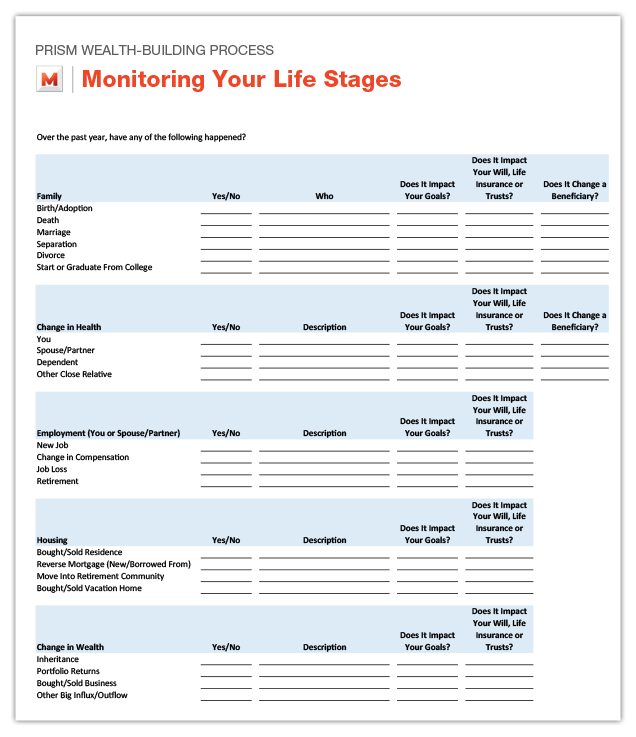
All of the PRISM worksheets are included in the Wealth-Building Toolbox, available on the Learn & Plan page: www.aaii.com/learnandplan. While you are on the Learn & Plan page, we encourage you to also take advantage of the PRISM Wealth-Building Academy.
We suggest going through the Monitoring Your Life Stages worksheet once per year to determine if any changes in your PRISM process are needed.
PRISM provides a framework for aligning your investment decisions with your goals. As I’ve explained in this article, many of the issues related to retirement can be worked into it. We encourage each investor to customize their PRISM wealth-building plan to suit their needs.
Portfolio Strategies

PRISM Wealth-Building Process

Retired Investor

No comments have been added yet. Add your thoughts to the discussion!
You need to log in as a registered AAII user before commenting.
Log InCreate an account