Equity Factors That Stand the Test of Time

A study analyzing U.S. equity factors from 1866 to the 2020s finds that factors such as value, momentum and low risk are robust and persistent.

A study analyzing U.S. equity factors from 1866 to the 2020s finds that factors such as value, momentum and low risk are robust and persistent.

The researchers extended the 1926–2020 U.S. Center for Research in Security Prices (CRSP) equity dataset by 61 years to include stock market data from 1866 to 1926, allowing them to test the out-of-sample performance of key equity factors over a much longer time span. This approach helps address concerns about data mining and performance decay by providing an independent sample.

The study found that value, momentum and low-risk factors showed consistent and significant alpha during both the in-sample period and the out-of-sample period, as seen in the accompanying figure. The out-of-sample alphas were statistically similar to those observed in the CRSP dataset, confirming that these factors have been economically significant for more than 150 years. The results suggest that the premiums associated with these factors are not temporary or due to data overfitting.
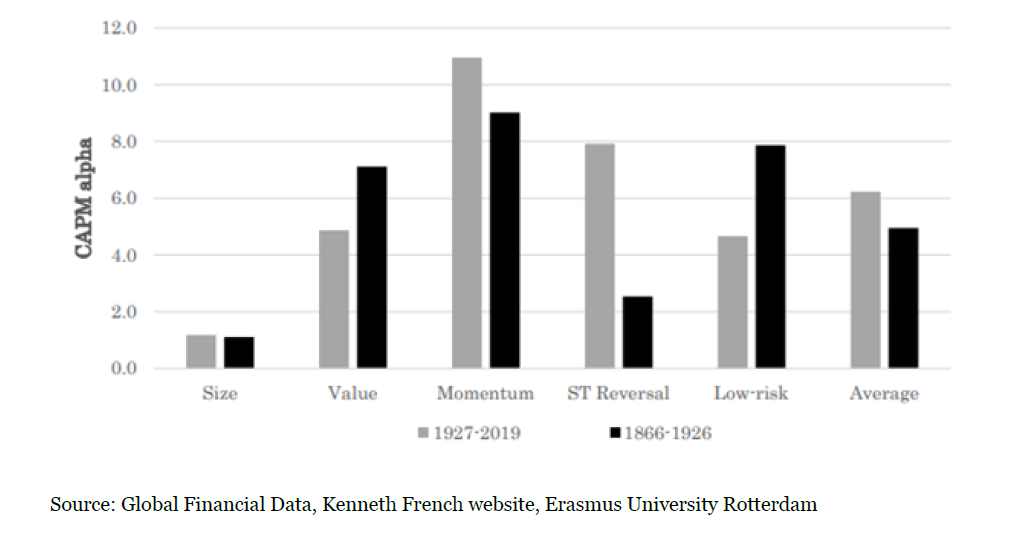
The researchers concluded that equity factor premiums such as the ones mentioned here are enduring features of financial markets. They also emphasized that the premiums do not decay over time, reinforcing their robustness as reliable components of investing strategies.

The findings serve as confirmation and a reminder that equity factors used by individual investors have statistical significance in providing above-average market returns in the past and may continue to do so in the future. They also help provide clarity on data mining and performance decay fears, showing that over time these factors are strengthened, not weakened.

Source: “Factor Premiums: An Eternal Feature of Financial Markets” by Guido Baltussen, Ph.D., and Bart van Vliet, CFA; CFA Institute Enterprising Investor blog, October 4, 2024.

Discussion

JOHN L from NJ posted over 1 year ago:

No surprise here. Before they were discovered and became widely known, "factors" earned excess returns. This is likely true for all past periods before "factors" were discovered. But now that these "factors" are well known; it is much less likely they will work in the future.


ROBERT A from NC posted over 1 year ago:

I doubt that buying good, profitable companies at reasonable prices and hanging onto them for many years will ever be a losing strategy.


BARRY J from TX posted over 1 year ago:

John L and Robert A are both spot one on their assessments of the minimal educational value the base article provides. It is a pulp piece by two employees at the offices of Northern Trust in Rotterdam Netherlands who used a “Back to the Future” methodology to manufacture an “extended” database and then used “statistical” torture” techniques to manufacture “research” from an “extended” database manufactured for a period where organized markets and market data, as we know it today, did not exist. Citation: Baltussen, Guido and van Vliet, Bart, and van Vliet, Pim, “The Cross-Section of Stock Returns before CRSP” (2023). #1 The authors diddled with the data until they had enough data to “prove” exactly what they wanted to prove. Surprise! There was only one US-based stock market before 1926. DJIA was founded in 1896, SPX in 1957; NASDAQ in 1971; and CRSP, their primary” source in 1960. This is why most researchers limit their research to the CRSP database which as compiled from data since 1926. #2 The authors “tortured the data” long enough to get the "statistical" answer they wanted. “Out-of-sample alphas” were “statistically similar” to those observed in the CRSP dataset.” I would have been surprised if they didn't find anomalies in primitive market data. I suspect they used whatever garbage data they found to fuel the flux capacitor of their “wayback machine.” #3 In 1992 Gene Fama of the University of Chicago and Kenneth French of Dartmouth University identified the first 5 “factors” (originally called market “anomalies” because they were not predicted by their earlier efficient market hypothesis) – “size” (i.e., smaller market caps have lower based rates to grow on), “value” (stocks with a book value higher than its current market valuation), “profitability” (companies that produce higher profits), “momentum” (stocks that generate price volume) and “growth” (the ability to reinvest retained earnings that increase internal rates of return higher than the market cost of capital). #4 There is no "blast from the past" here that will improve our investing future. These and other proven factors are fully captured in various AAII Premium screening programs. #5 The only surprises here are that Tudor found this "camera obscura" article in a blog and tried to turn it into useful information to educate AAII members. #6 We have to forgive Tudor and the authors. They are too young to know that you need a flux capacitor to turn garbage into time machine fuel. "You know what this means? This means that this damn thing doesn’t work at all!” - Dr. Emmet Brown, ‘Back To The Future’.


You need to log in as a registered AAII user before commenting.
Create an account

Log In

Get your free copy of our special report analyzing the tech stocks most likely to outperform the market.

Download the FREE Report Here: