

Related



PRISM Wealth-Building Process
A shift in investor composition for U.S. Treasuries has significantly increased price sensitivity among buyers, altering Treasury yields and market dynamics.
by Omar Beirat | December 2024

A shift in investor composition for U.S. Treasuries has significantly increased price sensitivity among buyers, altering Treasury yields and market dynamics.
An analysis by State Street examined data spanning the Federal Reserve’s transition from quantitative easing (QE) to quantitative tightening (QT). This research analyzed shifts in investor behavior influenced by QT and a decline in foreign central bank participation. The impact on the market was studied, focusing on the reduction of Treasury holdings by the Fed and foreign central banks.
The study indicates that this transition altered the Treasury market’s dynamics. During QE, the Fed was the main buyer, but as QT reduced the Fed’s holdings, domestic private investors became more sensitive to yields. The accompanying figure shows that households and nonprofits displayed greater sensitivity to yields, requiring higher returns post-QE.
To secure adequate investment for the expected $2 trillion in annual Treasury issuance over the next decade, yields may need to rise by 95 basis points. This projected increase, approximately 1.5 standard deviations above recent yield volatility, could contribute to higher market volatility and broader financial effects.
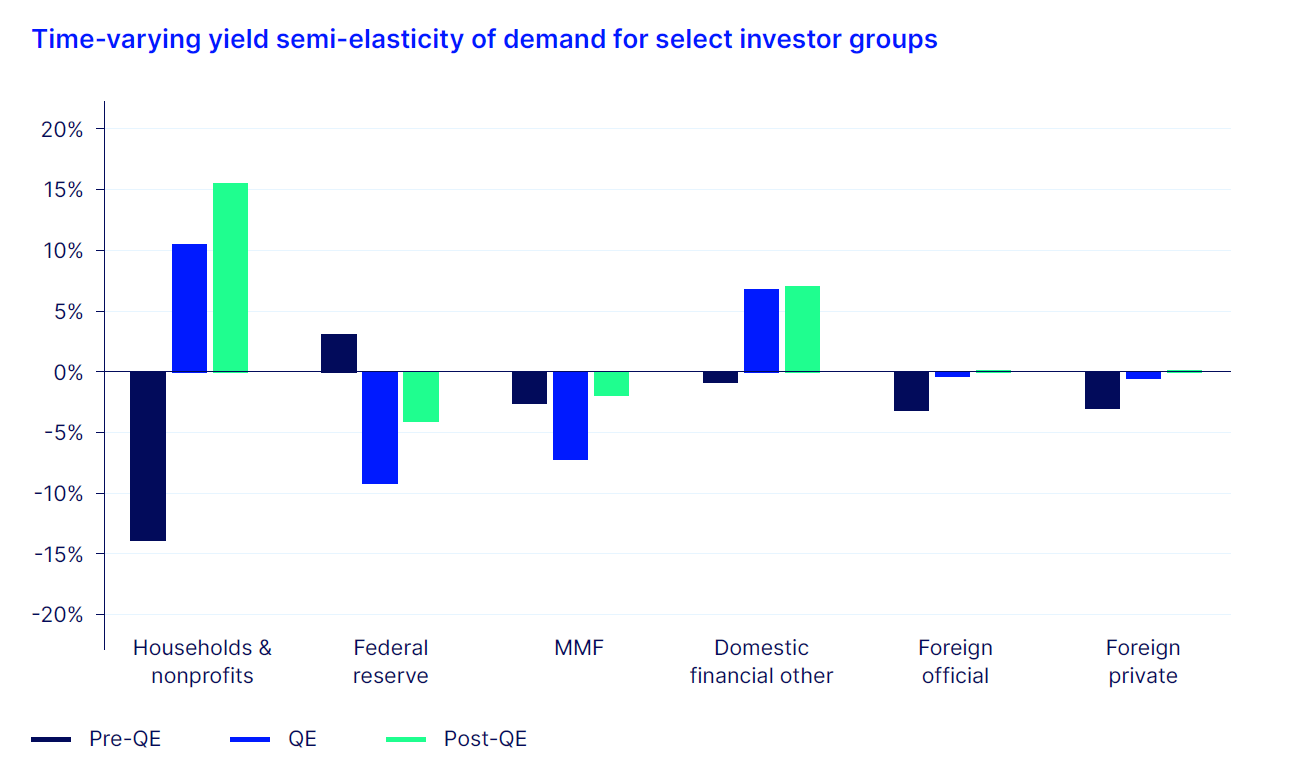
Scenario analyses suggest that traditional 60% equity/40% fixed-income portfolios could face declines of up to 8% due to increased interest rate exposure and wider credit spreads, challenging the perception of Treasuries as low-risk assets. This shift may also limit the Fed’s ability to influence long-term rates, complicating monetary policy during economic downturns. In addition, Treasury yields could fluctuate more in reaction to market data, raising the cost of government borrowing and adding potential budgetary pressures.
For individual investors, these changes suggest that Treasuries may become more volatile. Preparing for higher fluctuations in bond investments and diversifying portfolios could help manage potential risks. Strategies such as spreading investments across various asset classes and staying informed on market developments may support risk management in this evolving environment.
Source: “Who will buy the oncoming surge of treasuries? And at what price?” by Ramu Thiagarajan, Hanbin Im, Prashant Parab, Marvin Loh and Elliot Hentov; State Street Research, August 2024.
PRISM Wealth-Building Process

ROBERT A from NC posted almost 2 years ago:
You need to log in as a registered AAII user before commenting.
Log InCreate an account