

Related


Portfolio Strategies
Clarifying the Purpose of Diversification

Portfolio Strategies
A new analysis found that the long-term premium from owning stocks has existed over a longer time period than has been commonly believed.
by Tudor Pop | January 2025

A new analysis found that the long-term premium from owning stocks has existed over a longer time period than has been commonly believed.
Researchers looked at return data for the periods of 1800–1899, 1900–1999 and 2000–2023. They analyzed historical return data for multiple asset classes, focusing on long-term risk and return profiles. They evaluated equities, bonds, real estate and commodities across different markets and time periods to understand how these assets behave over long horizons and the role of diversification in enhancing returns. The authors observe, “The main message is that the U.S. equity premium over (government) bonds at and above 5% in the 1900s was considerably higher than estimates for the 1800s ranging between +1.6% and –0.6%.”
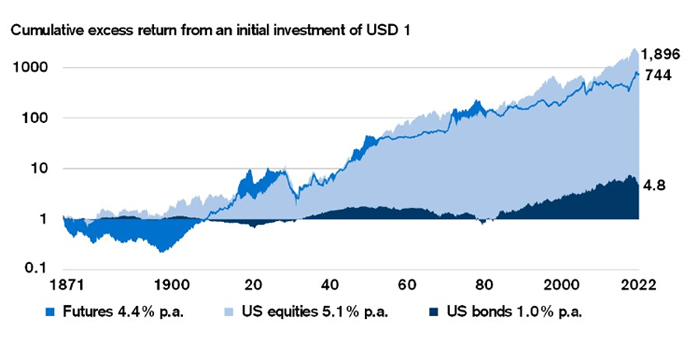
While stocks offered the highest long-term returns, they were also the most volatile asset class. Bonds provided more stability but with lower returns over time. Real estate showed promising returns, with variations depending on the market conditions. Commodities, while less predictable, contributed diversification benefits, particularly during periods of inflation or economic turbulence.
The researchers note that portfolios that hold a mix of these assets, rather than relying on one asset class alone, improved risk-adjusted returns over the long run.
The researchers conclude that while equities tend to provide the best long-term returns, diversification across multiple asset classes—especially bonds, real estate and commodities—helps mitigate risks and optimize performance. They emphasize the importance of considering long-term goals and diversifying investment portfolios to manage both returns and risks effectively.
For investors, the study underscores the significance of building a diversified portfolio. A balanced mix of assets improves the risk-return tradeoff, offering a strategic approach to achieving stable, long-term financial growth while managing volatility and market fluctuations.
Source: “Long-Run Asset Returns,” by David Chambers, Elroy Dimson, Antti Ilmanen and Paul Rintamaki; Cambridge Judge Business School, AQR Capital Management and Aalto University School of Business, October 10, 2024.
Portfolio Strategies
Portfolio Strategies

ROBERT A from NC posted almost 2 years ago:
BILL P from CA posted over 1 year ago:
BARRY J from TX posted over 1 year ago:
You need to log in as a registered AAII user before commenting.
Log InCreate an account