Discounted cash flow (DCF) models provide a structured framework for valuing investments, but their reliability is often compromised by their dependence on uncertain long-term projections and assumptions about the future.
Research led by Sandeep Srinivas, CFA, at the CFA Institute analyzed how DCF models estimate the value of an investment by discounting future cash flows, with a specific focus on terminal value. This component, which can account for up to 80% of the total valuation, relies heavily on assumptions about a company’s long-term survival and investor behavior. The study used historical data, case studies and patterns in investor activity to highlight the practical challenges of relying on DCF as a valuation tool.
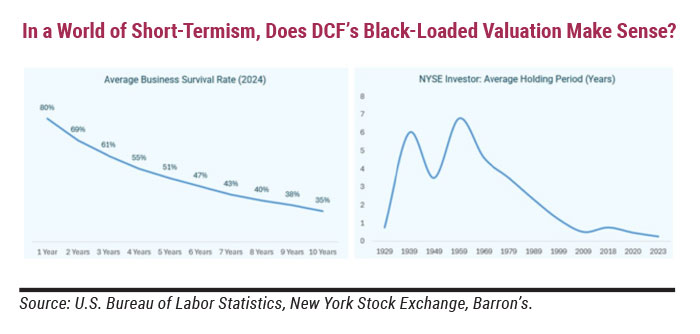
The findings reveal several critical challenges. Only 35% of businesses survive beyond 10 years, and average investor holding periods have fallen from eight years in the 1950s to just three months in 2023. This short-term focus among investors makes it difficult to benefit from the long-term cash flows that DCF models rely upon. The study references real-world examples, such as Eastman Kodak Co.  (KODK) and BlackBerry Ltd. (BB), to underscore the risks. If investors had relied exclusively on DCF assumptions, they might have overestimated these two companies’ resilience and been blindsided by their failures. As Srinivas explains, technological, regulatory or competitive disruptions can easily “upend even the most elaborate DCF assumptions.”
The researchers conclude that DCF models, while useful for providing structure and discipline, should not be treated as definitive valuation tools. They recommend combining DCF with other methods, like scenario analysis and sum-of-the-parts valuation, to create more realistic and flexible estimates. For individual investors, focusing on companies with strong cash flows and adaptability, using multiple valuation methods, and maintaining a long-term perspective can better equip them to navigate the uncertainties of modern markets.
Source: “The Discounted Cash Flow Dilemma: A Tool for Theorists or Practitioners?,” by Sandeep Srinivas; CFA Institute Enterprising Investor blog, January 13, 2025.








BARRY J from TX posted over 1 year ago:
You need to log in as a registered AAII user before commenting.
Log InCreate an account