


Related

Computerized Investing
Artificial intelligence can enhance investment research and decision-making, but it should be used carefully.
by Wayne A. Thorp | April 2025

Wayne Thorp leads a class in AAII's new Essential Investing Video Course. Go to https://www.aaii.com/ves for more information and to subscribe.
Imagine having a personal analyst working 24/7—scanning financial news, crunching numbers and identifying key investing opportunities before they become mainstream. Artificial intelligence (AI) is no longer exclusive to institutional investors. Today, individual investors have access to powerful AI tools that can analyze financial reports, track market sentiment and assist in building a well-informed investing strategy.
With AI-powered investing, you can:
AI can be a valuable tool for long-term investors looking to refine their strategies—whether that’s managing a retirement portfolio, optimizing dividend income or making sense of economic trends. The key is understanding how to use it effectively. This is the first in a new series of articles exploring AI-powered investing. We start with a broad overview of AI’s strengths and limitations when using it to aid your investment analysis.
The rise of AI in finance is already making a measurable impact. Consider the following data from CoinLaw:
These developments signal a shift: AI is leveling the playing field, providing individual investors with sophisticated analytical capabilities once reserved for Wall Street firms.
A large language model (LLM) is a type of AI trained on vast amounts of text-based data to interpret and generate human-like responses. In investing, LLMs can process financial reports, news articles, analyst research and earnings transcripts in seconds—helping investors quickly extract relevant insights.
Some of the most commonly used AI-powered investing tools are listed in Table 1.
Table 1. Popular LLMs for Investing
| LLM | Best For | Paid Plan |
|
ChatGPT (OpenAI) |
Research, summarization |
GPT-4o ($20/month) |
|
Claude (Anthropic) |
Document analysis |
Claude Pro ($20/month) |
|
Gemini (Google) |
Real-time insights |
Gemini Advanced ($19.99/month) |
|
Llama (Meta) |
Open-source customization |
Free |
|
Mistral AI; Falcon AI |
Quantitative trading |
Free |
LLMs serve as valuable research assistants for investors, helping analyze financial documents, summarize market trends and even generate investment theses. They are designed to process large amounts of text-based data, making them useful for:
While AI offers powerful advantages, it is not without risks. Investors should be aware of these limitations.
There are steps investors can take to maximize AI’s usefulness while avoiding its pitfalls.
Using AI for investment analysis requires both using the right AI and giving it the right prompts. Here are the key steps to follow.
Different LLMs specialize in different areas. Investors should select a tool based on their needs.
A prompt is the input or question you provide to an LLM to receive a response. AI responds best to specific, well-structured questions. The following are examples of some basic prompt structures.
You can also use more advanced prompting techniques.
It is crucial to craft precise and structured prompts to get the best investment insights from AI. Follow these tips for high-quality, high-impact prompts.
Tip #1—Be specific and provide clear instructions: Instead of asking, “Is Apple a good investment?”; say, “Summarize Apple’s latest earnings call and compare its revenue growth to Microsoft.”
Tip #2—Use context to improve the AI’s understanding. Providing background information can help refine responses. Example: “Assume I’m a long-term investor focusing on dividend growth. How does Johnson & Johnson compare to Procter & Gamble?”
Tip #3—Break down complex questions into steps. If the analysis requires multiple steps, structure your request sequentially. Here is an example.
Tip #4—Request data to be presented in a structured format. Tables, bullet points or structured summaries improve clarity and usability. Example: “Summarize Nvidia’s latest earnings call in bullet points.”
Tip #5—Guide the AI’s role for better insights. Tell the AI how you would like it to approach the response. Example: “That summary was too broad. Can you narrow it down to focus on revenue growth and competitive risks?”
LLMs can generate valuable insights, but they are not perfect. Investors should always validate AI-generated insights with real-world data sources such as SEC filings, earnings reports and financial databases.
AI should complement, not replace, fundamental and technical analysis. Investors can use AI-driven insights alongside traditional investment research to build a well-rounded strategy.
The AI revolution isn’t just coming—it’s already here. AI-powered tools are giving individual investors more control, deeper insights and greater efficiency in managing their portfolios.
Here some key takeaways that will help you make better use of AI:
As this series continues, we’ll explore how to:
Individual investors can gain a competitive edge by strategically adopting AI while maintaining a disciplined investing approach.
Artificial intelligence (AI) can help you spot warning signs about a company’s financials. However, it requires a little bit of effort since the major available AI chatbots cannot directly access content from a website. Rather, you have to gather the relevant data and give it to the chatbot to analyze.
Shorter commentaries can be copied and pasted directly into an AI text chatbot like OpenAI’s ChatGPT, Google’s Gemini or Anthropic’s Claude—all of which are large language models (LLMs). Longer text and financial data are best provided to these AI chatbots by uploading them as PDF files, Microsoft Word documents, Excel spreadsheets, etc. Each chatbot will tell you what file formats are accepted when you ask.
LLMs work very well for analyzing long documents or text. An example is the Risk Factors section of the Form 10-K. This section of the 10-K annual filing required by the U.S. Securities and Exchange Commission (SEC) discloses the business and financial risks a company faces.
Some disclosures are common across most companies. These include the risk of a technology issue disrupting business operations.
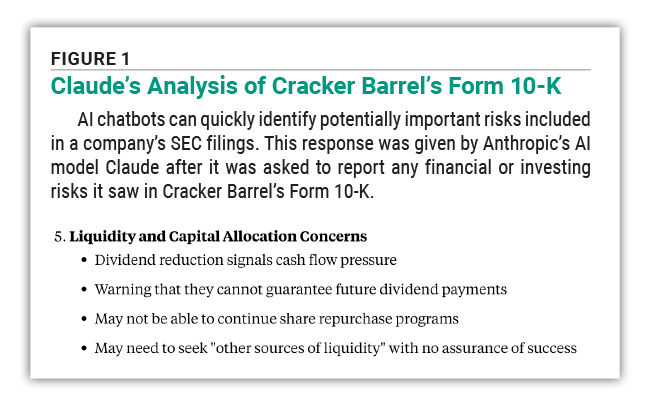
Other issues point to current or potential financial red flags. Restaurant chain Cracker Barrel Old Country Store Inc.  (CBRL) reduced its quarterly dividend from $1.30 to $0.25 per share in May 2024. “Dividend reduction signals cash flow pressure,” wrote Claude when asked to identify any financial and investing risks disclosed in Cracker Barrel’s fiscal-year 2024 Form 10-K filing (Figure 1). Stocks of companies that cut their dividends have historically gone on to underperform.
The Notes to Consolidated Financial Statements section is another part of a company’s 10-K filing to examine for financial red flags. This section lists the company’s accounting policies and any significant changes in the financial statement. Due to this section’s length, it’s best to copy and paste the text into a new document and then upload the document to the AI chatbot.
ChatGPT identified Cracker Barrel’s rising debt level, its high level of convertible debt that is due to mature in 2026 and its large lease liabilities. As a takeaway, ChatGPT cautioned, “Cracker Barrel’s high debt, rising interest costs, falling cash reserves and asset impairments indicate potential financial instability.” (We’ll note that Cracker Barrel hired new CEO Julie Masino last year to turn the business around.)
LLMs can also be used to analyze financial statement data. You will need to download the financial statements for the company you want analyzed to your computer or device and then upload the files to the AI chatbot.
AI chatbots vary in the types of files they can read. I found the most consistent method was to print the financial statements to a PDF file and then upload the PDF to the AI chatbot. I did this using the financial statements located at a stock’s AAII Stock Evaluator page (at the Financials tab). These statements are available to all AAII members.
The next step is to give the LLM the correct prompt. To generate an analysis of Boeing Co. (BA), I first told the chatbots, “Here are the financial statements for Boeing. Conduct a ratio analysis of them and list out your conclusions.” Both ChatGPT and Claude gave me a high-level overview of the trends they saw. Gemini asked me to clarify: “I can do that. What ratios are you most interested in?”
When I followed up by asking the AI chatbots to “give me a breakdown of specific risk factors,” each provided more specific analysis.
ChatGPT pointed out rising debt and negative cash flow as concerns. The AI chatbot warned that “low cash reserves and high cash burn could force Boeing to issue more debt or equity, hurting existing shareholders.” Gemini struck a similar tone by saying, “Fluctuations in operating cash flow raise concerns about the company’s ability to generate consistent cash.”
Notably, all three AI models pulled in information from outside sources when generating their responses. “Recent operational losses likely reflect costs associated with quality control problems, which have led to production delays, regulatory scrutiny and delivery issues,” commented Claude.
If there is a specific aspect of fundamental risk you are interested in, AI can assist you with that too.
Let’s say you are concerned about a company’s solvency—a big financial red flag. Upload the financial statements to an LLM and instruct it to do the analysis for you.
I started my prompt by telling each chatbot to pretend they are a credit analyst. This framing instructs the AI model on what viewpoint to use when generating a response. I then gave it specifics about what to focus on (Figure 2).
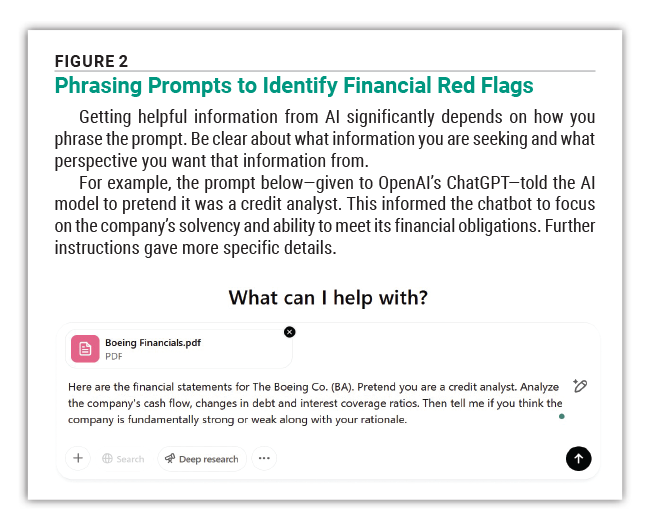
All three chatbots identified worsening trends for Boeing. Gemini gave the most basic analysis. Claude and ChatGPT were more specific. “The company is unable to generate positive earnings before interest, taxes, depreciation and amortization, making debt servicing problematic,” responded Claude. ChatGPT called Boeing a “high-risk borrower,” citing “a combination of negative cash flow, increasing debt, weak interest coverage and ongoing losses.”
LLMs can simplify the research process, but they do not replace the value of doing your own work. You should still analyze the business trends and look at the financial statements yourself. As you do this, check the chatbot’s conclusions to ensure it was not “hallucinating.”
The benefit of AI chatbots is their ability to quickly identify potential financial red flags that warrant further research. They can also be used to provide you with a second opinion about a company’s risk factors. How you write your prompt matters significantly. We suggest trying different prompts to determine which one provides the analysis you seek.
—Charles Rotblut, CFA
Computerized Investing

Computerized Investing


JOHN L from NJ posted over 1 year ago:
Wayne T from IL posted over 1 year ago:
ELISABETH H from MI posted over 1 year ago:
Wayne T from IL posted over 1 year ago:
BARRY J from TX posted over 1 year ago:
Wayne T from IL posted over 1 year ago:
BARRY J from TX posted over 1 year ago:
Wayne T from IL posted over 1 year ago:
You need to log in as a registered AAII user before commenting.
Log InCreate an account