


Charles Rotblut leads a class in AAII's new Essential Investing Video Course. Go to https://www.aaii.com/ves for more information and to subscribe.
In years past, AAII’s Best of the Web Guide highlighted websites in a range of investing and finance categories of interest to individual investors. Though curated, the guide still covered a large number of websites.
This year, we are making a change. Rather than compiling a comprehensive list, we are focusing on a small number of free investment websites that we think members should bookmark. These key resources provide valuable investing data, information and tools. In addition, they offer access to comprehensive databases not found elsewhere on the web.
CEF Connect
CEF Connect provides data, news and comprehensive information on closed-end funds.
The Daily Pricing tab provides closing price and net asset value (NAV) as well as other key metrics. At a glance, you’ll see the current market price’s percentage premium or discount to NAV, the distribution rate (yield), the one-year NAV return and the fund’s strategy. Clicking a fund name or ticker takes you to more in-depth information on the fund, including historical data on distributions, premium/discount pricing and performance.
The fund screener allows you to filter closed-end funds to find one that fits your desires. You can filter for various types of municipal bond, taxable bond, equity and hybrid funds. Common data points are preselected, but can be customized. Data is supplied by Morningstar. After searching, a list of funds meeting your criteria will be shown.
CEF Connect Closed-End Fund Screener

To take advantage of the portfolio and alerts tool, you will need to register for a free account. Doing so allows you to create and track a personalized portfolio with custom alerts set for various factors such as price changes.
The education center provides basic information such as how closed-end funds work and what types of investors they are best suited for. It also goes into detail about different strategies that closed-end funds can employ as well as more advanced topics such as leverage.
EDGAR
EDGAR is a database of regulatory filings operated by the U.S. Securities and Exchange Commission (SEC). The database is a great resource for finding filings such as quarterly and annual reports by corporations, mutual funds and variable insurance products.
In EDGAR, you can also find a description of a company’s business, a financial performance summary, risk disclosures, regulatory issues and legal issues, as well as disclosures of key material information. Information on insider transactions can also be found.
EDGAR Company Search

Using EDGAR can be a bit tricky at first, so here is some useful information to know. Regulatory filings are mostly designated by a number and code. Annual filings (10-K) provide comprehensive information about a company. Quarterly filings (10-Q) are published following the release of first-, second- and third-quarter earnings. Corporations and mutual funds can be searched by name or ticker. You are also able to search by state, country or standard industrial classification (SIC). EDGAR has a tutorial page that is useful for new users.
EMMA
Electronic Municipal Market Access (EMMA) provides data, disclosure and educational content on municipal bonds. Investors can find information on bonds issued by states, cities, counties and other muni bond issuers. Trade data, financial disclosures, official statements and other information is easily accessible for a given bond issue. (The documents available will vary by issuer and even issue.)
The muni bond comparison tool under the Tools and Resources tab allows you to compare trade prices and yields for municipal bonds with similar characteristics. To use the tool, you will need to enter the bond’s nine-digit CUSIP number, which can be found on EMMA.
EMMA New Issue Calendar
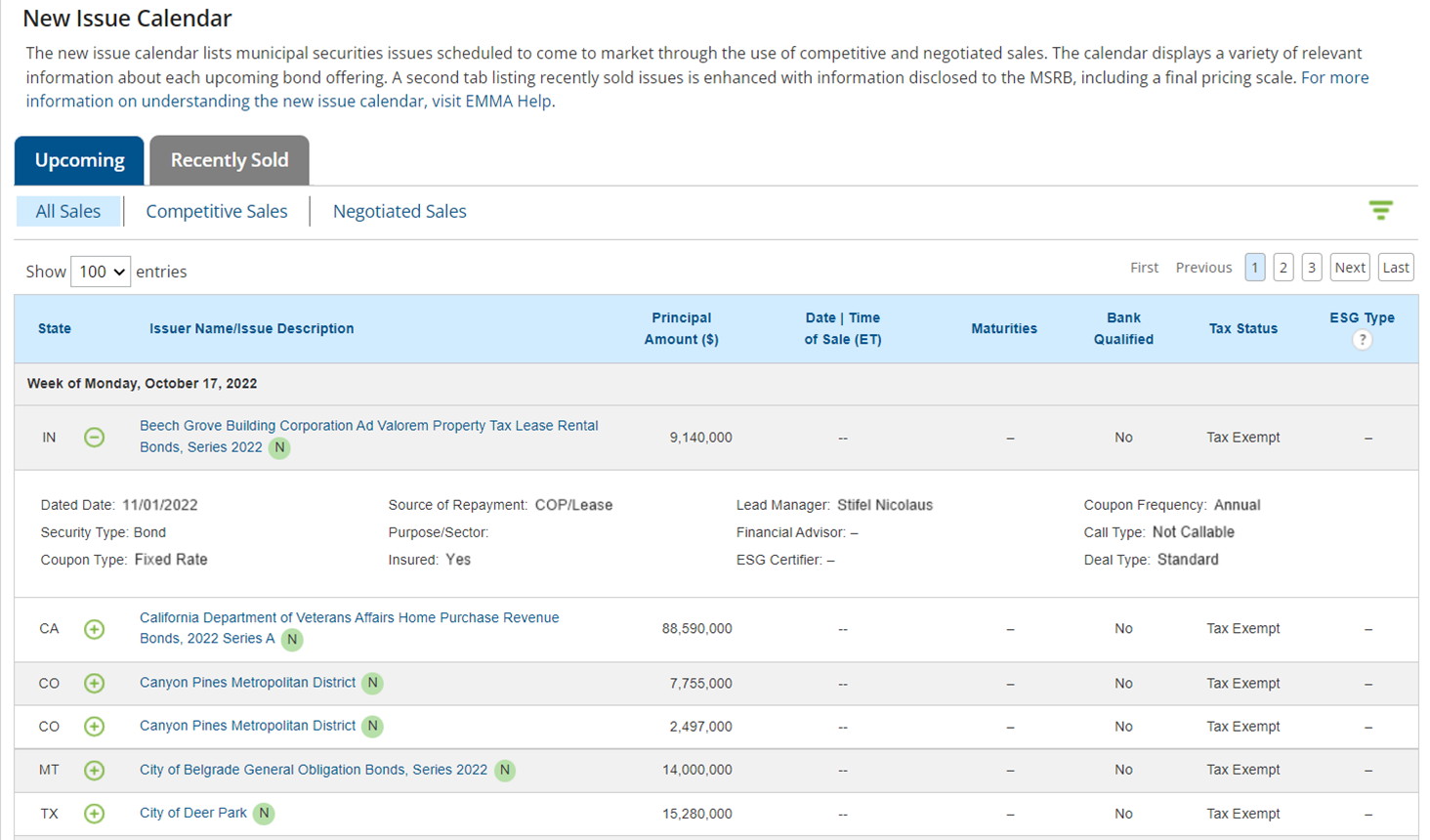
The new issue calendar lists municipal securities issues scheduled to come to market. Information on the security type, coupon type and frequency, whether the bond is callable or not and whether the security is insured or not is provided. Investors can also view daily and historical yield curves and indexes from a variety of third-party sources including Bloomberg, BondWave and others.
All of the aforementioned tools are free to access without registration. However, to use the MyEMMA tool you must register for a free account. The tool allows users to receive custom alerts when new information becomes available on EMMA for a particular security. It also allows you to save frequently used searches.
FINRA
The Financial Industry Regulatory Authority (FINRA) is a government-authorized not-for-profit company that oversees U.S. broker-dealers. A plethora of resources is available to individual investors for free, found under the For Investors tab on the website’s homepage.
BrokerCheck enables you to research the background and experience of financial brokers, advisers and firms. The tool provides easy access to information, instantly telling you whether an individual or firm is registered to sell securities, offer investment advice, or both, as required by law. Specifically, you get a snapshot of a broker’s employment history, regulatory actions and investment-related licensing information, arbitrations and complaints.
FINRA BrokerCheck
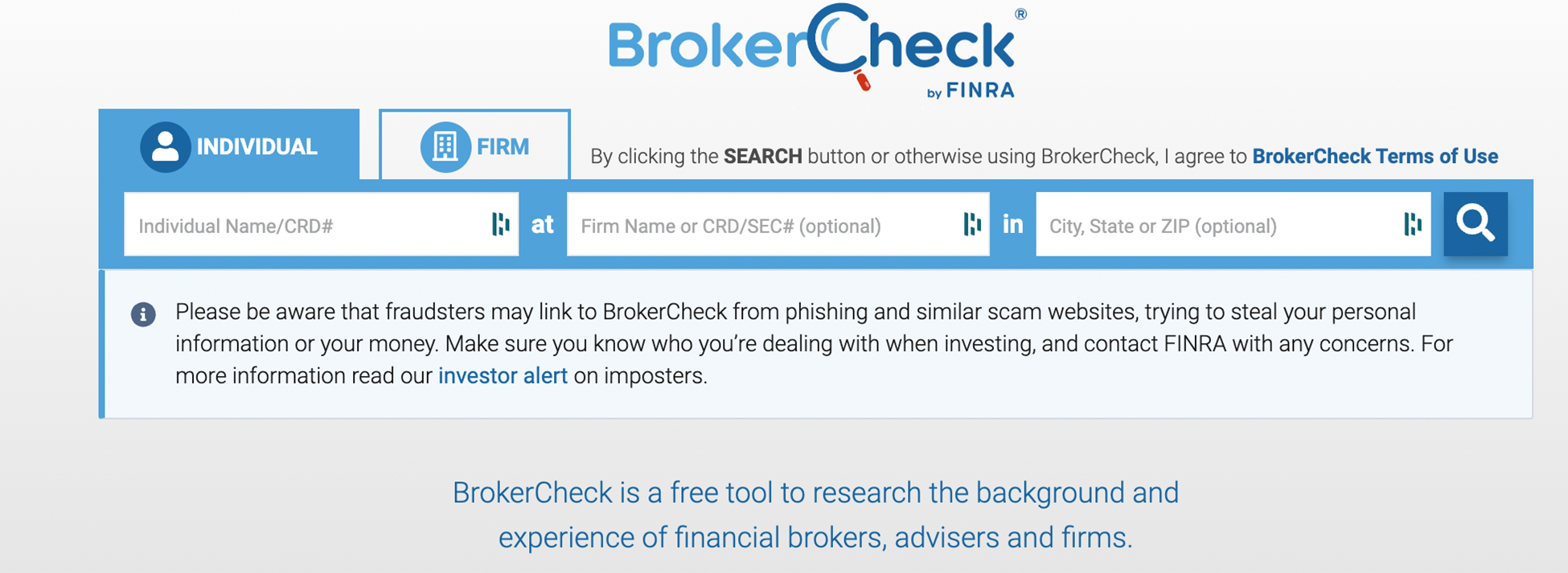
Other useful tools allow you to search for funds, bonds, professional investment designations, SEC-related arbitration awards, actions against individuals and unregistered soliciting entities. An array of calculators covers most needs for retirement, including estimating Social Security earnings, 401(k) and IRA required minimum distributions (RMDs) and 401(k) contributions, plus savings, education savings for college, loan payments (fixed-income) and accrued interest from bonds.
FINRA’s Investor Insights page provides topical articles covering personal finance, investing and protecting your money. Articles explain basics such as market capitalization, volatility and avoiding fraud, as well as more advanced topics like alternative and emerging securities products.
Individual investors can also file complaints, resolve a securities-related dispute, use FINRA’s Securities Helpline for Seniors and review other avenues for recovering losses. Note: BrokerCheck has its own dedicated help line, with the phone number at the top of the webpage.
FRED Economic Data
Short for Federal Reserve Economic Data, FRED is a popular online database consisting of hundreds of thousands of economic data time series from numerous national, international, public and private sources. FRED covers banking, business, fiscal, consumer price index (CPI), monetary and financial data. FRED tracks more than 800,000 data points from over 100 sources. It is a one-stop shop for anyone trying to understand the economy.
From the home page, users can search for data by typing in their search term or alternatively can browse the data through organized points of access. Data are browsable by 1) the source, 2) release document, 3) category, 4) latest update and 5) tags. You can also search by popular series or by trending terms like gross domestic product (GDP), inflation, unemployment and gold.
FRED Economic Data
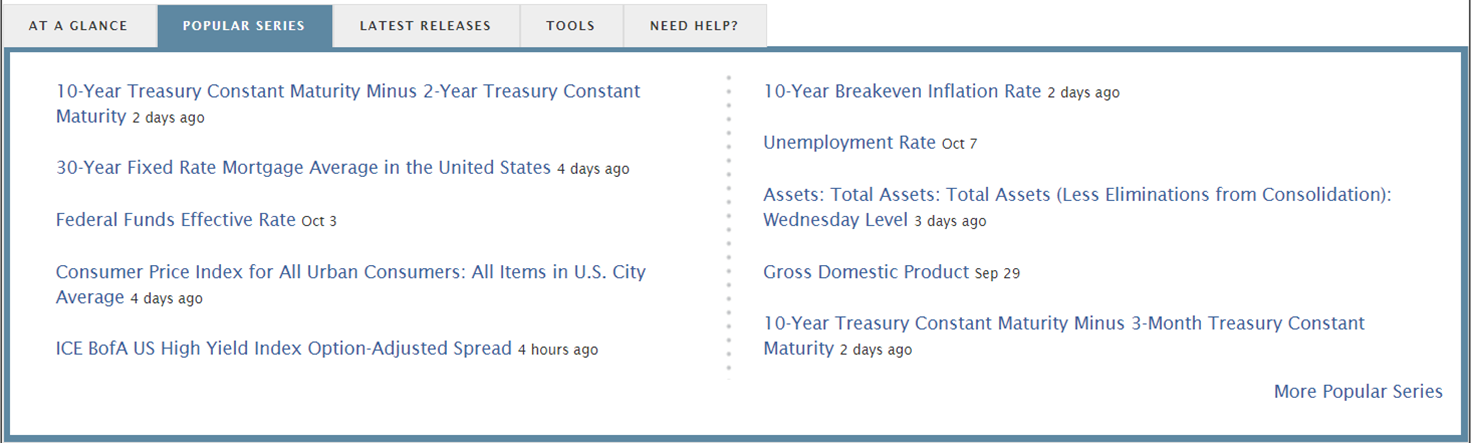
For first-time users, we recommend selecting the Category icon, which breaks down the available data into the following topics: money, banking and finance; population, employment and labor markets; national accounts; production and business activity; prices; international; U.S. regional; and academic.
Each specific category has further breakdowns of subcategories. For example, in money, banking and finance, subcategories include banking, business lending, exchange rates, financial indicators, interest rates, monetary data and foreign exchange intervention. Most investors will find the financial indicators subcategory most valuable; it provides information on indicators such as stock and bond market indexes, volatility indexes and financial activity measures. The interest rates subcategory reports rates for a wide range of financial instruments.
IRS.gov
The Internal Revenue Service (IRS) is a comprehensive resource for tax-related items. It is an authoritative source for answers to tax questions and provides access to tax forms and instructions. Its newsroom keeps readers up to date on tax news, including any changes to deadlines.
Tax payments, including those for estimated federal taxes, can be made directly on the website. Tax records and refund status can both be easily accessed.
Select Individuals from the File drop-down menu for the most pertinent information and resources. Among the useful areas here for individual investors is the Life Events section. It is organized by type of event such as married, separated and divorced, health care law, disasters and casualties, planning for retirement and mutual fund distributions. Links take you to resources that explain the tax impact of each event.
IRS Life Event Resources
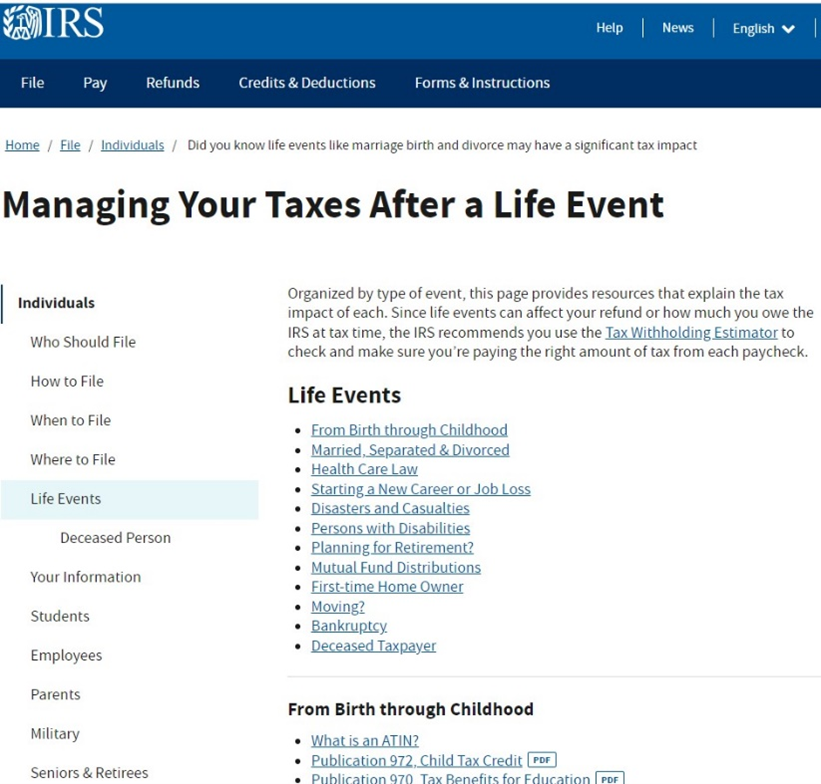
The site has a tax withholding estimator tool that helps you assess the federal income tax you may want your employer to withhold from your paycheck and to see how your refund, take-home pay or tax due are affected by the withholding amount.
Click on Seniors & Retirees from the Individuals area to find valuable information ranging from Social Security benefits and individual retirement arrangements to filing. The Social Security benefits section helps you determine if your benefits are taxable and allows you to request your benefit statement. The individual retirement arrangements section provides answers about distributions and withdrawals.
Other pages of the Individuals area provide information on whether you need to file a tax return, where to get free tax help from volunteers, tips for choosing a tax professional, how to amend a tax return and what to do if you can’t pay; plus, it provides access to the IRS’ free online filing service.
Moody’s
Moody’s database provides credit ratings for corporate bonds. Moody’s is one of the three largest credit rating agencies in the world, along with S&P and Fitch Ratings. We highlight Moody’s because of the extensive amount of information available to individual investors.
Moody’s Rating Actions
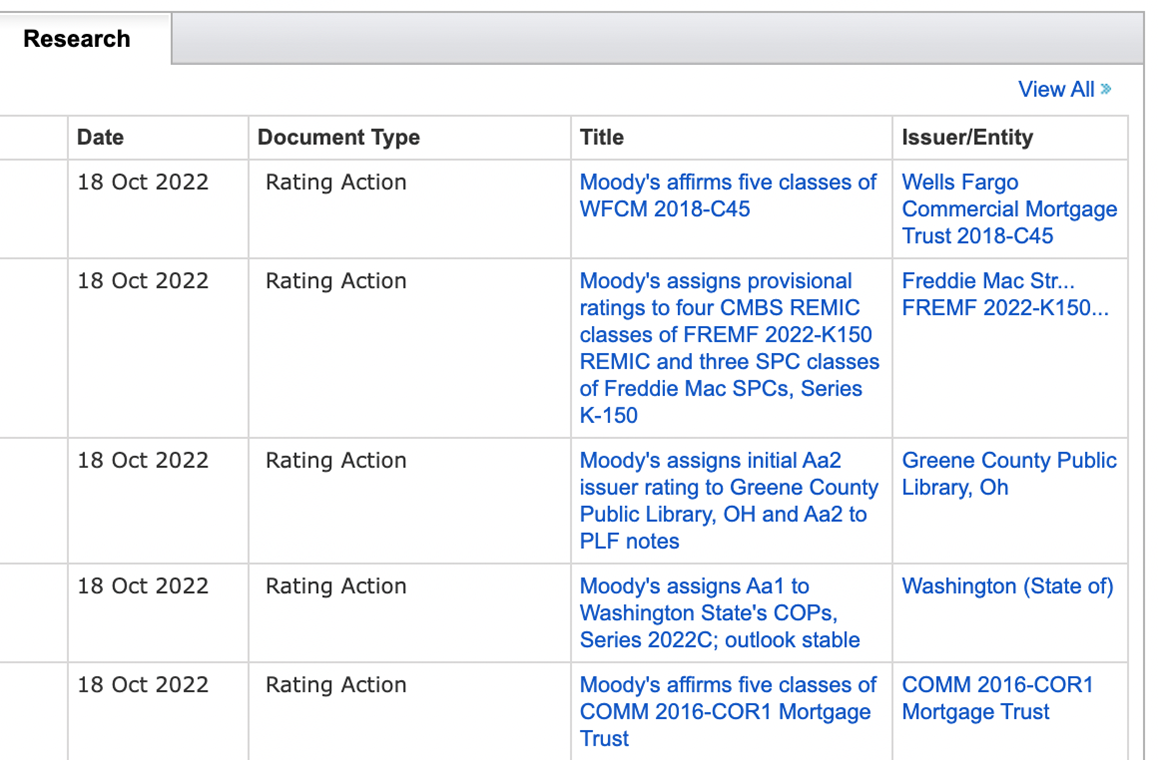
Registration is required, though a paid subscription is not needed to access credit rating reports. Both bond and stock investors may find the information useful for assessing a firm’s creditworthiness.
The Rating Actions section of the website lists the latest rating news issued by Moody’s analysts. Reports are also available on insurance companies, closed-end funds and municipal bonds in addition to other debt issues.
How We Chose These Investment Websites
In determining which websites to feature, we took into account the quality of information provided as well as the agency, organization or entity running the website. We also sought authoritative resources that were available at no cost to individual investors.
All of these websites stand out as leaders in their respective fields. Several are used by us regularly. If there are resources you believe should have been included in this list, please post them in the comments section at this article on AAII.com.
Related

Portfolio Strategies
What You Can Gain From Reading the Economic Tea Leaves
Related

Financial Planning
What the SEC Is Doing for Individual Investors
Discussion
FREE REPORT

DALE S from OH posted over 3 years ago:
DAVID H from NV posted over 3 years ago:
DAVID H from NV posted over 3 years ago:
You need to log in as a registered AAII user before commenting.
Log InCreate an account