

Related

Investor Professor
The SEC chairman and education director address AAII members’ concerns in a wide-ranging discussion covering the volatile markets, investor scams, SEC initiatives and teaching your kids.

Charles Rotblut leads a class in AAII's new Essential Investing Video Course. Go to https://www.aaii.com/ves for more information and to subscribe.
The U.S. Securities and Exchange Commission (SEC) is an independent agency tasked with protecting investors and overseeing the securities markets. SEC chairman Jay Clayton and education director Lori Schock participated in a live AAII town hall digital event with me in April that directly addressed member needs and concerns. An edited transcript of our conversation is presented below. The full presentation can be viewed at www.aaii.com/webinars. See Member News in this issue for more on AAII’s webinar series.
—Charles Rotblut, CFA
Chairman Clayton and Lori, thank you for joining us. I know our members are looking forward to hearing from both of you.
Jay Clayton (JC): Charles, thank you for inviting us. Your members, and main street investors more generally, are extremely important to us as people we serve.
In our economy, our capital markets, we really need investors to put their money to work for the long term. It’s extremely important to our day-to-day economic activity, but also our resilience in times like this.
The focus here at the SEC over the last several weeks has been keeping the capital markets functioning, keeping investors apprised of the information that they need to make good, sound investment decisions. Although we have shifted to a mandatory telework environment, the people of the SEC have dedicated countless hours and, importantly, their expertise to keep our markets functioning during this time. I want to make a special shout-out to them for doing so. I think it’s enabled us to get to where we are today, which is a point of relative calm in our marketplace.
So with those opening remarks, I’d like to turn it over to Lori. She’s passionate about ensuring that our investors have the information they need to make good decisions.
Lori Schock (LS): Thank you, Jay. Just because we’re in a virtual environment, I don’t want anyone to think that we’re not here. We are here. We’re on the job. My office, the SEC Office of Investor Education and Advocacy, continues to take investors’ questions and complaints as they come in.
We switched to this virtual environment of providing investor education broadcasts, if you will. We’ve done some Twitter feeds and chat-type things with some of our federal colleagues as well. So, we wanted to make sure that people have answers to their questions during this time. We have also put out industry alerts, including a couple that have dealt directly with the coronavirus, about some of the investment scams that we’re seeing.
I always like to call out the SEC’s EDGAR database. It’s a database of regulatory company filings. What other SEC resources should individual investors be aware of?
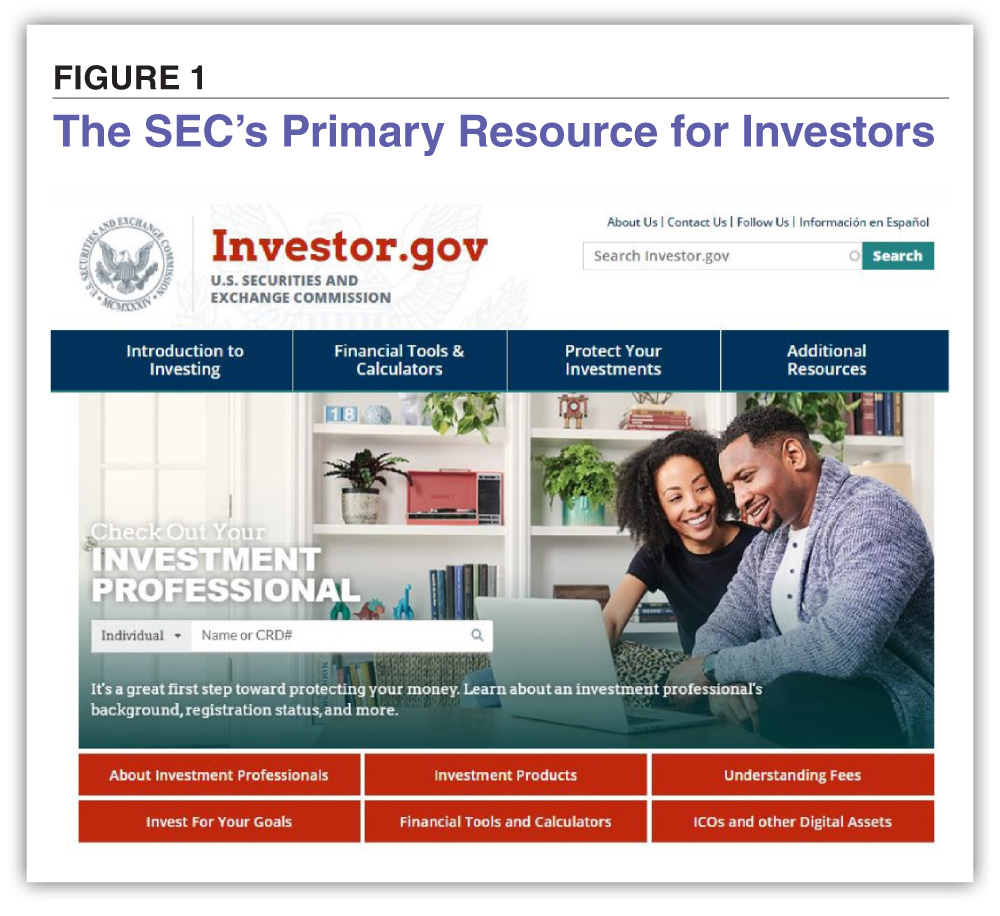
JC: Investor.gov is our principle resource for retail investors [Figure 1]. There’s a host of tools there. There are videos about how to select a financial professional, compounding, analysis as well as fraud and red flags. I would recommend to anyone who’s getting started investing or who’s looking for tools to help explain investing to others—including to your children—use Investor.gov. To the extent you have suggestions on how we can improve Investor.gov, please send them to us. And Lori, maybe you could talk a little bit about how people can check on their financial professionals there.
LS: On Investor.gov, the very first thing you will see is “Check Out Your Investment Professional.” All you have to do is put in that person’s name.
People do a lot of research on where they may travel or what hotel they might stay at, but it’s interesting to find out that people can work years—if not decades—with a financial professional and never run a background check on them. So, go to Investor.gov, put in the person’s name and you’ll see a lot of information there. Should the person not show up as being registered, that’s a big red flag.
Let’s say the person is registered and licensed. Then you can see if there have been any regulatory complaints against them or actions taken against them. You can also find out how long they have been in the business and how often they have changed firms. It’s just a wealth of information that we want people to look at before they turn over their money.
Even if you’ve worked with someone for a while, check them out once a year. Maybe on your birthday, it’s your gift to yourself just to run that background check and make sure everything’s still in order.
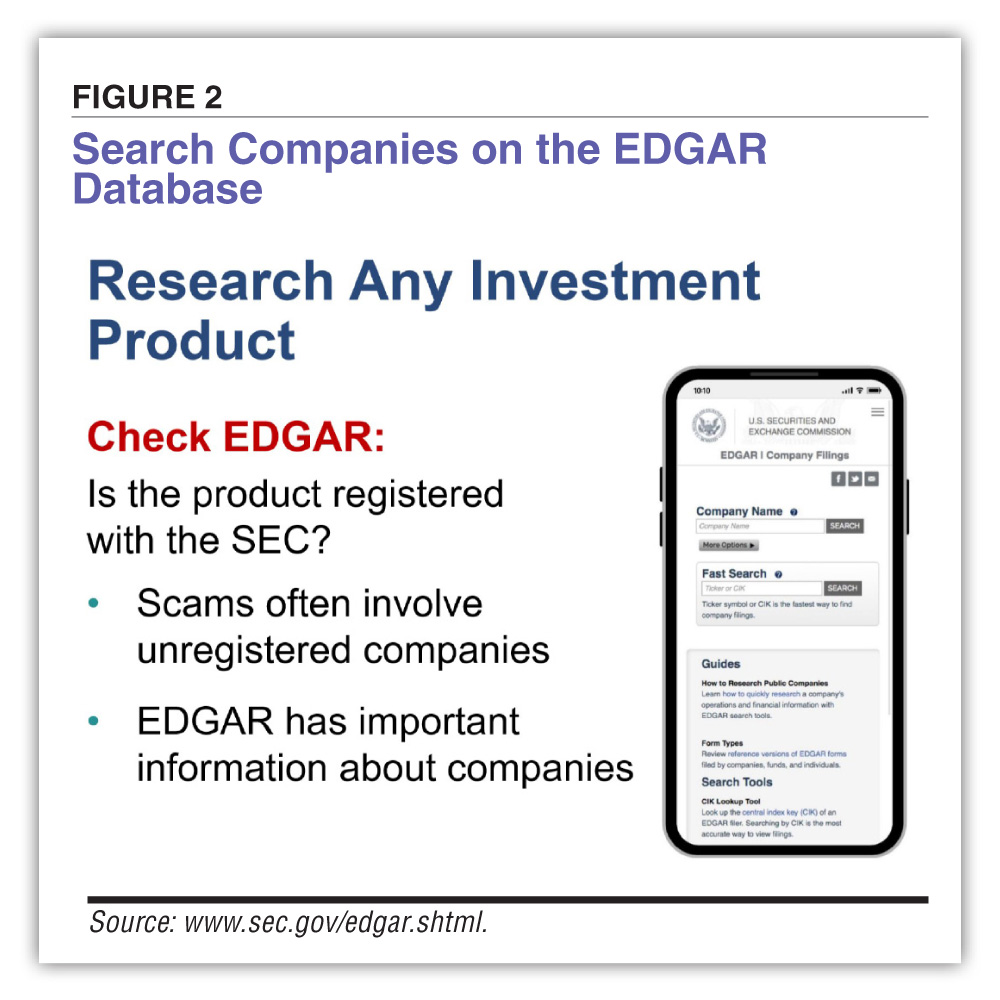
Charles mentioned EDGAR, which is also a great way to check out businesses [Figure 2]. They should be registered also. There’s some exemptions to registration, but most main street investors are dealing with entities that are registered. We see a lot of investment fraud that involves unregistered people selling unregistered products. If you have a promised and guaranteed return, hold onto your wallet. When it comes to investing, there are no guaranteed returns.
You can check out all of these things from Investor.gov, as well as some other videos and resources that are available for certain segments of our society, such as military or teachers. I would hope you’ll spend some time just poking around and seeing what’s available. And again, as the chairman said, we’ll take comments on ways to improve it.
Chairman, I know you’ve published handwritten notes, and they’re available on SEC.gov. Would you like to briefly discuss those and perhaps highlight them?
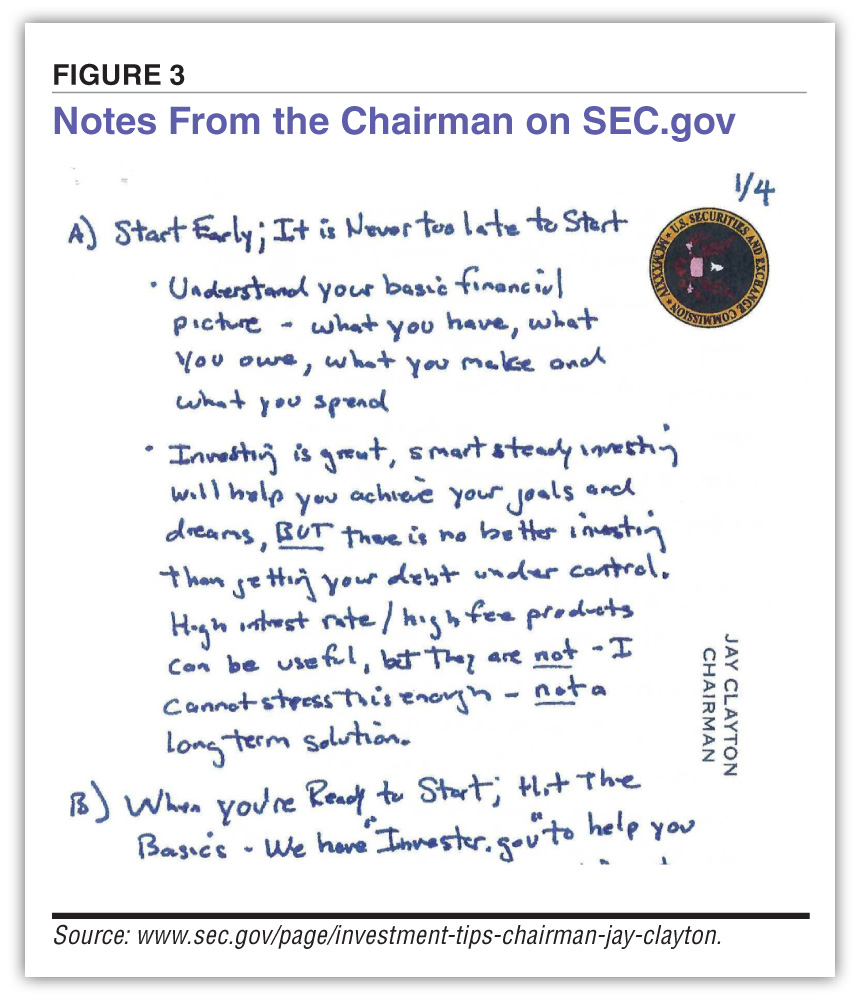
JC: Lori and I have traveled the country, and it’s most gratifying to meet with individual investors. I’m asked a number of incredibly insightful questions. And a lot of times they are, “What are your tips for investors, and what should people know?” I wanted to make sure that I was consistent and getting out the important concepts, like compounding and the types of red flags that you should avoid, as Lori mentioned. Addressing some of those guaranteed higher returns: Guarantees and higher returns never go together. If somebody is guaranteeing you high returns, stop talking to them. I wanted to make sure that people have my concepts, and so I wrote them down. And then having them written down, I decided, well, why not post them?
They’re available on our website [Figure 3]. I hope people take a look at them. I think that they’re great things to share with your children. These ideas will give them a good introduction to how investing works and the types of things you should have front-of-mind in investing—including whether it’s right to start investing. It’s so important to get your financial house in order as part of any investing plan. I would not want to see somebody devoting a ton of time to investing without getting their general credit position and other financial matters in order.
I wanted to ask you both about www.sec.gov/tell-us. I know both of you have been very active in terms of trying to reach out to individual investors. Could you talk about the site?
JC: We really value engagement with our main street investors. Here in Washington, we can get a lot of views from a lot of people who are professionals at giving us views. That’s why Lori and I go out to town halls and we have Tell Us; we want to hear directly from the people who we’re here to serve. Is the information that’s provided to you by a mutual fund company or an exchange-traded fund (ETF) the kind of information that is of use to you? And do you understand the fees they’re charging and the expenses?
We want to hear from you because we want our rules to work for you. It’s your money at the end of the day, and our rules should work for you. Lori, you really engage with people on a day-to-day basis and I get a lot of great feedback from you on how to craft our rules in a way that works for the people who we’re here to serve.
LS: I think you hit the nail right on the head with the fact that there’s no lobbyist group for retail investors, for main street investors, or an association that represents them necessarily. So that’s why this forum to get retail investor input into our rulemaking and process is so important.
That was part of the emphasis for us doing a bunch of the town halls that we did for Regulation Best Interest (BI) and for Form CRS. That rule-making will impact retail investors. It goes into effect this summer. It’s one that’s going into effect, but we did receive a lot of investor input into it. The accredited investor standard certainly impacts retail investors.
It’s important for us to have that feedback and incorporate it as part of our process for rule-making; especially if the rule-making could impact retail investors so directly.
Great. Chairman, since you have taken the office, is there anything that you’ve done that you think has helped individual investors? What improvements do you think you would cite that individual investors should be aware of?
JC: Well, I don’t want to tie it to me. When I arrived here, particularly in the main street investor space, I asked our long-time staff what improvements they thought should be made. One of the areas that continued to come up when people are investing—whether they are investing $100 a month or $500 a month, if they’re lucky—is how much of that money is going to work for them when they hand $500 a month to somebody and where is that money going? Is $495 going into stocks and $5 to expenses or is it $475 to stocks and $25 to expenses? Knowing how much of your money is going to work for you and how much of it is going to pay for advice or other expenses—you shouldn’t have to work hard to do that.
Our efforts around Form CRS and Regulation BI are designed to provide people with that information. When people are armed with that information, they make better choices and competition increases; all of which is part of America and what makes America a great place.
So, thanks to the staff, I think we’ve brought a fair amount of transparency to those issues to allow our investors to make better choices. That’s something that I’ve proudly been able to do. I also recognize that we need to continue to focus on it.
A lot of members have asked, “What initiatives are the SEC focusing on that are particularly pertinent or would be of interest to individual investors?”
JC: I mentioned one and Lori mentioned one: Regulation BI, which raises the standard of conduct required from brokers. Related to the Form CRS, the client relationship summary, making it clear that professionals have to tell their clients when they’re a broker or an investment adviser and how much of their money has gone to work for them and the types of fees and expenses that they charge. Other initiatives involve trying to enhance the investor experience overall with the fund sector, both ETFs and mutual funds.
In terms of what’s happening in the way stocks trade, we’re looking at our market infrastructure and whether investors—investing directly or through funds—are getting the best execution they can possibly get.
There’s a pocket of the market that I believe needs more sunlight. That is the penny stock market and over-the-counter (OTC) market. Too many of our main street investors view these types of investments as having the same risk level as companies that you see quoted on our more common stock exchanges. They are not. They are—on average or as a general matter—much riskier investments. I want our main street investors to understand that. The rules in the penny stock space have not been updated to take advantage of our modern communications technology. They should be. So, we’re working on that.
We’re working on modernizing disclosure requirements for our large public companies to reflect changes in the marketplace. If you go back 30 years ago, the assets on the balance sheet of most companies were property and equipment: factories, machinery, trucks, things like that. Those were the tangible assets that people looked at to assess the value of a company and its production capacity. Today in many places, it’s intellectual property and human capital that drive the value of companies. Our disclosure rules should reflect that.
Those are some of the things that we’re working on. As you can see, in many ways they’re in line with modernization of the requirements to reflect today or the use of modern communications technology to give investors better insight into exactly where their money’s going.
Is there anything I didn’t ask you that you want to highlight?
JC: Hey, Lori, I’ve been dominating this. Why don’t you go first? You always have so many good ideas. Is there anything that I’ve missed out on here that is important for people to think about?
LS: Our enforcement division has certainly been busy during this time. You may have seen that more than 20 companies have had trading suspended. These companies were making claims of either having a vaccine for the coronavirus or maybe testing, when allegedly they were shell companies for five years that hadn’t really been doing anything. But now, all of a sudden, they’re the ones who are going to have the fix to this pandemic. I just want people to be aware of that.
Unfortunately, we have unscrupulous people who will try to take advantage of any crisis. We’ve seen it too many times. It will last for the duration of the crisis and then some. History is indicative here.
We’re also seeing some scams maybe from people who might be thinking, “I’m going to go fly to safety” with certificates of deposit (CDs). These are often offshore. They require large amounts of investment, say a $200,000 minimum, where the money’s being wired offshore. They use fake names that look very similar to U.S. firms. So please do some due diligence, especially when it comes to wiring anything offshore or if you think the name looks close to a name that you know. Is that really the company you think it is?
Unfortunately, we’re seeing some additional scams right now, so just keep your eyes and ears open. Should you see or hear any of these scams, please report them to us. You can do that from www.sec.gov/tcr. That’ll be the fastest way for us to follow up on those tips that you may be seeing.
JC: I’ll just follow up on that. Investors are our eyes and ears on the ground. We have a very robust whistle-blower program. We have, as Lori mentioned, a TCR program: tips, complaints and referrals. I think even through this unprecedented time and our staff functioning away from their desks, they get through those complaints in a matter of sometimes hours; but in almost all cases, less than a few days. If you see something fishy, let us know so we can take a look at it and keep somebody else from being a victim.
Our capital markets, and particularly our equity markets that people see on television every day, functioned incredibly well through two stresses at the same time. The first stress was significant, what the professionals would call a “risk-off trade.” I would explain this as being a shift from long-dated bonds and bonds of relatively less quality and equities to short-term securities and securities of relatively higher-quality like Treasuries and other short-dated high-quality paper. It was a giant shift over the course of three weeks. In fact, it was similar to a shift that happened over the course of three months in the financial crisis. Combine that with a move to a remote working environment, the infrastructure held up pretty well. The markets functioned.
People may have not liked the prices that they were getting, but if they wanted to get in or out of a particular security, they were usually able to do it. That is a testament to the work that’s gone on over the last decade to shore up the plumbing in our financial system. So here we are in a period of relative calm [end of April] and trying to figure out what’s next. What’s next for our financial markets depends a lot on what’s next for our general economy.
My last point of emphasis here is, it is a really good thing that in this country public companies have to tell people how they’re handling matters like this. That kind of information in the marketplace is great for investors, not only because we can figure out how to allocate our capital, but it’s also great generally for our society. Given the rules that we have and the requirement that people tell us the truth, the truth makes it easier for us all to plan. ?
Investor Professor

Financial Planning

Barry Estell from California posted over 6 years ago:
Mike from FL posted over 6 years ago:
Hugh from Maryland posted over 6 years ago:
J Maberry from IL posted over 6 years ago:
DANIEL B from MI posted over 6 years ago:
DANIEL B from MI posted over 6 years ago:
BARRY J from TX posted over 2 years ago:
You need to log in as a registered AAII user before commenting.
Log InCreate an account