


Charles Rotblut leads a class in AAII's new Essential Investing Video Course. Go to https://www.aaii.com/ves for more information and to subscribe.
-
 The unpredictability of late-in-life costs highlights the importance of financial planning for aging-related expenses
 - Housing and care need decisions include aging in place vs. care facilities, transportation, home modifications and funding care through savings or insurance
- A one-page PRISM plan helps you clarify investment allocations and risk tolerance and prepare for possible cognitive decline
Late-in-life costs are difficult to predict but can be significant. LongTermCare.gov estimates that 69% of people will use long-term care services. The average duration of long-term care is three years (Table 1).
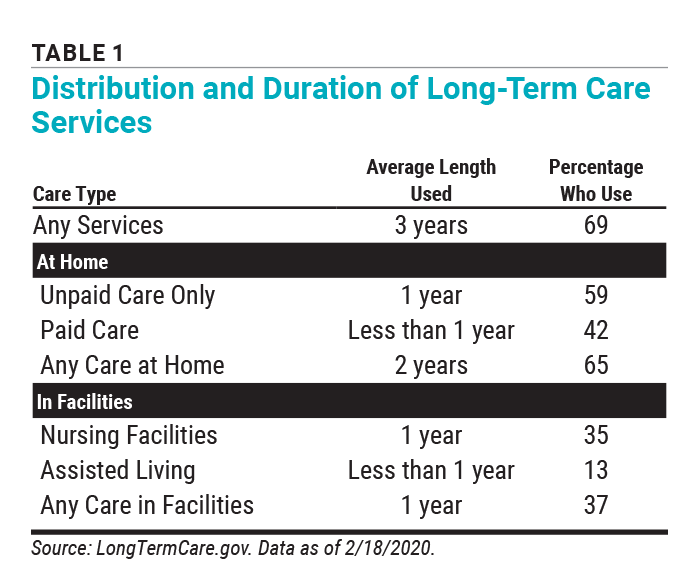
A large variance exists around these numbers. While one-third of those who are currently age 65 will not need significant long-term care, 20% will need it for longer than five years.
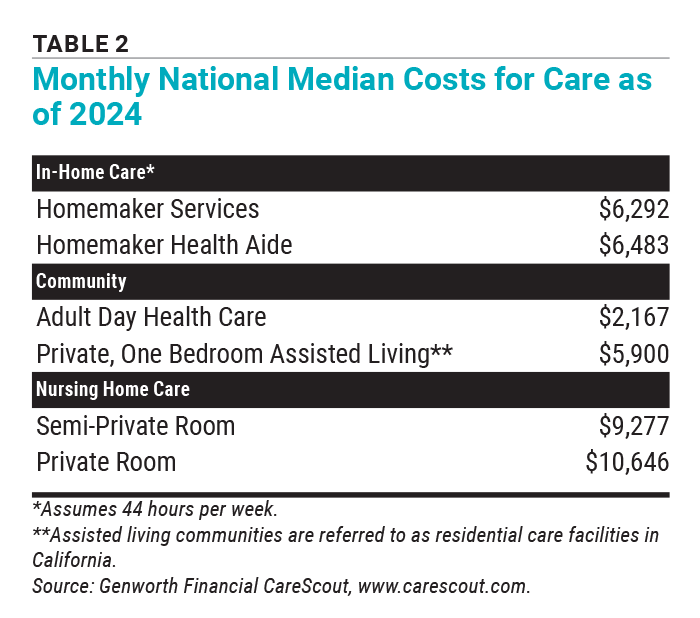
Howard Gleckman, a senior fellow at The Urban Institute, suggests that single people without long-term care insurance should conservatively plan on spending $200,000 per year for care. This amount is double for married couples. Table 2 presents the current median monthly costs for a range of care types.
Though there are uncertainties about when, how much and what type of care you will need late in life, creating a plan can help you prepare for the possibility in advance. The plan can also serve as a talking point with your children or others you trust about any preferences you have.
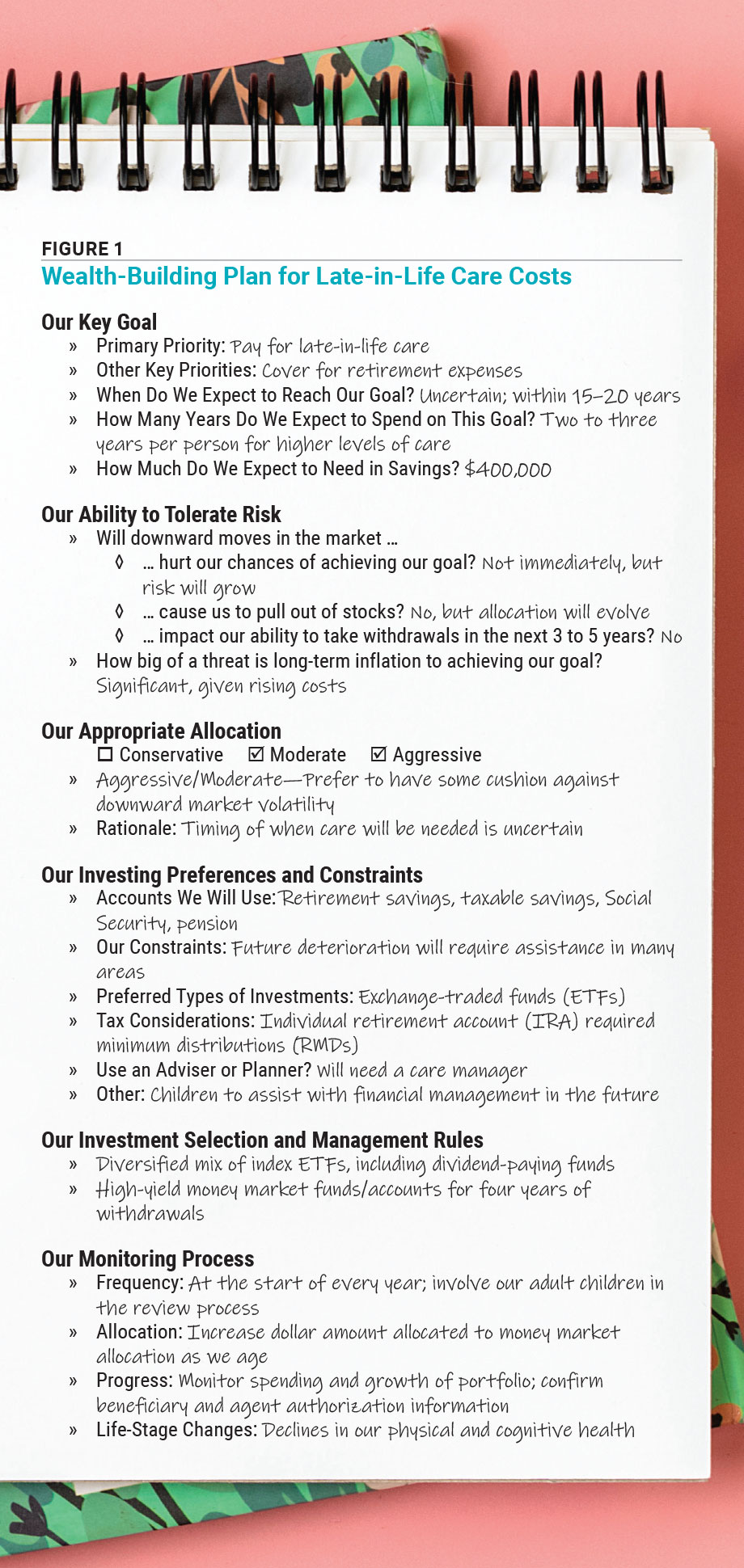
A 70-year-old married couple serves as the example for the PRISM Wealth-Building Plan presented in this article (Figure 1). Gary and Brenda are in good health and live independently. Their mortgage is paid off. The couple receive $50,000 per year in Social Security and pension benefits. They also have $1.0 million in total savings. Neither is a military veteran.
Considerations Related to Late-in-Life Care
There are many possibilities when it comes to care—more than we can fully address in this article.
One big decision is the type of residence you wish to age in. Staying in your own home (aka aging in place) or with an adult child may be desired. The layout of the home and the presence of any stairs are big considerations. Modifications to the house may also be required to accommodate changes in mobility. Those who choose to stay in their house must account for maintenance and repair costs. Logistical considerations must also be taken into account, including how you will get groceries and who will provide transport when you are no longer able to drive.
Residential communities vary in cost not only by geography but also the services provided. Independent living communities provide food and activities. Personal care services such as pill reminders and assisting with showers cost extra. Assisted living provides more care but, in my and my wife’s experience, still assumes residents are mostly independent and ambulatory. Memory care provides far more services and attention, but at an even higher cost.
At all three levels, the ability to transport oneself is a big consideration. We commonly saw assisted living and memory care communities require residents to be a “one-person transfer.” This means a resident can be moved from a seated position to another place (e.g., from one chair to another) with the assistance of just one person. Residents who need two people to help them transfer will likely be required to hire caretakers to assist them.
Skilled nursing facilities are options for those who are two-person transfers and/or have medical issues requiring additional attention. These facilities are expensive.
Regardless of place of residence, caretakers may need to be hired. Their costs vary not only by locale and skill set, but also whether they are hired directly or through an agency. A professional care manager may also be needed.
Medicare and Medicare Advantage plans will cover health-care-related costs but not personal care costs such as assisting with bathing. There is also a significant gap between the time when someone needs some assistance and when they will qualify for benefits under a long-term care insurance plan, if such a policy has been taken out.
Goal: Pay for Late-in-Life Care
The first step, and the cornerstone of the PRISM Wealth-Building Process, is identifying and prioritizing goals. Gary and Brenda feel confident about being able to cover their regular retirement living expenses with the income expected from their Social Security and pension benefits plus their savings.
They do not wish to be a burden on their adult children, and they desire to make covering late-in-life expenses a key goal. Alzheimer’s disease runs in both of their families. While the couple are both currently in good health, they are concerned about the possibility of requiring memory care in the future.
Gary and Brenda assume one year of memory care will cost approximately $100,000 per person. They also budget for independent living community costs of $70,000 per year and assisted living community costs of $100,000 per year. The couple also assume they will spend an additional $70,000 on future personal care costs.
In total, they budget for $400,000 of costs. This budget is based on assumptions about the amount and level of care they will need. Though Gary and Brenda anticipate moving to an independent care facility before they need higher levels of care, they plan on using proceeds from the sale of their home to help cover the costs.
The timing of all these costs is unknown. For the purpose of planning, they assume they will move into independent living in their mid-80s, with the higher care costs potentially starting in their late 80s.
Were the couple to have one of their adult children directly care for them, the costs would be much lower, particularly if Gary and Brenda aged in place or moved in with a family member. A caretaker or other assistance aid may still be needed, and such costs should be accounted for. There may also be potential costs to make the residence more accessible for the couple (e.g., a remodeled bathroom, ramps, improved lighting, etc.)
Risk Tolerance: Uncertain Time and Spending Duration
Gary and Brenda are fortunate to be in a position where they do not currently need to spend down their retirement savings. Thus, they can afford to withstand stock market volatility for the time being. The couple understand the importance of not reacting to shorter-term fluctuations in the stock market.
While they have started taking some retirement withdrawals, the amount is less than the overall gains realized by the portfolio in an average year. Thus, sequence risk (a series of bad returns in the stock market) should not impact Gary and Brenda’s ability to take withdrawals.
Future inflation is a threat to the couple’s goals. They have incorporated a small buffer in their forecasts for future spending but realize they will have to reevaluate the amount needed for their goal in the future.
Those who anticipate needing a higher level of care within the next few years may have less risk tolerance. The determination is whether there is enough cash flow—either through sources of guaranteed income or the ability to make portfolio withdrawals—to cover those costs should a downturn in the stock market occur.
Asset Allocation: Growth Now, Prepare to Spend Later
Gary and Brenda desire to continue seeking growth of capital. They also wish to maintain some cushion against volatility given the uncertainty of when they will need to increase their spending. The couple accomplish this by opting for AAII’s aggressive-to-moderate transition allocation model. This calls for 75% of the portfolio to be invested in a diversified set of stocks and 25% to be invested in fixed income and safe assets.
The couple realize this allocation will evolve over time. Gary and Brenda also realize that once they begin having cognitive issues, they may not be able to make proper portfolio allocation decisions. They account for this possibility by informing their children of their intention to shift to a more conservative allocation upon moving into an independent living facility. This change is intended to protect the portfolio from market volatility once large withdrawal amounts are required.
Gary and Brenda intend to have at least one year of long-term care expenses allocated to a money market fund before moving into a retirement community. They will increase this allocation to four years of expenses as they age and begin to need assistance and/or their health shows signs of deterioration.
To the extent the portfolio is of a significant size to cover higher costs, an allocation to growth assets can still be maintained. The percentage of the portfolio that will remain in stocks will be dependent on the couple’s spending needs relative to the value of the portfolio. The greater the wealth, the larger the allocation to stocks that can be maintained.
A different school of thought argues for protecting the amount needed for the projected expenses from stock market volatility. Those in this camp suggest that investors should make use of bond ladders and/or long-term care insurance. Life insurance with a long-term care option is another possibility. Annuities can also serve a role by providing an ongoing stream of guaranteed income. Some annuity contracts do come with a long-term care rider, but their costs must be taken into consideration.
Investing Preferences and Potential Cognitive Decline
As stated above, Gary and Brenda both receive Social Security and pension benefits. They also have retirement savings accounts and taxable brokerage and savings accounts.
The couple utilize exchange-traded funds (ETFs) in their investment accounts. Gary and Brenda choose to avoid individual stocks to simplify their investing strategy.
While both are currently able to pick and manage stocks, they realize that the onset of Alzheimer’s disease would limit their ability to do so in the future. One of the first signs of cognitive impairment is problems with numeracy.
Gary and Brenda own traditional individual retirement accounts (IRAs) and Roth IRAs. They have instructed their broker to automatically distribute the required minimum distributions (RMDs) from their traditional IRAs to their savings account once per year. This is done for simplicity. It also ensures that the couple never unintentionally miss taking an RMD—something that will be helpful as they age.
The couple feel confident enough in their investment skills that they do not need a financial planner. Gary and Brenda do explain their investing strategy to their children. They further explain what decisions they want made if and when their adult children step in to assist with managing the couple’s portfolio. The couple also agree to transfer control of their personal finances in the future to an adult child they have designated.
Gary and Brenda also write down that they will eventually want a care manager to be hired. Though this person will not be involved in managing the couple’s finances, they include this on their PRISM one-page wealth-building plan because it will be an additional expense that their portfolio will need to pay for. Gary and Brenda do not use an accountant and have previously established their estate plan.
Those who prefer not to use or cannot count on family to assist them can consider using an adviser, a robo-adviser, a daily money manager (DMM) and/or a trust administrator in addition to a care manager. Such decisions should be made before cognitive decline sets in. It is also best to meet with such professionals before they are needed in order to establish a relationship and convey what you are seeking the professional to do in the future.
Investment Selection and Management Rules
Gary and Brenda use a diversified mix of low-cost ETFs that track major, well-known indexes including the S&P 500 Dividend Aristocrats index. (Companies comprising this index have raised their dividends every year for the last 25 consecutive years.) The couple also have a high-yielding money market fund for their cash savings.
The couple will check their ETFs once per year to ensure the objectives have not changed and the fees remain low relative to similar funds. They will also compare the yield on their money market fund against similar funds to ensure it remains competitive.
The PRISM process enables personalization. Other investors may prefer holding individual stocks, bonds, mutual funds or other types of investments.
We suggest simplifying portfolio holdings as you age, particularly as you approach your later years. Doing so reduces the number of decisions that need to be made. It also makes it easier for a family member or someone else you trust to take over managing the portfolio and make the decisions you would want them to.
Monitoring Allocation, Progress Toward Goals and Life Stages
During the later years of life, a person can properly manage their portfolio until they are no longer able to. It is difficult to know when this bridge has been crossed. Cognitive decline and impairment are big risks; they degrade your analytical and decision-making skills. It is not unusual for someone not to realize they are having difficulties until after bad financial decisions are made.
Gary and Brenda account for this by agreeing to involve their adult children in their annual portfolio review process. The couple will discuss their investing strategy and portfolio allocation with their family. Aiding the discussion are simple projections made by Gary and Brenda regarding their future income and spending. The numbers need not be exact, just close enough to set expectations of when spending will rise and by how much.
At the start of each year, Gary and Brenda will also make sure the beneficiary and authorized agent information on their accounts is correct. An authorized agent is a person who can make transactions within the account on behalf of the account owner. It is beneficial to designate someone to serve in this role, though considerable thought must be given as to who. The authorized agent must be someone you trust to act in your best interest. An authorized agent will need to be established for each account at each financial institution you work with.
The medical power of attorney is another key document. It enables someone you trust to make medical decisions on your behalf. This can be the same person as your authorized agent or a different person. From a financial standpoint, this document may come into play when coordinating care and living arrangements is needed (e.g., moving into memory care).
Gary and Brenda plan on increasing their allocation to their money market account gradually over time. Their goal is to have at least enough to cover one year of long-term care expenses by the time each is 87 years old. This age is based on both being in good health. The couple realize that the target age is an assumption.
As Gary and/or Brenda’s care needs increase, spending will need to be monitored by the couple and their children. Retirement spending over time often follows a pattern that resembles a smile. Spending is higher early in retirement when people are in good health and active. It often declines during the middle years as activity levels drop but health remains fairly good. Spending then rises during the later years as health worsens and more care is required.
A One-Page Wealth-Building Plan Can Help You Prepare for Late-in-Life Costs
One of the biggest challenges in financial planning and investing is longevity risk. Longevity risk is the chance of outliving your savings. While we all want to maximize both quality and quantity of life, our late-in-life years can come with physical and cognitive challenges. The costs accompanying such challenges can be high, depending on what help is needed.
A one-page PRISM plan can help you prepare for the forthcoming costs. It can also provide a framework upon which to base future decisions. These include where you would like to live and who will provide care for you. If you are comfortable doing so, we suggest discussing these decisions with your family members.
Everyone ages differently, will have different needs and has different opinions on where they would like to age. There is no single plan we can suggest that will work for every person. What this one-page PRISM plan does do is provide an example of a framework you can use for your own personal planning.

Related

Financial Planning
Shifting Control of Personal Finances With a Daily Money Manager
Related

Financial Planning
The Benefits and Costs of Long-Term Care Insurance
Discussion
FREE REPORT

Get your free copy of our special
report analyzing the tech stocks
most likely to outperform the
market.
BARRY J from TX posted over 1 year ago:
JOHN L from NJ posted over 1 year ago:
PATRICK F from WA posted over 1 year ago:
D R from WA posted over 1 year ago:
D R from WA posted over 1 year ago:
You need to log in as a registered AAII user before commenting.
Log InCreate an account