

Related

Portfolio Strategies
Key Numbers for Your Retirement Prep Checklist

PRISM Wealth-Building Process
Retirement readiness in the U.S. varies significantly by income level, with lower-income workers needing to replace a larger share of their pre-retirement income but facing greater shortfalls in doing so.
by Omar Beirat | April 2025

Retirement readiness in the U.S. varies significantly by income level, with lower-income workers needing to replace a larger share of their pre-retirement income but facing greater shortfalls in doing so.
Using the Vanguard Retirement Readiness Model (VRRM), researchers analyzed household savings, Social Security benefits and investment assets to estimate how much income different groups can replace in retirement. The study focused on late baby boomers (age 61 to 65), Generation X (49 to 53) and millennials (37 to 41). Researchers considered how different factors such as market conditions, Social Security cuts and life expectancy could impact a retiree’s financial security. The goal was to understand which groups are most at risk of falling short in retirement.
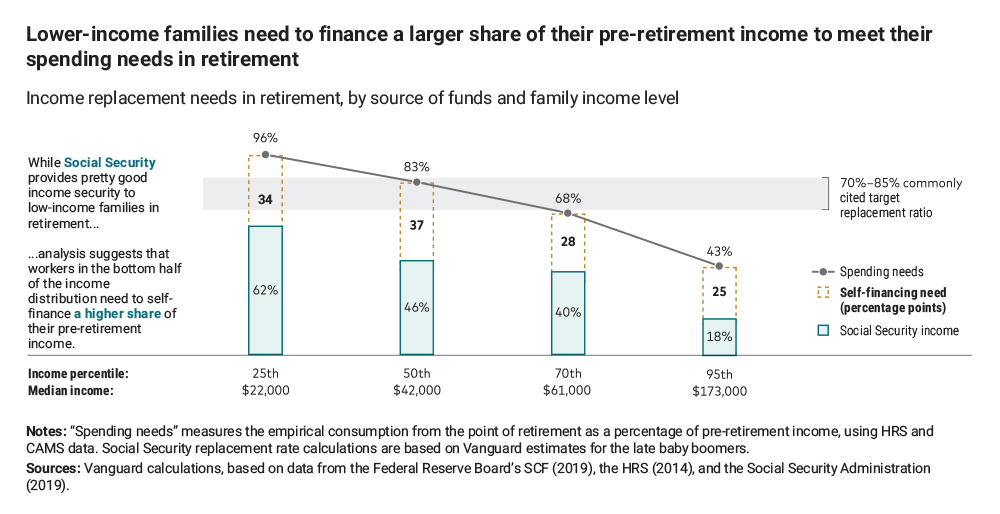
The figure highlights the disparity found in income replacement across four income levels. Lower-income retirees (25th percentile) rely heavily on Social Security, which covers 62% of their retirement income, but they still face a 34% shortfall that must be self-financed. Middle-income workers (50th percentile) receive 46% of their retirement income from Social Security, leaving them with a 37% gap to cover. Upper-middle-income retirees (70th percentile) see 40% of their income replaced by Social Security, requiring them to self-finance 28% of their spending needs. Meanwhile, higher-income retirees (95th percentile) need significantly less of their pre-retirement income in retirement, spending only 43%, with 18% covered by Social Security and a 25% shortfall.
For individual investors, these findings emphasize the importance of proactive retirement planning. Relying solely on Social Security is not enough, especially for lower- and middle-income workers who face the largest shortfalls. To bridge the gap, investors should prioritize long-term savings through employer-sponsored retirement plans, individual retirement accounts (IRAs) and other investment vehicles.
Source: “The Vanguard Retirement Outlook,” by Andrew S. Clarke, CFA, CFP, Fiona Greig, Ph.D., Kevin Khang, Ph.D., Kate McKinnon, Ph.D., Fu Tan, Ph.D., and Victoria Zhang; Vanguard, July 1, 2023.
Portfolio Strategies
PRISM Wealth-Building Process


No comments have been added yet. Add your thoughts to the discussion!
You need to log in as a registered AAII user before commenting.
Log InCreate an account