

Related

PRISM Wealth-Building Process
We use the example of a hypothetical couple to illustrate how the PRISM process can get you to your retirement goal.

Charles Rotblut leads a class in AAII's new Essential Investing Video Course. Go to https://www.aaii.com/ves for more information and to subscribe.
Each new year brings about new resolutions. Unfortunately, many people fail to achieve their goals. One study cited by Psychology Today found that just 19% of people stick to their New Year’s resolutions.
One of the best ways to achieve your goals is to have a written plan for achieving them. The PRISM Wealth-Building Process is designed to help you do this. It is a five-step process for creating a framework to achieve your financial goals.
Since many financial and investing goals are set in January, we show you here how the PRISM process can be used to establish a plan for reaching them. Specifically, we use a hypothetical couple, Jack and Cynthia. They are both age 50 and want to be more disciplined in building and managing their retirement savings—a common goal and common New Year’s resolution many people have.
A common first step for achieving a goal—be it a New Year’s resolution or a longer-term goal—is to write it down. An oft-cited study by Gail Matthews, Ph.D., at Dominican University in California found that those who wrote down their goals were 42% more likely to achieve them.
Chances are you have more than one goal for what you want to do with money. Jack and Cynthia are no different. They want to retire comfortably, travel, help their children in the future and give to charity. In such situations, prioritization is important.
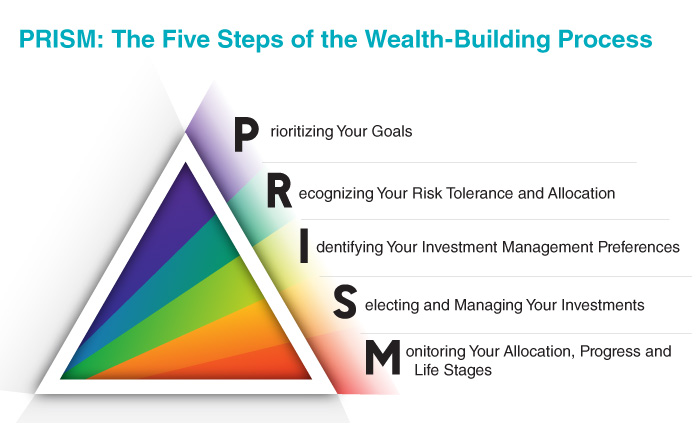
Using Step 1 of the PRISM process, they prioritize saving for retirement as their first goal. They set a target date for retiring at the year they turn 67. This will be the date both will be able to claim their full retirement benefits from Social Security. The date also sets the number of years they have to achieve their goal at 17.
To estimate the duration of retirement—the period over which they will spend on the goal—Jack and Cynthia take into consideration their current health, their parents’ longevity and estimates from online life expectancy tables and calculators. Based on this, they assume that at least one of them will live to age 90 or longer. The couple choose a 30-year spending duration for retirement to err on the conservative side.
Jack and Cynthia set an estimated cost of retirement at $2.4 million. This number is based on what they think they will spend annually in retirement on their desired lifestyle multiplied by the number of years in retirement. Though the actual cost will rise with inflation, the couple assume their portfolio will grow at a faster rate.
Assigning a dollar value to a financial goal is just one part of reaching a financial goal; another big part is having that amount of wealth grow over time. Growing wealth to achieve a long-term financial goal requires maintaining an allocation to equities over a long period of time to benefit from compounded returns.
Step 2 of the PRISM process helps you recognize risk tolerance and allocation. Jack and Cynthia start with the first part of this step by filling out the risk questionnaire.
The questionnaire helps the couple realize that they have high a tolerance for risk from a timing standpoint. Retirement is nearly two decades away, which gives their portfolio plenty of time to recover from any shorter-term drops. They also hope to have a long and healthy retirement. This would be an extended period over which their portfolio can continue to benefit from the long-term compounding of returns.
Being AAII members, Jack and Cynthia understand the importance of moderating how much they will take out of retirement savings to spend each year. They agree to limit first-year withdrawals to just 4% of their savings once in retirement and then adjust this amount each year by inflation.
The inclusion of income from Social Security benefits lessens their financial risk by not making the couple solely reliant on their portfolio to fund their retirement.
Psychologically, they have reacted to the down markets differently. Jack has been more willing to endure downturns—viewing them as opportunities to buy stocks on the cheap. Cynthia is a bit more conservative, preferring to have some less volatile assets in the portfolio to lessen the dips. They both self-describe their knowledge of key investing concepts as moderate. The couple perceives themselves as having a good understanding while still realizing that there is more they can learn.
The risk questionnaire shows that Jack and Cynthia have the risk tolerance to follow an aggressive allocation. Recognizing Cynthia’s desire to have a counterbalance to equities in the portfolio, the couple agree to include some exposure to bonds.
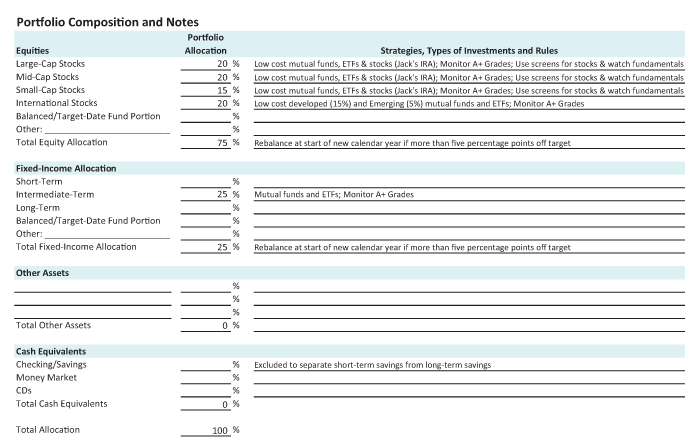
In reviewing the AAII Asset Allocation Models, they opt for the transitions version of the aggressive investor model. This allocation calls for a 75% weighting in equities and a 25% weighting in fixed income. It still provides much growth but reduces the level of volatility relative to the full aggressive investor model’s 90% allocation to equity.
With their allocation determined, Jack and Cynthia can now go about determining what investments to use to achieve their financial goal of saving for retirement.
Here is a copy of the guidelines Jack and Cynthia wrote down as part of Step 4 of the PRISM Wealth-Building Process, Selecting and Managing Your Investments. They are using their 401(k) plan accounts to hold low-cost mutual funds with return grades of A or B for most time periods. In Cynthia’s IRA, they are holding ETFs with return grades of A or B for most time periods. Jack prefers to own individual stocks and holds them in his IRA. He uses the AAII stock screens to find stocks and monitors the A+ grades on the stocks he holds.
An important bridge exists between recognizing the appropriate allocation to achieve financial goals and selecting the right investments to do so. That bridge is Step 3 of the PRISM process: Identifying Your Investment Management Preferences.
These preferences reflect two things. The first is how involved you want to be in the selection of the individual securities that will populate your portfolio. The second is acknowledging any constraints or restrictions you may face.
Both Jack and Cynthia have 401(k) plan accounts through their respective employers. Both plans only offer mutual funds as investment options. Jack holds index funds in his, while Cynthia’s plan mostly offers actively managed funds. In their respective IRAs, Jack invests in individual stocks while Cynthia holds exchange-traded funds (ETFs).
Whenever spouses have separate accounts but common goals, some coordination must be used both in terms of allocation and selecting investments. Allowances must be made for differences in preferences (e.g., individual stocks versus ETFs) as well as any constraints. In this case, the couple must own mutual funds to get the benefits of their 401(k) plans.
The couple agree to have Jack hold stocks in his IRA, while Cynthia holds bond ETFs in her IRA. Mutual funds and ETFs will be used to allocate to international equities (developed and emerging markets) and bonds. Jack will target domestic companies with his stock picks.
They will combine their accounts into a single tracking portfolio using AAII’s My Portfolio tool. Doing so gives them a higher-level view of everything they own. It also makes it easier for them to coordinate the choice of investments.
The first three steps of the PRISM process lead an investor to Step 4: Selecting and Managing Your Investments.
An analogy would be starting a new fitness regimen at the start of the year. A person may set a goal of losing weight or achieving a certain level of fitness. Before exercising, they would be wise to consider any potential health risks and allocate time in their schedule to workout. They would then decide whether they prefer working out at home or at a gym, as well as determining whether to work with or without a trainer or class instructor (in-person or virtual).
Similarly, with the PRISM process, the investments selected to help achieve a financial goal reflect the first three steps. The PRISM process narrows down the field of potential investments to the most suitable ones based on an investor’s allocation requirements and investment management preferences.
Jack and Cynthia start with their 401(k) plans. These are their largest accounts due to the higher contribution limits and employer contributions. The couple use the AAII Asset Allocation Model to determine which fund categories to look at—large-cap, mid-cap, small-cap, international and emerging market stocks as well as intermediate-term bonds. They purposely choose not to use target-date funds. The latter decision reflects their preference to manage their own portfolio allocation.
When choosing funds, they place an emphasis on funds with low expense ratios, given the drag on returns that high fund fees can have. Jack and Cynthia use the mutual fund evaluator on AAII.com to analyze individual fund returns over one-, three-, five- and 10-year periods. The couple establish a preference for funds with return grades of A or B for most periods, if available through their plans. For the actively managed funds in Cynthia’s account, they keep an eye out for any manager changes.
In Cynthia’s IRA, they target ETFs following broad, well-known indexes. The choice of ETFs is made with the same rules used for mutual funds, though with AAII’s ETF grades. Should there be funds within Cynthia’s 401(k) in one or more of the target allocation categories with lackluster relative performance and/or high expenses, Cynthia underweights them to the extent reasonably possible. The couple then use her IRA and Jack’s 401(k) to bring their overall portfolio’s allocation back to their target.
ETFs are selected using criteria similar to those used for mutual funds. Cynthia considers holding developed and emerging market stock ETFs in her IRA since Jack holds shares of domestically based companies in his IRA.
The couple check their mutual funds and ETFs once per quarter. They pay particular attention to the actively managed funds in Cynthia’s 401(k) for any unexpected quarterly returns. They are less concerned with the performance of Jack’s mutual funds and Cynthia’s ETFs since both follow broad indexes. A change in the index followed would prompt them to reevaluate a mutual fund or ETF.
Jack has a preference for growth and uses the AAII stock screens to find ideas. He establishes written directives regarding his buy and sell rules. They include minimum levels of revenue and earnings growth and a cap on valuations, plus profitability and positive cash flow. Should any of his stocks no longer possess one or more of these criteria, he will sell them.
He opts to look at his individual stock holdings weekly, with a focus on any notable news that has come out. He also monitors the A+ grades on his stocks for any deterioration. He conducts a deeper dive into each stock following the release of their quarterly earnings. Any stocks that meet a sell rule are sold and replaced.
He adds all holdings to the My Portfolio tool on AAII.com, which makes tracking them easier.
The final step of achieving any goal is monitoring one’s progress toward it. Are you still on track to reach it? Has anything occurred that would cause you to change or alter the goal? Is there a need to lower the goal’s priority relative to other goals?
Retirement is a big goal. Though the date at which it occurs can change from the intended target (either due to voluntary or involuntary reasons), there will be a time when most people do retire. As such, it is a top financial goal.
Near the end of each year, Jack and Cynthia’s monitoring process starts with their savings contributions. They look at how much they saved for retirement relative to the goals they established during the previous year. In doing so, they take into consideration anything that might have caused them to miss their targets—unexpectedly large expenses, a change in employment status, etc. The couple take into consideration any change in their employer’s policy for matching 401(k) contributions. If they fall short during any one year, they seek to boost their savings rates during the next year it is possible to do so.
Then at the start of each calendar year (e.g., January 1), Jack and Cynthia check the allocation of the combined accounts to ensure it is within a reasonable range of their target. They also look at the overall value of their portfolio relative to their target. Their goal is to ensure their retirement savings remain on track assuming a reasonable level of future savings contributions and portfolio returns.
The couple take the further step of reviewing their current life stage. In doing so, they consider their current health and as well as any change in their family. At the same time, Jack and Cynthia also take the time to review all of their beneficiary designations to ensure they are correct and up to date.
If no changes are necessary, they go back to their regular process. If a change in their life stage does occur—such as approaching retirement—they revisit their goals and determine if a change in their plan is needed by working through entire PRISM process again.
The PRISM Wealth-Building Process gives Jack and Cynthia the structure for achieving their primary goal of being disciplined in building and managing their retirement savings. They now have a framework and set of self-defined rules they can use for making future investment decisions.
There is an added benefit. Research shows that those who write down and follow a plan are more successful at achieving their goals. PRISM helps you create a written plan based on your personal goals, risk tolerance and preferences.
Go to www.aaii.com/learnandplan to take advantage of the PRISM Wealth-Building Process, an AAII member benefit. If you would like us to demonstrate the PRISM process for people at other life stages, please let us know at the online version of this article in the comments section or by emailing us at journal@aaii.com.
We think you’d like this related webinar! Creating Your Own Personalized Wealth Plan With PRISM
PRISM Wealth-Building Process

PRISM Wealth-Building Process
PRISM Wealth-Building Process

Hugh P from WA posted over 4 years ago:
You need to log in as a registered AAII user before commenting.
Log InCreate an account