


Charles Rotblut leads a class in AAII's new Essential Investing Video Course. Go to https://www.aaii.com/ves for more information and to subscribe.

Featured Tickers:
- Benefits of investing in freer, local companies in emerging markets
- How freedom-weighted indexing avoids autocracy risks
- Key considerations for allocating and managing emerging markets exposure
Perth Tolle founded Life + Liberty Indexes and created the first emerging markets exchange-traded fund (ETF) based on a freedom-weighted strategy, the Freedom 100 Emerging Markets ETF  (FRDM). Cynthia McLaughlin and Charles Rotblut, CFA, sat down with Tolle in late February to discuss the ins and outs of investing in emerging markets.
Cynthia McLaughlin (CM): Why should investors invest in emerging markets?
Perth Tolle: Emerging markets provide diversification from the U.S., especially at a time when U.S. valuations are so much higher relative to the rest of the world. Emerging markets rank as the cheapest in the world as far as equity asset classes go—even cheaper than developed international markets, whose valuations are already much lower than U.S. stocks currently.
Demographics are also more attractive in emerging markets relative to developed markets. Many of the emerging market countries we invest in [at Life + Liberty Indexes] have even stronger demographic trends, largely because their citizens enjoy a greater degree of freedom. We think that’s a very important advantage.
Lastly, emerging markets are poised to provide 60% of world gross domestic product (GDP) growth going forward. And these countries are growing from a very low base relative to developed markets.
Diversification, favorable demographics, attractive relative valuations and high expected participation in world economic growth going forward are characteristics that are advantageous for investors to capture in emerging markets.
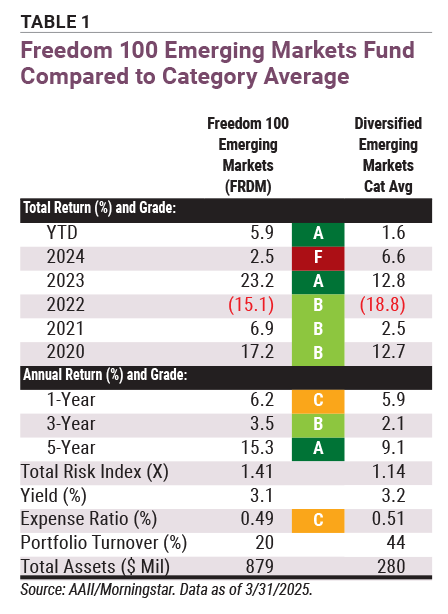
[For complete stats on the Freedom 100 Emerging Markets ETF, see its Fund Evaluator page.]
CM: How much do you see U.S. investors allocating to foreign stocks and emerging markets?
That depends on each individual or institution’s time frame and risk tolerance. Most of the emerging markets allocations I see are somewhere between 5% and 20% of one’s equity allocation, with 20% being on the higher side.
Charles Rotblut (CR): When you talk to advisers, do they differentiate between developed and emerging markets?
In the U.S., I generally see a clear category split between developed markets and emerging markets.
CM: Some investors believe they get sufficient international exposure by owning U.S. companies that do business overseas. What are your thoughts on this?
You do get some exposure that way. Conversely, you get some U.S. exposure by holding international companies that do business in the U.S. However, you would miss out on capturing the growth of companies in the local economies in each of those markets.
Something I’m very proud of with the Freedom 100 Emerging Markets ETF is that we provide access to local shares, not just American depositary receipts (ADRs). Our fund consists of approximately 80% local shares and 20% ADRs.
Our investors have access to local companies in most of the included countries. Some companies may not do any business with the U.S. and some of them may have some business with the U.S., but you would not get access to the majority of our portfolio holdings if you’re only invested in U.S. multinationals.
CM: What are the tax considerations of investing in an international fund? Foreign dividends and currency translation come to mind.
The tax advantages of an ETF remain the same whether you invest in an international fund or a U.S. fund. This is because of the creation-redemption process with the in-kind creations and redemptions that ETFs use. The only exceptions are countries that are cash-only. [Editor’s note: ETFs exchange baskets of ETF shares and assets with authorized participants—which are typically large trading firms—instead of buying and selling shares of stock on the open market.]
Because of the creation-redemption process, our fund has generated very few capital gains distributions over time. It is a U.S.-dollar-denominated fund. We don’t hedge the currencies in each individual country because it would be very difficult to predict the direction of currencies.
CM: What guidelines would you offer to an individual investor who is interested in targeting specific emerging market countries?
Targeting is an important word. There is much higher risk in the emerging markets space due to the number of autocracies. Those include China, Russia, Saudi Arabia, Egypt, Qatar, the United Arab Emirates (UAE) and Turkey. There are many autocracies and semi-autocracies in the emerging markets universe.
Many people are reluctant to invest in emerging markets because they do not want to participate in human rights violations or subsize the way companies do business in the more authoritarian markets.
Companies in autocracies are not free to act in their own best interest or in the best interest of their stakeholders. They have to put the state’s interests first.
They have very opaque ownership structures, so investors often don’t know who they are directly benefitting when they invest.
There’s also a lack of transparency in the data and accounting standards. Without free media and expression, as well as independent verification of the accuracy of data, companies’ financial data are somewhat meaningless for investment purposes.
Those are some examples of what we consider autocracy risks that exist most conspicuously in the emerging markets space.
Most emerging markets indexes and funds use market-capitalization weights, which results in large allocations to countries with high autocracy risk. To avoid this, and to get freer country exposures, we use freedom weights instead. Countries that have higher freedom levels get higher weights in our index, and the worst-scoring countries (highest autocracy risk) are naturally excluded as a result of freedom weighting.
We’ve found that freer markets have more sustainable growth because their growth is not debt-driven or state-mandated. These economies also demonstrate greater resilience and recover more quickly from drawdowns. They allocate capital more efficiently, which supports long-term development and innovation. They have less capital flight and capital destruction—both in terms of monetary capital and intellectual capital.
That’s why we think the freer markets are the best places to capture the next big growth stories. With index investing, a few big growth stories typically account for an outsized portion of returns. We want to be in the places where we have the best chance of capturing those big growth stories, and we think that the freer markets are where we will find them.
CR: Is market cap a liquidity issue more than anything else in terms of buying and selling stocks?
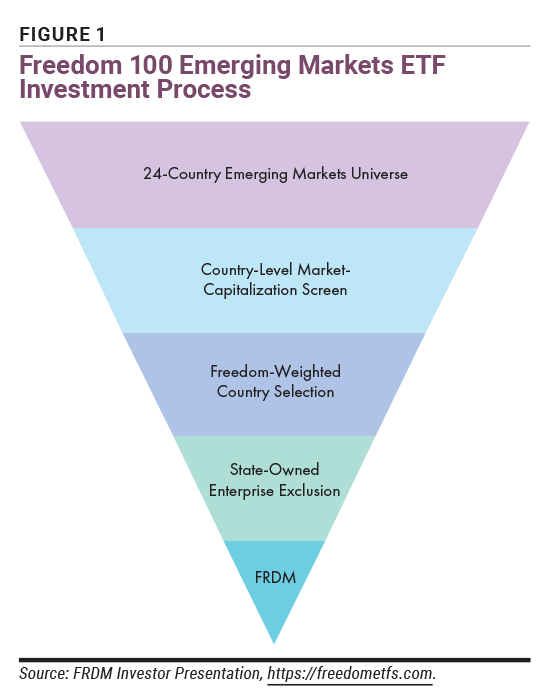
Before we apply freedom weights, we screen the emerging markets universe for minimum market cap and liquidity to ensure tradability (Figure 1). Some countries are excluded at this step because they are too small (Czech Republic) and some are excluded because they are not liquid enough (Peru). What we end up with is a highly tradable eligible universe.
CM: I noticed that you rebalance the Freedom 100 Emerging Markets’ portfolio just once per year. What is the logic for doing so?
The human freedom data—personal and economic freedom scores—comes out once per year. Since this is the main input into our freedom-weighting process, we rebalance once per year, after the data is released.
CR: If a country drops in the freedom rankings, do you hold it until the rebalancing period?
You’re referring to what we call the freedom decline momentum rule. This rule states that if an included country declines by more than five points on the freedom scale developed by Freedom House—a third-party research and advocacy organization that evaluates political freedom—it will be dropped from the index.
We use Freedom House for this rule because it provides a faster score by making decisions by committee, rather than with a transparent, quantitative methodology such as the one used by our main data providers, the Cato Institute and the Fraser Institute.
We want to catch declines in freedom early because we’ve noticed that when freedom declines, it does so very quickly. When freedom increases, it’s typically more gradual.
The freedom decline momentum rule was triggered once by Turkey in the 2018 index rebalance. It has not been triggered again since.
CM: Is there ever a case for including state-owned enterprises in the Freedom 100 Emerging Markets because they are more likely to be successful with state backing?
The exclusion of state-owned enterprises is the only active assessment we do at the individual security level. We exclude such companies to bring the economic freedom theme all the way through to the security level. We are taking the position that the less government interference in private market activity, the better.
Private companies are in the best position to determine the most efficient ways to operate and grow. In contrast, government-backed enterprises are often inefficiently run and would otherwise be replaced by more innovative or competitive firms. This misallocation of resources and capital slows progress and ultimately weakens long-term economic growth.
It’s an acknowledgement of the phenomenon of spontaneous order, or emergent order, which is the idea that order comes out of natural chaos. Individuals operating in private markets are best equipped to determine the best use of technologies and resources, the best things to produce, and how to price them. The surprises and innovations that arise from this are much better than anything central planning could come up with.
CM: For assessing a country’s freedom, what resources are available to the public?
The Cato Institute, the Fraser Institute and Freedom House are all public sources. There are other sources as well, such as the Economist Intelligence Unit, which has a democracy index.
The Human Freedom Index and its data set (the data source we use for freedom metrics) is the only one I am aware of that includes both personal and economic freedom indicators.
CM: The Morningstar data feed shows a difference in returns between your ETF’s share price and its net asset value (NAV). This is completely beyond your control, but how much should this affect investors’ buy or sell decisions?
That spread appears to be in line with the average for emerging market funds. A lot of that comes from the fact that the overseas markets are closed when the ETF trades during U.S. market hours.
For example, markets in Taiwan and South Korea are closed for Lunar New Year for weeks at a time, but the ETF keeps trading. When those markets open again, the ETF readjusts and closes the gap. Those are things we can’t control. With emerging markets investing or overseas investing, NAV and price will sometimes differ.
Freedom Data Sources
-
Democracy Index
Annual report published by Economist Intelligence Unit, the research and analysis division of the Economist Group -
Freedom in the World
Annual global report published by Freedom House -
Human Freedom Index
A global measurement of personal, civil and economic freedom copublished by the Cato Institute and the Fraser Institute

Related

ETFs and Mutual Funds
Going Global: Mutual Funds and ETFs Targeting Regions and Countries
Related

ETFs and Mutual Funds
Emerging Markets Funds Offer Diversification Plus Growth
Discussion
FREE REPORT

Get your free copy of our special
report analyzing the tech stocks
most likely to outperform the
market.
BARRY J from TX posted over 1 year ago:
JEFFREY D from NY posted over 1 year ago:
ROBERT A from NC posted over 1 year ago:
You need to log in as a registered AAII user before commenting.
Log InCreate an account