


Charles Rotblut leads a class in AAII's new Essential Investing Video Course. Go to https://www.aaii.com/ves for more information and to subscribe.
- Most investors say their current cash allocations are near target, despite recent market volatility
- Cash is used for future buying opportunities, downturn protection and covering expenses or withdrawals
- Interest rates impact some cash decisions, but most focus on spending needs and peace of mind
Even with this year’s market volatility, the majority of AAII members told us they consider their cash allocations to be near their target levels. Three out of five respondents (60%) to our latest Big Question survey described their cash positions as being “about right.” In contrast, only 20% described their current cash allocations as being above their target range.
Allocations to cash and cash equivalents varied by investor. Allocations of 5% to 10% were most common, listed by 27% of respondents. An additional 16% of AAII members surveyed said they allocate less than 5% of their portfolios to cash. At the other end of the spectrum, we saw 19% of respondents allocating more than 30% of their portfolios to cash. Notably, we did not observe big differences among individual investors who are currently working full time, those who are working part time and those who are retired.
More than three-quarters (76%) of respondents place their portfolio cash into money market funds. Brokerage sweep accounts were second at 40%, followed by certificates of deposit (CDs) at 34%.
The Big Question survey is part of a periodic initiative to give AAII members a chance to talk about their investment decisions and challenges. Each survey asks what we’re describing as a “big question” about a subject of interest to many individual investors. A randomly selected group of AAII members is asked a specific question, as well as follow-up questions intended to provide more clarity and background.
More than 850 AAII members responded to the latest survey, which was conducted during the week of April 7, 2025. This was the same week the financial markets experienced high levels of volatility in response to President Donald Trump’s announcement on April 2 of widespread tariffs.
Reasons Why Individual Investors Are Holding Cash
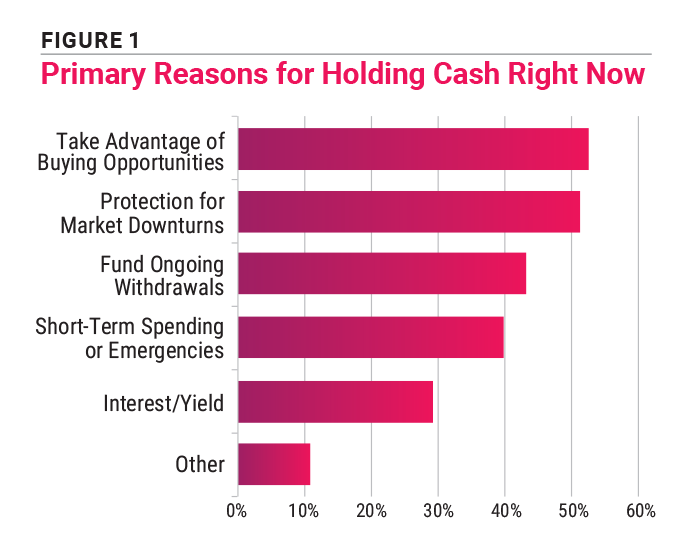
There are three primary reasons AAII members are holding cash right now (Figure 1). They seek to use cash to take advantage of future buying opportunities (53% of respondents), as protection against market downturns (51%) and/or to fund ongoing withdrawals such as retirement income (43%).
Cash plays a varied role in individual investors’ portfolios. When asked an open-ended follow-up question about what role cash plays in their portfolio overall, nearly 20% of respondents said they hold cash specifically for portfolio withdrawals, living expenses or regular distributions. AAII member Wayne Branco says, “A cash allocation allows me to make periodic withdrawals without needing to sell bonds or securities.”
More than 14% of respondents use cash as a buffer or cushion for unexpected expenses. “I believe in the theory that four to six months of savings keeps me from worries about unexpected expenses that might come to me,” responded AAII member Rev. Harold Stockman.
Holding cash to weather market downturns without needing to sell assets at depressed prices was another common response. AAII member Thomas Turo is in this group. “Cash is a nonvolatile asset that allows me to take periodic distributions to fund my lifestyle without having to sell more volatile assets during down markets.”
Psychological comfort was a theme underlying many responses. Cash was commonly described as providing peace of mind and emotional security or helping investors sleep better. AAII member Bruce Andich told us, “Cash lets me sleep at night and tolerate large market declines without panic selling.”
Expenses and Time Horizon Determine Portfolio Cash Allocations
Having enough cash to cover expected expenses was the most common method used by the AAII members surveyed to determine how much of their portfolio to allocate to cash. About 21% of respondents said they do this.
Many AAII members specifically mentioned keeping enough cash for three, four or five years of expenses. Greg Siereveld targets a cash allocation “of around 10%.” The AAII member “tries to maintain two to three years of regular monthly withdrawals to avoid using other sources when markets are down.”
Percentage allocations were mentioned by 18% of the individual investors who responded, with the most common range being 5% to 10%. Craig Bradshaw allocates about 5% of his portfolio to cash and cash equivalents. “I have a reasonably sized pension, Social Security benefits, rental income and dividends that cover living expenses,” explained this AAII member.
Overall, respondents who are still working were more likely to use a percentage-based approach toward determining their cash allocations than those who were retired. They also kept a smaller amount of cash for covering expenses.
Cash Allocation Changes
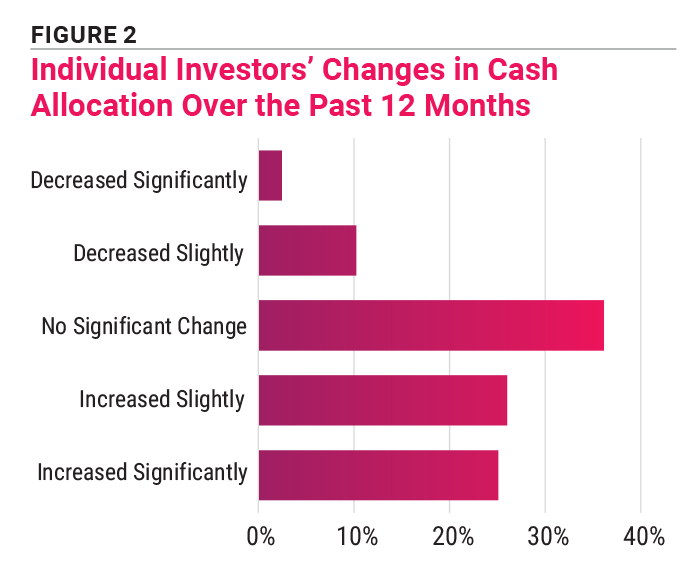
Slightly more than half of all respondents have raised their cash allocations over the past year. This group was split between those who increased their cash exposure significantly (25%) and those who increased it slightly (26%), as shown in Figure 2.
Expectations for market volatility and high valuations for stocks were the most common reasons given for increasing cash allocations. Anthony Tuk’s view of the stock market as being “overbought and overvalued” was his reason for allocating more to cash. Tim Allison shared a similar view, saying he believed “that the stock market was overvalued.”
More than one-third of all respondents (36%) have not changed their allocation over the past year. Many of these respondents have a set allocation or target cash allocation. “My financial plan dictates what I do,” Ed Fitch told us. Benton Hobgood said that because his “financial plan has not changed,” his “cash allocation has remained the same.”
Stocks and mutual funds/exchange-traded funds (ETFs) are the preferred investment choices for reinvesting cash into, selected by 41% and 38% of respondents, respectively. Just 5% of survey respondents said they would reinvest cash into bonds.
The Impact of Interest Rates on Cash Allocations
Given the ongoing higher interest rate environment, we asked respondents whether current interest rates influence how much cash they hold in their portfolios. Respondents were split. While more than half (57%) said no, interest rates are not having an influence, a sizeable minority (43%) said yes, they are.
Among the AAII members who don’t let interest rates influence their cash holdings, the most common reason is that they base their cash allocations on their specific spending needs and income requirements rather than on prevailing interest rates. Many of these investors maintain cash reserves to cover several years of expenses regardless of the current interest rate environment.
“Cash is a buffer,” explained Mark Johnson. “I spend time making sure I’m getting a good interest rate for my cash, but the rate is not why I have cash.” Ken Owenby echoed a similar sentiment: “My cash is to meet an asset allocation target—regardless of rates.”
Returns were overwhelmingly the primary reason given by respondents whose cash allocation decisions are influenced by interest rates. They view cash as an attractive asset class when interest rates are higher.
Robert Rainish cited the trade-off between “risk-free returns” and stock market “downside risk.” Rainish summarized this by adding, “The higher the interest rate, the lower my risk exposure to stocks.”
Michael Scully pointed to the current yields being offered: “Interest rates are higher than they were for many years, making it profitable to have money in safe cash.”
Most Investors Do Not Separate Cash Needed for Withdrawals
Slightly more than three-quarters of all respondents (76%) do not separate cash allocations for withdrawals from cash intended to be used for future investments.
Among the 24% of respondents who do separate cash needed for withdrawals from cash set aside for reinvesting, many do so to ensure that expenses are covered without disrupting their investing strategy. A significant portion cited the need to manage required minimum distributions (RMDs). Others let cash accumulate from dividends or other sources to fund future investment opportunities.
Designating cash for specific purposes gives Kurt Utterback “a mental separation of ‘buckets,’ which reduces emotional temptations.” He told us that he holds “much of the cash in a nontaxable (Roth) account to reduce taxes—otherwise interest on cash is taxed as ordinary income.”
J. Linnemann uses cash to take withdrawals. He elaborated in a follow-up email: “I use cash to avoid uncertainties surrounding RMDs—specifically forced selling of more shares if the market drops after the RMD amount is set—as well as tax uncertainties due to unknown dividends from my taxable holdings during the year.”
Putting Cash Back to Work
The question “Do you have a plan for when or under what conditions you would deploy a significant portion of your cash into investments?” drew mixed responses. About 47% of respondents said yes, while 41% said no.
Many of those who have a plan would deploy more of their cash into the market in response to significant declines or corrections. Several gave thresholds. Some AAII members specified smaller thresholds, such as a 10% drop in stock prices, while others have much larger thresholds, such as a 40% drop. Some use dollar-cost averaging or chart indicators, while others seek to put cash to work during periods of panic or overselling.
“Anytime the market falls at least 10%–15%, we begin adding funds to equity ETFs/mutual funds,” Warren Nossaman told us. “If the market drops less than 10%, we just hold tight and wait for a better opportunity. It doesn’t matter why the market is down; we just know that most investors will overreact, thereby creating the opportunity.”
Anthony Render is among those who use technical analysis to help determine when to put excess cash to work. He seeks out “clear recoveries in the current depressed market, such as the price crossing above the 200-day and 50-day moving averages.”
The Peace-of-Mind Factor
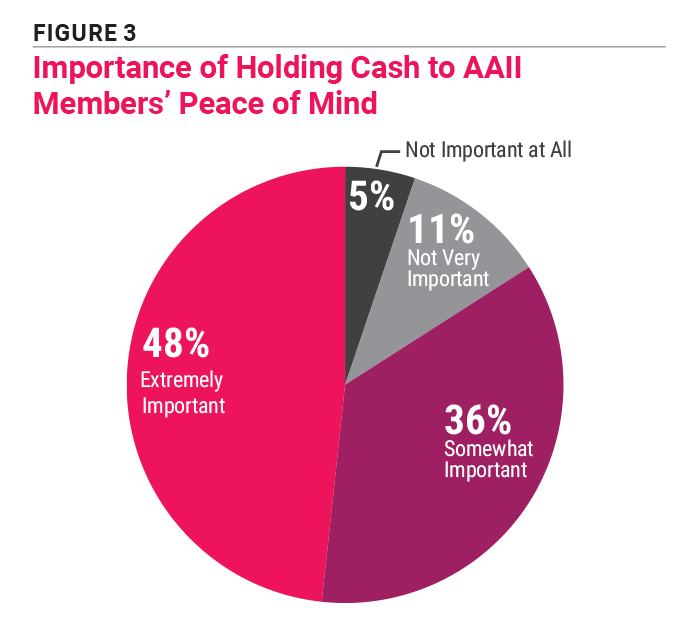
Finally, we asked AAII members how important holding cash was to their peace of mind as an investor. Almost half (48%) described holding cash as being extremely important. Another 36% selected “somewhat important” from the four multiple choice answers given (Figure 3).
Many described cash as a buffer that helps them stay calm during periods of market volatility or economic uncertainty, especially those who called it extremely important. “The cash allocation would keep me from selling more volatile assets in a down market,” wrote Mike Beavers.
For others, particularly those who said it was somewhat important, cash provides flexibility to cover near-term expenses or to avoid having to sell investments at an inopportune time. Peter Wald is in this second group. He maintains a cash allocation “so I don’t feel like I need to sell equities in a market downturn.”

Related

ETFs and Mutual Funds
The Benefits and Risks of Short-Term Bond Funds
Related

PRISM Wealth-Building Process
Guidelines for Selecting Bonds and Cash-Like Instruments
Discussion
FREE REPORT

Get your free copy of our special
report analyzing the tech stocks
most likely to outperform the
market.
JOSEPH M from OK posted over 1 year ago:
J M from NJ posted over 1 year ago:
JON S from TX posted 10 months ago:
You need to log in as a registered AAII user before commenting.
Log InCreate an account