



Related

AI-Powered Investing
With LLMs, creating stock screens tailored to precise investment theses becomes far easier, faster and more intuitive.
by Wayne A. Thorp | June 2025

Wayne Thorp leads a class in AAII's new Essential Investing Video Course. Go to https://www.aaii.com/ves for more information and to subscribe.
Finding promising investment opportunities has never been easy. While investors today have access to an unprecedented volume of information, intelligently processing that data is an entirely different challenge. According to Morningstar’s 2024 Individual Investor Behavior Survey, 43% of individual investors admitted to missing profitable opportunities because they were overwhelmed by the sheer volume and complexity of available data.
With over 6,000 publicly listed companies on U.S. exchanges alone, the problem isn’t scarcity of options—it’s the difficulty of efficiently filtering, analyzing and acting on the right opportunities at the right time.
Institutional investors have long used sophisticated algorithms, predictive models and real-time data feeds to maintain an edge. Individual investors, by contrast, have traditionally relied on static screeners, spreadsheets and manual analysis. However, advances in large language models (LLMs) such as OpenAI’s ChatGPT and Anthropic’s Claude are now democratizing access to research and screening capabilities powered by artificial intelligence (AI).
These tools can help investors create highly customized stock screens, surface hidden opportunities and accelerate decision-making when used wisely. But thoughtful implementation—including prompt design, real-time data integration and disciplined validation—is essential to realizing their full potential.
At its core, stock screening is the process of narrowing a universe of thousands of companies into a manageable list that matches defined criteria: value, growth, income, quality, etc.
Traditional screening methods require investors to navigate structured databases, manually input filters and sort through long lists of results. Evaluating key financial metrics—such as price-earnings (P/E) ratios, debt-to-equity levels, revenue growth, dividend yields and free cash flow—is often a slow, linear process.
These tools are powerful, but static. Most screeners require multiple steps to adjust metrics, while few allow the nuance of combining financial filters with strategic context (e.g., “companies growing earnings but maintaining conservative balance sheets”).
LLMs simplify this process dramatically. An investor can define a multifactor screen combining valuation, profitability, momentum or dividend criteria with a single natural-language prompt and get a filtered list in seconds.
Example Prompt: “Find U.S.-listed companies with a P/E ratio under 15, positive earnings growth over the past three years and a dividend yield above 3%.”
LLMs translate this into a multi-criteria screen. When paired with real-time data (more on that shortly), they can return specific stocks that meet all the conditions—including links to source data or summaries of recent earnings.
This flexibility is transformative. FactSet’s April 2025 Earnings Insight report shows that the S&P 500 index’s average price-earnings ratio was approximately 22.3. Filtering for a price-earnings ratio under 15 targets companies significantly undervalued relative to the broad market—a classic starting point for value-oriented investors.
With LLMs, creating screens tailored to precise investment theses becomes far easier, faster and more intuitive.
The real power of LLMs lies in their flexibility. Every investor brings a unique blend of objectives, constraints and philosophies to stock screening. LLMs allow you to articulate your style—and then build screens that match it precisely. Table 1 illustrates prompts for a few common investing styles.
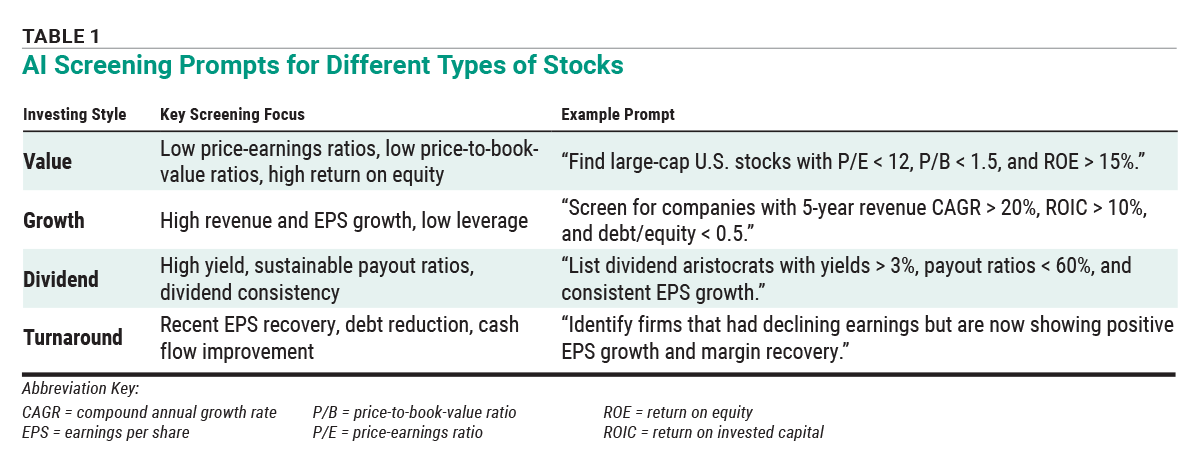
These prompts don’t just output lists. In many cases, the LLM can also explain why a company qualifies, link to relevant earnings calls and news stories, and help identify red flags before you dig deeper.
You’re a conservative investor looking for reliable income and reasonable valuations.
An Example Prompt: “Find companies with a P/E under 15, free cash flow margin above 10%, dividend yield above 3%, and payout ratio under 65% — based on the most recent quarterly data.” (Figure 1)

The LLM, when connected to real-time data, might return names like:
Each of these companies meets the screen—at least on paper. Your next job is validation.
LLMs can summarize Form 10-Ks, pull dividend histories or compare sector averages. Ultimately, you must cross-check fundamentals manually—using tools like AAII’s Stock Evaluator, the U.S. Securities and Exchange Commission’s (SEC) EDGAR database, or other financial websites—to ensure the data is current and accurate.
Suppose, instead, you’re focused on companies with accelerating fundamentals and limited leverage.
Example Prompt: “List U.S. companies with 5-year revenue CAGR above 25%, ROIC above 12%, debt/equity below 0.3, and consistent positive EPS for the last 4 quarters.” (Figure 2)

The LLM might surface names in technology, biotechnology or specialty software that meet those requirements. The power of this workflow is not just speed—it’s also agility. You can also refine the screen on the fly.
Example Refinement Prompt: “Now remove any companies with forward P/E above 30 or with a PEG ratio above 2.”
Work that previously required building and updating spreadsheets is now a conversation. This enables a deeper focus on analysis, not data wrangling.
By default, most LLMs are trained on datasets that lag by months. So, even if your prompt is perfect, the output might reflect outdated earnings, obsolete valuation metrics or delisted stocks.
This is not a minor issue. It can undermine everything. In 2024, Deloitte Insights reported that investors integrating real-time financial data achieved, on average, 8% higher annualized returns than those using static datasets. This advantage arises from more accurate valuation metrics, up-to-date financials, and awareness of recent earnings developments and/or dividend changes.
To fully capitalize on LLM capabilities, investors must ensure that screens reflect current rather than historical realities. There are several ways investors can bridge the gap between LLM flexibility and real-time financial accuracy. Keep in mind that all AI-generated screens should be treated as drafts, not final answers.
If you’re using ChatGPT Pro with plug-ins enabled:
Example Prompt: “Using the most recent financial data, find mid-cap stocks with ROE above 15% and free cash flow margin above 10%.”
This setup connects the LLM to dynamic sources, reducing the risk of stale screens.
If plug-in setup is too complex, consider using platforms that combine LLMs with financial databases out of the box. For example:
FinChat allows for natural-language stock queries against real-time financial metrics as of 2025. Figure 2 shows FinChat’s Copilot rewriting a financial prompt.
Some newer broker-integrated AI tools also allow for screening with current earnings and analyst estimates.
Example Prompt: “What are this quarter’s top-performing companies in the S&P MidCap 400 with low P/E and strong cash flow growth?”
The system returns current data with no plug-in required.
If your LLM doesn’t have access to live data:
This manual step takes time, but it is critical.
Effective use of LLMs depends on the precision of the prompt. Strong, detailed prompts produce high-quality screens. Vague prompts generate noise. Best practices for prompts include the following.
However, even with strong prompts, AI must be seen as a discovery tool, not a decision-making engine. In 2023, the Journal of Financial Data Science found that over 35% of AI-generated stock screens contained material errors when users failed to validate outputs. The following are some of the risks of LLMs to keep in mind.
According to the CFA Institute’s 2025 Survey on AI and Investment Management, 77% of professional portfolio managers believe individual investors who thoughtfully integrate AI into their process will achieve durable advantages.
When combined with real-time data and critical human judgment, LLMs democratize access to sophisticated research and screening power once reserved for institutions.
Success will belong not to those who merely adopt AI tools but to those who ask sharper questions, validate answers and adapt dynamically. The future of investing belongs to the thoughtful. Are you ready?
AI-Powered Investing

AAII Stock Ideas

Financial Statements

Dave A from USA posted 8 months ago:
You need to log in as a registered AAII user before commenting.
Log InCreate an account