

Related

Stock Strategies
Dividend investors can enhance yield, support growth and reduce risk by diversifying across sectors.

Charles Rotblut leads a class in AAII's new Essential Investing Video Course. Go to https://www.aaii.com/ves for more information and to subscribe.
When investors think about dividends, certain sectors come to the front of mind. Utilities is often the first sector associated with dividends. Consumer staples, energy and real estate are others.
There is justification for this reputation. Many companies in these sectors pay dividends and have done so for a long time. Investors seeking income-producing stocks will find plenty of options in these sectors.
However, there is a penalty for limiting the sectors you look to for dividend ideas: missing out on other potentially attractive stocks. Dividend-paying stocks can be found in all 11 S&P sectors. Expanding your universe to all sectors can help obtain higher yields, more dividend growth and greater diversification.
This month, we show you how sectors compare in terms of yields and make the case for diversifying. To get exposure to a broad range of dividends, we also highlight sector-agnostic screens you can use to find individual stocks and where to find sector exchange-traded funds (ETFs).
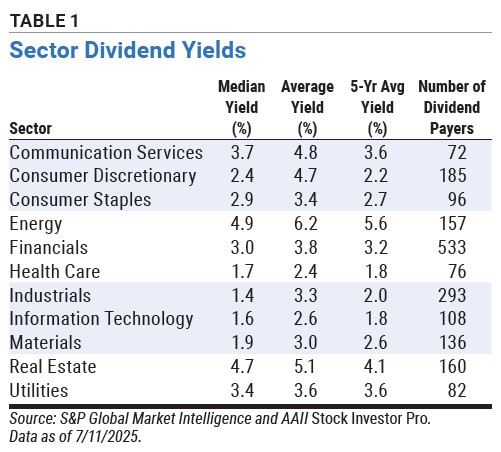
Nearly 1,900 exchange-listed stocks are dividend payers. All 11 sectors have average yields well above the U.S. market’s current yield of 1.1%, as shown in Table 1. Median and average yields are calculated based on the indicated yield, which is the total dividend expected to be paid over the next 12 months divided by a stock’s share price. All but three sectors have average yields above 3.0%. Most sectors have current yields above their five-year average yields—a sign of attractive valuations.
Diversifying isn’t simply about getting higher yields; it’s also about protecting your portfolio while seeking higher total returns. Sectors rotate in terms of the best and worst performers over time. Economic and business cycles impact the profitability of each sector differently. Momentum also ebbs and flows, with some sectors outperforming for a period of time, only to underperform later.
Sectors also experience different business cycles from one another. For example, high oil prices make energy companies more profitable and help them to raise their dividends. But high oil prices hurt industrial companies, particularly those engaged in transportation. Diversification ensures the odds of being allocated to the right sector at the right time.
AAII has nine stock screens that seek dividends as a core part of their approach. The only one that specifically targets certain industries is the AAII Graham Defensive Investor Utility screen. As the name implies, this screen looks specifically for utilities stocks. Benjamin Graham suggested analyzing utilities stocks differently than other companies because their business models allow them to take on higher levels of debt.
All of the other dividend-focused screens either mostly or fully ignore the sector or industry affiliation of the companies they seek out.
The AAII High Relative Dividend Yield screen, for example, adjusts its maximum allowable payout ratio for utilities stocks, but otherwise has no rules regarding sectors. Sectors represented by passing stocks include consumer discretionary, industrials and materials. This screen ranks among the most-favorited screens by AAII members.
You can find AAII’s dividend-seeking stock screens by looking for screens tagged with the letter “Y” (indicating a focus on yield) in the Factors column of the All Screens table on AAII.com. These screening strategies specifically look for dividend-paying stocks and require minimum absolute dividend yields or stocks that are trading with yields above their historical averages or sector/industry norms. Passing company lists are updated daily.
The AAII Dividend Investing (DI) model portfolio also holds stocks from a variety of different sectors. This is done to reduce the impact of industry and sector risks as well to include more opportunities for dividend growth. Nine different sectors were included in the DI model portfolio as of early July.
An alternative to selecting individual dividend-paying stocks is to hold an ETF or mutual fund. There are several dividend-focused ETFs and mutual funds. These are broad funds that target dividend stocks as a group.
An alternative for dividend investors who wish to diversify by sector is to use sector funds. There are nearly 570 sector and industry group ETFs. All AAII members can use AAII’s Guide to the Top ETFs to find them.
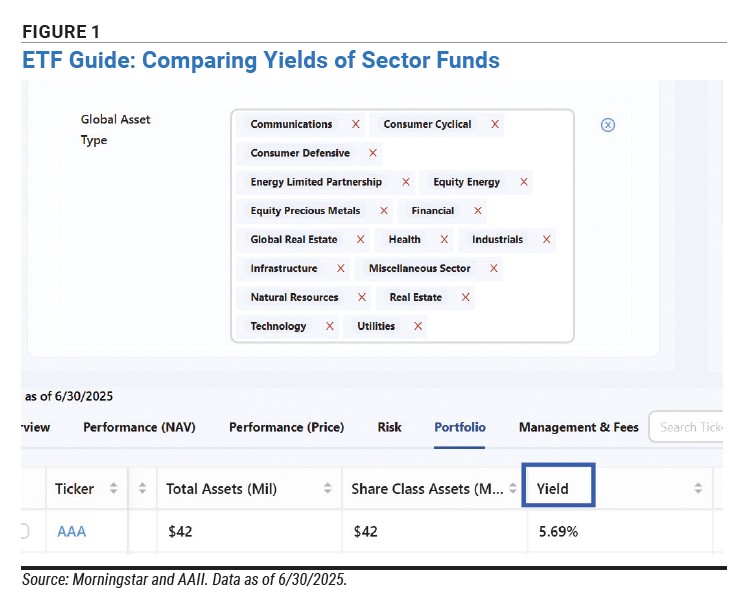
In the Expanded ETF Listings section of the guide, click on Sector Equity. This will take you the list of sector funds in the AAII ETF Screener. To remove a sector, click the red X to the right of the sector name in the Global Asset Type box (as shown in Figure 1).
If you wish to sort the ETFs by yield, click on the Portfolio tab above the table of passing funds. Then, click the Yield column heading to sort by highest to lowest or lowest to highest.
(The same instructions apply to the Guide to the Top Mutual Funds.)
As a general guideline, we suggest looking for ETFs and mutual funds with assets under management (AUM) of at least $25 million. Sector funds will give you access to a broader range of companies, while industry ETFs will allow you to directly target specific types of dividend payers.
ETFs and mutual funds should not be judged by name alone. Take the time to look at the fund’s fact sheet and prospectus, both of which are available on its fund family’s website. These documents explain what types of stocks and other assets are targeted. Links for fund websites can be found in the Management & Fees tab of the ETF and Mutual Fund Guides.
A+ Investor and AAII Platinum subscribers have a few additional tools for finding candidates to diversify their dividend holdings.
The AAII Custom Stock Screener allows you to filter for stocks with the traits you desire. For instance, you can create a screen with criteria targeting stocks within a specific sector or industry that have a minimum yield and level of dividend growth as well as a maximum payout ratio.
The ETF Screener and Mutual Fund Screener can also be used to create and conduct customized searches. Both allow you to specify characteristics such as yield, size, performance, expense ratio and tax-cost ratio.
The First Cut ETF Screens can give you a head start on searching for fund ideas. The High-Yielding Equity ETFs screen identifies several sector and industry ETFs. The Hottest Sector ETFs screen can also be customized to only find funds with a minimum yield requirement.
Stock Strategies

ETFs and Mutual Funds

Investor Professor

No comments have been added yet. Add your thoughts to the discussion!
You need to log in as a registered AAII user before commenting.
Log InCreate an account